1922
45 pages • 1-hour read
Stephen King1922
A modern alternative to SparkNotes and CliffsNotes, SuperSummary offers high-quality Study Guides with detailed chapter summaries and analysis of major themes, characters, and more.
Important Quotes
Content Warning: This section of the guide includes discussion of gender discrimination, child death, death by suicide, animal cruelty, animal death, alcohol use, cursing, and death.
“I cozened him into it, playing upon his fears and beating down his quite normal objections over a period of 2 months. This is a thing I regret even more bitterly than the crime, for reasons this document will show.”
(Page 1)
In the first pages of the novella, Wilf acknowledges that he is responsible for Henry’s decision to help him kill Arlette, acknowledging how he manipulated him. His regret over this fact invites some sympathy for his character, something that is rare in the text. However, ironically, even after years of suffering from killing Arlette, he still struggles to have “regret” for it. In this way, his words quickly erase that sympathy, underscoring the fact that he still has no remorse for murder.
“‘I will never live in Omaha,’ I said. ‘Cities are for fools.’ This is ironic, considering where I now live, but I will not live here for long; I know that as well as I know what is making the sounds I hear in the walls.”
(Pages 1-2)
Wilf’s retrospective narration builds tension in the novella for the reader. Here, he mentions the “sounds” in the walls, immediately making the reader question what is causing them and whether they truly exist. Additionally, he points out the irony of the arc that his character will take in the text: he kills to remain on his farmland, yet ends up leaving it anyway.
“He had his mother’s looks (a woman’s looks are the honey, you know, that lure men on to the stinging hive).”
(Page 4)
Wilf’s thoughts about his son underscore the gender discrimination he holds toward women. His use of a metaphor, comparing women to bees, reveals his belief about women as dangerous. This emphasizes The Violence of Patriarchal Control. He views his wife as trying to “lure” him and Henry off the farm; in reality, he is the one who deceives his wife into getting drunk and lures Henry to help him kill her.
“Yet she means to drive us away from it as surely as the angel with the flaming sword drove Adam and Eve from the Garden.”
(Page 7)
When Wilf and Henry discuss killing Arlette, Henry repeatedly brings up religion as a defense against committing murder. Here, Wilf uses this tactic against him, making an allusion to the story of creation in the Christian Bible. He metaphorically compares his wife to the angel that kept Adam and Eve from returning to the Garden of Eden, their paradise. In the Bible, Adam and Eve are driven out because they sinned and disobeyed God’s law, but Wilf doesn’t mention this. Rather, this metaphor lends insight into how Wilf feels about his farm and how desperately he wants to stay there, viewing it as his paradise and trying to convince his son that this is true.
“We finished the second bottle (she did) and half of the third before her chin dropped onto her wine-stained bosom and she began to snore. Coming through her thus constricted throat, those snores sounded like the growling of an ill-tempered dog.”
(Page 14)
Because the novella is in the first-person point of view and told from Wilf’s perspective, his narration justifies his actions and paints Arlette in a negative light. He uses a simile to compare the way she sounds while sleeping to an “ill-tempered dog,” trying to emphasize her coarse, animalistic nature; an attempt to dehumanize her before the murder.
“He set the lamp down by the book I had been reading: Sinclair Lew’s Main Street. I never finished it; I could never bear to finish it.”
(Page 18)
This quote is an allusion to the 1920 novel Main Street by Sinclair Lewis. Wilf’s choice to read this novel leading up to Arlette’s murder lends unique insight into his character. In Main Street, the protagonist, Carol, leaves the city with her husband to move to a small town in Minnesota. She at first approaches it with the goal of bringing culture and progressivity to the small town; however, she instead faces isolation, as the community she joins ostracizes her for her attempts to change their way of life. In Wilf’s mind, Carol’s story foreshadows what he will undergo, but in reverse. If he leaves the life he knows and the land he controls, he will face isolation and never truly fit into life in the city.
“When they weren’t kissing, that was. I hoped what we’d done had not spoiled such sweet pastimes for him, but believed it had. That I had. And of course I was right.”
(Page 26)
Wilf’s thoughts are an acknowledgement of the impact of Arlette’s murder and his manipulation of Henry on Henry’s psyche. These words underscore the theme of The Psychological Consequences of Evil. Immediately after the murder, Wilf faces internal strife over what he has done to Henry, foreshadowing the tragic downfall of Henry throughout the course of the novella.
“You might understand that all the joy has gone out of the world for you, that what you did has put all you hoped to gain out of your reach, you might wish you were the one who was dead—but you go on. You realize that you are in a hell of your own making, but you go on nevertheless. Because there is nothing else to do.”
(Page 40)
Wilf comments on these events in retrospect after he kills Elphis by sending her into the well to cover Arlette’s body. These words create narrative tension, foreshadowing the horrific events that will come next, while also lending insight into his motivation. Essentially, he believes that after he kills Arlette, he has no choice but to try to cover the murder and continue his life, which he does for eight years following her death.
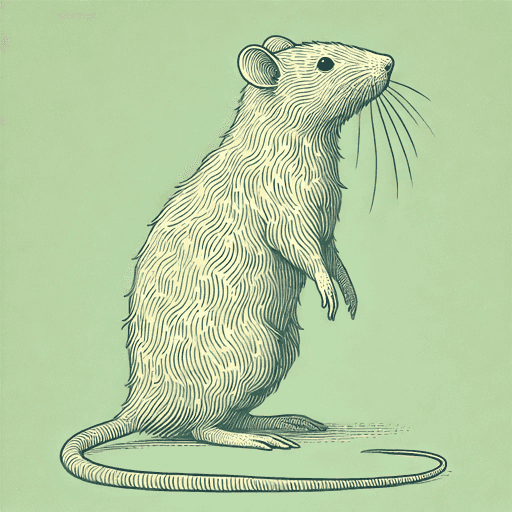
“They were already nibbling at poor old Elphis as she lowed and kicked (more feebly now), and one sat on top of my dead wife’s head like an eldritch crown.”
(Page 40)
This imagery, depicting a rat sitting on Arlette’s head and appearing as a “crown,” introduces an extended metaphor that will carry throughout the text. The fact that Wilf thinks of the rat as a “crown” foreshadows his later feeling that Arlette is the “Queen” (98 and 122) to the rats. For this reason, Wilf attaches the rats’ actions to Arlette herself, ignoring their natural behavior for much of the novella and instead seeing them as a form of divine retribution for his crime.
“I pushed open the door to our bedroom with a queer sense of certainty: the blood would be back. It would be pooled on the floor, splashed on the walls, and soaking into the new mattress. Sheriff Jones would look. Then he would turn to me, remove the handcuffs that sat on his meaty hip across from his revolver. […] There was no blood and no smell of blood, because the room had had days to air out. The bed was made.”
(Page 46)
Wilf’s visions of the bloodied room underscore The Psychological Consequences of Evil. He fears that he will be caught by Sheriff Jones, with the rule of law serving as his only perceived obstacle. Instead, the absence of blood and Sheriff Jones’s subsequent dismissal of any wrongdoing on Wilf’s part underscores The Impact of Rural Isolation. Because Sheriff Jones knows Wilf and arrives at the farm already blaming Arlette, and there are no other possible suspects or explanations, Wilf receives no resistance to his claims of innocence.
“I couldn’t take my eyes off that circle of heaving dirt. It was as if the well were alive, and we were seeing the beating of its hidden heart.”
(Page 51)
When Henry and Wilf look down into the well, they are shocked when they see the ground moving, believing that Arlette is still alive. Wilf’s thoughts pay homage to another Gothic horror story, “The Tell-Tale Heart” (1843) by Edgar Allan Poe. In it, the narrator kills an old man, then puts his dead body beneath their floorboards. However, as the hours go on, the narrator becomes convinced that they can still hear the man’s heartbeat. The parallel evokes the guilt and regret that lead Wilf to write his confession.
“It took [Henry] four or five minutes to laugh himself out, and he scared a murder of crows up from the fence that kept the cows out of the corn, but eventually he got past it.”
(Page 52)
In this scene, Henry laughs at the idea of the Sheriff looking around the farm and seeing the well, responding with relief when the Sheriff leaves without doing so. The mention of crows alludes to several other Stephen King works where crows symbolize evil. For example, in his 1978 novel The Stand, crows are frequently associated with the primary antagonist and representation of evil, Randall Flagg. In his series of novels, The Dark Tower, they often function as spies or signs of death for the Crimson King. In 1922, their presence is brief but disturbing, emphasizing the evil committed and its impact on Henry.
“For farmers out in the middle, the Great Depression started when the Chicago Agricultural Exchange crashed the following summer. But the summer of 1922 was as perfect as any farmer could hope for.”
(Page 55)
Wilf’s reflection on the year 1922 puts the struggle that he went through into a larger context. The “perfect” summer of 1922 marks the beginning of his downfall, which corresponded with the lead-up to the Great Depression, Dust Bowl, and the downfall of many Midwestern farmers. His words serve as justification for his action; because conditions were so good, he could only envision them getting better, not worse, if he stayed on the farm.
“I drew in a breath, but with it came a stench of putrefaction and decay so strong that I fell back with my hand over my nose. The need to scream was strangled by the need to retch. With that smell in my nostrils I could almost see Arlette at the other end of the pipe, her flesh now teeming with bugs and maggots, liquefying; her face beginning to drip off her skull, the grin of her lips giving way to the longer-lasting bone grin that lay beneath.”
(Page 61)
King’s diction emphasizes the horror of Arlette’s death, using words like “putrefaction,” “decay,” and “teeming” to create an unsettling and grotesque sensory atmosphere. At the same time, the fact that these images appear in Wilf’s head underscores the theme of The Psychological Consequences of Evil. While he outwardly acts like things are under control, this moment in the barn marks the beginning of his crime taking over his psyche.
“[I]n that moment I hated [Harlan] […] [I]t was the brand-new shiny green Nash. It was the silver belt buckle made in the shape of a dolphin. It was the new silo, painted bright red, and the indoor plumbing. Most of all it was the plain-faced, biddable wife he’d left back at his farm, no doubt making supper in spite of her worry.”
(Page 68)
Wilf’s view of Harlan when he comes to talk about Shannon’s pregnancy lends new perspective to the theme of The Violence of Patriarchal Control. Wilf acknowledges that his “hate” for Harlan is rooted in the success that Harlan has, thereby introducing the idea of jealousy into Wilf’s feelings. He strives to be a self-made man, as Harlan is, living off the land and prospering. This fact lends insight into his decision to kill Arlette, wanting to increase his land size and compete with Harlan’s success.
“A boy will take any excuse to drive a truck when driving’s new. But of course the new wears off. The new wears off everything, and it usually doesn’t take long. What’s beneath is gray and shabby, more often than not. Like a rat’s hide.”
(Page 75)
Wilf’s acknowledgment that “everything” will “wear off” confirms that he knows his plan to distract Henry with fun activities ultimately won’t work, but he still does nothing to address the deeper impact of his crimes. This passage also reflects Wilf’s mindset of dissatisfaction with life. Whether it’s his wife, his success, or his land, eventually, he wants to move on to something better. This foreshadows that any benefits he gains from Arlette’s murder will be short-lived.
“[I]n those days you could buy two months’ worth of groceries for 35 dollars, or a good used harness at Lars Olsen’s smithy. You could buy a train ticket all the way to Sacramento… which I sometimes wish I had done. 35. And sometimes when I lie in bed at night, I can actually see that number. It flashes red, like a warning not to cross a road because a train is coming. I tried to cross anyway, and the train ran me down.”
(Page 76)
Wilf uses a metaphor, comparing the $35 he had to get to pay for Shannon’s tutor to a flashing train signal. He ignores it, comparing the events that follow to himself being run over by a train. This metaphor is important because it further emphasizes the way that Wilf tries to shift blame and refuses to take responsibility for his actions. Instead of addressing what he did or attempting to truly help Henry, he instead focuses on what he loses by giving the $35 to Harlan for Shannon’s tutoring rather than spending it on something of greater value for himself.
“I love you Poppa even if I don’t know why, since everything we did has brought me mizzery.”
(Page 81)
The misspelling of the word “mizzery” in Henry’s note to Wilf underscores Henry’s immaturity. Though he’s still struggling with the moral and emotional repercussions of their act, in the pages that follow, Henry commits several serious crimes and ends his life by suicide. These words remind the reader that, unlike Wilf, Henry hasn’t had time to form a strong moral code and may not be entirely responsible for his actions.
“I limped into the kitchen, leaving bloody footprints and thinking in a confused way of the oracle warning Pelias to be aware of a man wearing just one sandal.”
(Page 92)
In Greek mythology, King Pelias takes the throne of Jason’s father, usurping it for himself. The man with one sandal is Jason, who returns to take the throne back. In this scene, Wilf thinks of this story as he returns to the kitchen after being bitten by the rat. This allusion creates a feeling of both danger and inevitability for Wilf: Just as Jason marked Pelias’s downfall, this moment begins Wilf’s downfall as he gets an infection, loses his livestock, and ultimately is forced to sell the farm.
“For a moment I seemed to see myself as if from outside: a man naked except for an unbuttoned duster, his body-hair matted with blood all the way to the groin, his torn left hand glistening under a thick snotlike coating of cow-salve, his eyes bugging out of his head. The way the rat’s had bugged out, when I stepped on it.”
(Page 93)
In a moment of clarity, Wilf pauses to reflect on his physical and mental state after killing the rat and rushing out to the barn to check the pipe. His brief lucidity highlights the theme of The Psychological Consequences of Evil. He can see that he’s in a compromised, chaotic state, but he still doesn’t see this as a result of his guilt. At the same time, however, his metaphorical comparison of himself to the rat he just killed foreshadows the inevitability of his downfall and, perhaps, his subconscious awareness that he is ultimately to blame.
“Are you on the exchange, Mr. James? I see you are not. No. I was not. I was by myself on the farm I had killed for, with no means of summoning help.”
(Page 96)
Wilf realizes that, without a telephone and unable to drive, he could die of his infection on the farm. This moment emphasizes the theme of The Impact of Rural Isolation. For the first time, without his wife, Henry, or his neighbors, Wilf realizes just how dangerous his life on the farm can be when he must face it in isolation.
“George the rooster was lying frozen to the ground beside the woodpile, and the cows were lowing. When had I last fed them? I couldn’t remember.”
(Page 109)
As Wilf looks around the farm after being bitten, his thoughts reflect his growing delirium and inability to even care for his farm as a result of both his perceived haunting and his infection from the rat bite. He has lost all sense of time, not even knowing when he fed the animals and allowing his rooster to be killed by the snow. At the same time, his thoughts underscore the irony of his situation: he is losing his farm, the thing he killed for, and is not able to do anything about it.
“So then I told [Sheriff Jones] I’d killed her, and oh, the relief. A plugged pipe inside my head had magically opened, and the infected ghost which had been trapped in there was finally gone.”
(Page 109)
Wilf finds great relief when he confesses to killing Arlette to Sheriff Jones, underscoring the theme of The Psychological Consequences of Evil. Though he is relieved when Sheriff Jones misinterprets his confession, the moment emphasizes a solution to the impact of evil acts: taking accountability. Wilf arguably does this when writing his confession, but he does so too late for him to face legal consequences for his actions.
“There was a time when Harlan, assisted by his wife, would have taken care of my place while I was in the hospital; it’s how we neighbored out in the middle. But even after the mournful blat of my dying cows started drifting across the fields to him while he sat down to his supper, he stayed away.”
(Page 114)
When Wilf returns to the farm after being in the hospital, he finds that all his livestock is dead. His thoughts here emphasize the theme of The Impact of Rural Isolation. In the past, the only thing that kept him from being truly isolated was the presence and help of his neighbors, the Cotterie family. Now, without them, his absence from the farm leads to the death of his animals. This shows Wilf’s hubris in not acknowledging how much he relied on others to keep his farm running.
“I sometimes wonder if Sallie Cotterie ever came back to Harlan, or if he went to her in McCook after he lost the farm. I don’t know, but I think Shannon’s death probably ended that previously happy marriage. Poison spreads like ink in water.”
(Page 123)
This simile, comparing the “poison” of what he did to “ink” spreading in what, emphasizes the theme of The Psychological Consequences of Evil. Wilf’s thoughts about Harlan and Sallie in the final pages imply that even their downfall was brought about by Arlette’s murder. At the same time, these words also convey the theme of The Violence of Patriarchal Control. In addition to the blame Wilf holds for Shannon’s death, Harlan, too, is responsible for taking control over Shannon’s life, ignoring his wife, and sending Shannon to St. Eusebia.

Unlock every key quote and its meaning
Get 25 quotes with page numbers and clear analysis to help you reference, write, and discuss with confidence.
- Cite quotes accurately with exact page numbers
- Understand what each quote really means
- Strengthen your analysis in essays or discussions