1922
45 pages • 1-hour read
Stephen King1922
A modern alternative to SparkNotes and CliffsNotes, SuperSummary offers high-quality Study Guides with detailed chapter summaries and analysis of major themes, characters, and more.
Symbols & Motifs
Content Warning: This section of the guide includes discussion of suicidal ideation, death by suicide, animal death, and death.
Rats
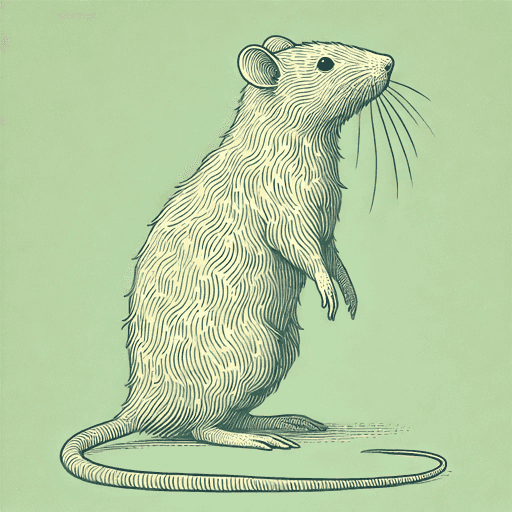
The rats found throughout the novella are a symbol of physical, moral, and psychological decay. They first appear when Wilf goes back to check on Arlette’s body, which he pushed down the well. At first, he thinks that Arlette is moving and trying to talk, then he sees a “rat that had been chewing on the delicacy of her tongue” (27). It emerges from her mouth, tail first, forcing open her jaw and clawing on her chin. After, it drops onto her lap, then is joined by a “flood” of others that emerge from Arlette’s clothing. From there, the rats repeatedly appear throughout the novella, consuming Arlette’s body, attacking Achelois, biting and nearly killing Wilf, and then appearing as hallucinations to Wilf in the hotel room at the story’s end.
Because this is supernatural horror, it is unclear how often the rats are physically present and how often they are just a figment of Wilf’s imagination. In this way, the rats underscore the theme of The Psychological Consequences of Evil. They are a physical embodiment of decay and destruction, literally eating Arlette’s body and destroying Wilf’s livestock. At the same time, they overwhelm Wilf’s psyche. They are present, at least in Wilf’s eyes, in his home, in the clothing factory where he works, in the library, and in the hotel room where he dies. The further Wilf gets from the farm, the more likely it is that the rats are projections of his tormented mind. However, rats can infest urban spaces like factories—with their abundance of waste and dark corners—and libraries—full of paper and other materials for nesting—especially in the early 20th century.
Arlette’s Grin
Arlette’s “grin” is a motif in the novella that underscores the psychological impact of Wilf’s act of murder. When he tries to kill Arlette, he is forced to cut her several times with a butcher’s knife as she struggles against him. When the burlap sack comes off her head, Wilf notes how “[w]ith the last two [cuts] I had carved her cheek and her mouth, the latter so deeply that she wore a clown’s grin. It stretched all the way to her ears and showed her teeth” (16). King’s diction emphasizes the horror of what Wilf has done. The use of the word “clown” contrasts with Wilf’s actions, comparing Arlette’s death to a symbol of innocence and happiness.
However, the word “grin” evokes the gesture’s dual nature: it can imply both happiness and deception. Wilf is haunted by the grin, seeing it each time he returns to the well, even when he expects it to be covered by the mattress. He also sees it in his dreams. In his narration, he notes that he can see the grin when Arlette “whisper[s]” to him about Henry’s fate: “her cocked ear-to-ear grin… I can see it now, as I write. I told myself to die, but my heart kept pounding. Her hanging face slid along mine” (99). In this way, Arlette’s face continues to haunt Wilf’s mind, underscoring the theme of The Psychological Consequences of Evil.
The Land
The land that Wilf fights for, both his own farmland and the 100 acres that Arlette inherits, is a symbol of the American Dream. Its meaning changes throughout the text as Wilf’s relation to the land changes. At the start, the land is a symbolic representation of Wilf’s pride and success. He views himself as a strong patriarch and a self-made man, a fact which is clear to him through his ability to maintain a farm and build a life through his hard work. When Arlette suggests selling the land, Wilf’s reaction underscores just how much value he places in it: he chooses to kill her rather than finding a more logical solution. In this way, the land develops the theme of The Violence of Patriarchal Control. Wilf has created his idyllic life on his farmland. When Arlette challenges this ideal, noting the potential for an easier life with the money from the farmland, Wilf reacts violently.
By the novella’s end, the land has come to represent everything that Wilf has lost. Initially, Wilf continues to hold onto the land, refusing to sell it even after the roof collapses on both the house and the barn. Instead of a blessing, it is now a curse, a belief reinforced by Wilf’s neighbor, Harlan, who refuses to buy the “cursed” land. In the end, he sells it for next to nothing. Because of his evil actions, Wilf is left without the very thing he fought to maintain.

Unlock the meaning behind every key symbol & motif
See how recurring imagery, objects, and ideas shape the narrative.
- Explore how the author builds meaning through symbolism
- Understand what symbols & motifs represent in the text
- Connect recurring ideas to themes, characters, and events