33 Place Brugmann
A modern alternative to SparkNotes and CliffsNotes, SuperSummary offers high-quality Study Guides with detailed chapter summaries and analysis of major themes, characters, and more.
Summaries & Analyses
Quizzes
NEWReading Tools
Summary and Study Guide
Overview
Alice Austen’s historical novel, 33 Place Brugmann (2025), focuses on a single apartment building in Brussels, beginning in August 1939 on the eve of World War II and continuing through the German occupation of Belgium. The story centers on the interconnected lives of the building’s residents, particularly Charlotte Sauvin, a young art student who has colorblindness, and her close relationship with her Jewish neighbors, the Raphaël family. As the Nazi threat grows, these relationships are tested by fear and betrayal, forcing each character to make deep moral choices about survival, resistance, and loyalty. Through their intertwining stories, the novel explores The Cost of Passive Complicity, the role of Art as a Repository of Humanity, and The Limits of Objective Truth.
33 Place Brugmann is Austen’s debut novel. The narrative is told from the perspectives of multiple residents, creating a complex mosaic of subjective experiences that challenge the notion of a single historical truth. The story weaves in philosophical questions, particularly from Ludwig Wittgenstein’s Tractatus Logico-Philosophicus, as characters grapple with the relationship between language, reality, and ethics in a world descending into chaos. The novel is inspired by real people and events from World War II, including the activities of the Belgian resistance and the covert operations to save priceless European artworks from Nazi looting.
This guide refers to the 2025 Grove Press edition.
Content Warning: The source text and this guide feature depictions of religious discrimination, ableism, sexual harassment, bullying, mental illness, death by suicide, animal death, graphic violence, sexual content, cursing, illness, death, and emotional abuse.
Plot Summary
In August 1939, the residents of 33 Place Brugmann in Brussels live interconnected lives under the growing shadow of war. Charlotte Sauvin, an art student who has colorblindness, and her architect father, Francois, are inseparable from their neighbors, the Raphaëls, a Jewish family of art dealers. Charlotte and the Raphaël children, Julian and Esther, spend their summer making films with a new movie camera. This idyllic time is fraught with tension as Julian, a brilliant Cambridge mathematics student who is secretly in love with Charlotte, prepares to return to England. His unspoken feelings are complicated when Charlotte reveals she has a new boyfriend, an older architect named Philippe Kahn. The simmering political situation comes to a head when Julian’s father, Leo Raphaël, is approached by a Flemish art dealer, Mats, who offers to act as a front for his business once anti-Jewish laws are enacted. Leo furiously rejects the offer, realizing the danger his family is in. As the Molotov-Ribbentrop Pact is announced, Leo accelerates his plans, arranging with Francois to hide his valuable art collection under a new parquet floor being installed in the Sauvin apartment. The summer ends abruptly when Charlotte wakes to find the Raphaëls have vanished in the night, leaving everything but a note for her on a blank canvas behind. She feels a deep sense of betrayal, especially by Julian.
The narrative jumps to the period after the Nazi occupation of Belgium in May 1940. Charlotte is in Antwerp with Philippe, whom she marries in a secret, unregistered ceremony before he leaves to join the resistance in France. Unbeknownst to him, Charlotte is pregnant. With the art academy closed, she returns to her father’s apartment in Brussels and takes a sewing job at a uniform factory. The other residents of Number 33 adapt to the occupation in their own ways. Masha Balyayeva, a Russian Jewish refugee and seamstress living in the attic, is in Paris with her lover, Harry, a British spy. She becomes an operative in his resistance network, but is eventually betrayed by an informant, shot, and then killed by Harry to prevent her capture by the Gestapo. The Raphaëls are scattered: Sophia and Esther are in the Outer Hebrides, where Esther becomes a nurse tending to wounded soldiers, while Leo is in a Welsh slate quarry, overseeing a secret project to hide the National Gallery’s art collection.
Life in occupied Brussels becomes increasingly grim. Charlotte is harassed by her new factory manager, a Nazi collaborator named DeDecker. After telling him she is pregnant and vomiting on him during a confrontation, she quits her job and begins making and selling hats to survive. In the apartment below hers, Dirk DeBaerre lives alone. After his father, Martin, is arrested for helping a Jewish family, his mother Katrin confronts Dirk with the fact that Martin is not his biological father. Distraught, she attempts to die by suicide by stepping in front of a tram. Dirk lets her die instead of authorizing a surgery that would save her life. Now an orphan, Dirk becomes a cold observer, attending meetings of the collaborationist Flemish National Union (VNV) to gather information. Across the hall from him, Colonel Herman Warlemont secretly joins an escape line, hiding downed Allied airmen in his apartment by passing them off as people with disabilities under his care. The network is perilous; Miss Agathe Hobert, the nosy neighbor on his floor, grows suspicious of the men coming and going.
The climax builds when Julian’s plane is shot down over Flanders. After being sheltered by farmers, he is smuggled into Brussels and taken to the most dangerous possible safe house: the Colonel’s apartment at Number 33. His presence is almost immediately detected by Dirk, who sees him through the Colonel’s doorway and feels conflicted about his allegiances. Miss Hobert also reports hearing voices, prompting the new Nazi-sympathizing tenant, Ivo Van Cauter, and the building notary, Jan Everard, to demand a search of the apartment. To create a diversion, the Colonel has his trained dog, Zipper, viciously attack Van Cauter as he enters the apartment. In the chaos, Julian slips out a window onto the narrow fourth-floor ledge, making his way along the building’s exterior to Charlotte’s balcony. He climbs into her kitchen, where she finds him moments later. Their reunion is short-lived; Dirk appears at Charlotte’s door, warning them that Julian’s scheduled extraction by a contact named Captain Anderson is a Gestapo trap. As proof of his sincerity, he gives Charlotte a red pencil, a token from a shared, difficult childhood memory.
Forced to act quickly, Charlotte and her father devise a new plan. Francois disguises himself as Julian and goes with Charlotte to meet Anderson in the square. They intentionally confuse and stall him by insisting they are there to measure him for a new hat, causing him to miss the departure of the bakery truck that was Julian’s intended transport. As Anderson leaves in frustration, Julian, who is disguised in Dirk’s oversized suit and shoes, is smuggled out of the building by Dirk. Julian escapes Brussels hidden under sacks of grain in the real getaway vehicle. The next morning, however, the Gestapo raid 33 Place Brugmann. They arrest the young newsboy who served as a contact for the resistance and begin tearing apart the Raphaëls’ apartment in search of the missing paintings. In the Sauvins’ apartment, they find Francois’s old, nonfunctional rifle from the Great War. Despite another German officer’s protests that it is harmless, the SS arrests Francois for possessing a firearm.
As Francois is taken away, he assures Charlotte he will be back by evening. Schmidt, the officer who tried to defend him, continues the search of the Raphaël apartment with the help of their former cleaning woman, Incarna, who has become an informant. That night, a lone RAF bomber, piloted by a Belgian aristocrat avenging his own father’s death, destroys the Gestapo headquarters on Avenue Louise. Charlotte goes to the site the next morning and learns that everyone inside, including her father and the newsboy, was killed in the attack. Experiencing grief, she walks home through the city streets. As she walks, the baby inside her moves for the first time, a faint flicker of life that breaks through her despair. She realizes she must live on for her child and for the memory of those she has lost.
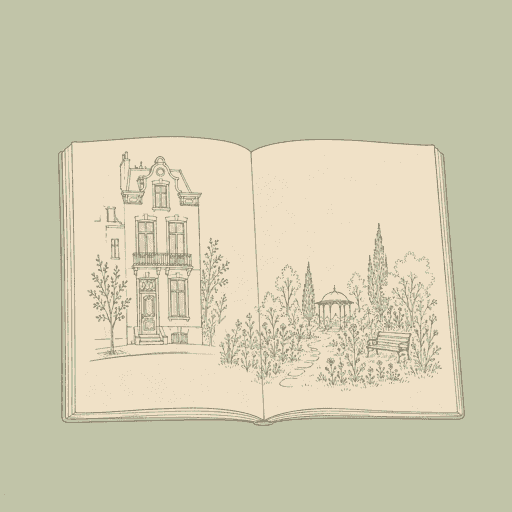
Back in the apartment, she finds her father’s sketchbook. Instead of his usual work, it is filled with fantastical architectural drawings that reimagine Number 33 as a utopian garden where all its residents live in harmony. On the final page is a hopeful self-portrait of Francois, holding a pencil that is also an olive branch, beneath the quote, “What is thinkable is also possible” (342). Meanwhile, Julian successfully makes his way over the Pyrenees and learns that Philippe has been killed in action. He also knows the secret that the Raphaëls’ priceless art collection remains safe, hidden beneath the floorboards of Charlotte’s living room. The novel closes with Charlotte, pregnant and alone but filled with a new, quiet strength.

Get in-depth, chapter-by-chapter summaries and analysis from our literary experts.
- Grasp challenging concepts with clear, comprehensive explanations
- Revisit key plot points and ideas without rereading the book
- Share impressive insights in classes and book clubs