A Better Man
69 pages • 2-hour read
Louise PennyA Better Man
A modern alternative to SparkNotes and CliffsNotes, SuperSummary offers high-quality Study Guides with detailed chapter summaries and analysis of major themes, characters, and more.
Chapters 16-22Chapter Summaries & Analyses
Content Warning: This section of the guide includes discussion of physical abuse, graphic violence, pregnancy termination, death by suicide, and death.
Chapter 16 Summary
At 2:30 am, Gamache and Beauvoir run along the flooded Rivière Bella Bella toward a bend in the river. Earlier, after securing Tracey at the bistro with Billy, Olivier, and Gabri, Gamache had left Reine-Marie to watch Homer and prevent him from leaving the house. Now, standing at the river with their flashlights, Gamache and Beauvoir see Vivienne’s body in the water, trapped by debris.
Thinking of his own pregnant wife, Annie, Beauvoir shoves past Gamache and attempts to enter the freezing water to retrieve the body. Gamache restrains him in a bear hug, insisting it is too late. Beauvoir, sobbing, says Vivienne is pregnant, then reveals that Annie is also almost three months along. A sob from the darkness behind them announces Homer’s presence.
Homer runs straight into the river. Gamache and Beauvoir plunge in after him, fighting through the bitter cold as Homer thrashes toward his daughter. Gamache is knocked underwater, but Beauvoir pulls him up. They finally drag the exhausted Homer back to shore.
Reine-Marie appears on the path, explaining that Homer saw them from the bedroom window and ran out before she could stop him. Gamache notices a bruise on her cheekbone; she says Homer struck her accidentally when she grabbed for his arm. All three men are trembling uncontrollably from hypothermia.
Chapter 17 Summary
Gamache showers but has a panic attack when water hits his face, reliving being submerged. He imagines Vivienne’s final moments: falling from the bridge, hitting the freezing water, struggling desperately before the cold and current overwhelm her.
Downstairs, Homer and Beauvoir warm by the fire. The Sûreté divers and crime scene unit will not arrive until morning. Beauvoir takes Reine-Marie aside to tell her about Annie’s pregnancy. Gamache tries unsuccessfully to reach Chief Superintendent Toussaint for an update on the flooding. The RCMP commissioner tells Gamache they are opening the dam floodgates without approval, following his advice. He warns Gamache that Toussaint has political aspirations, is distancing herself from Gamache, and will blame him for their insubordination. Gamache asks for RCMP divers to retrieve Vivienne’s body.
When the divers bring Vivienne’s body ashore, Homer collapses to his knees. Dr. Harris, the coroner, arrives and confirms Vivienne has been dead at least two days. Homer insists on identifying the body; Gamache escorts him and makes him promise not to touch her.
When Gamache sees the agent assigned to watch Tracey at the bistro, he discovers that Cameron arrived and dismissed the officer. Worried, Gamache rushes to the bistro, where he finds Agent Cameron threatening Tracey with a fireplace poker. Gamache intervenes; Cameron claims he was trying to force a confession. Under questioning, Cameron admits he had feelings for Vivienne and visited her when Tracey was in jail, trying to help her leave him.
Gamache formally informs Tracey of Vivienne’s death. Tracey claims she was depressed and died by suicide. Gamache confronts him, and Tracey admits beating her after she said the baby was not his and that she was leaving him. Homer appears in the doorway. Gamache steps between them and arrests Homer for the assault on Reine-Marie in order to stop Homer from coming after Tracey.
Chapter 18 Summary
At sunrise, Clara, Myrna, and Ruth watch as Vivienne’s body is removed in a body bag. Tracey emerges from the bistro and wonders aloud if she was insured. Homer crosses himself as the coroner’s vehicle departs.
Gamache questions Cameron, asking if Vivienne’s child was his. Cameron denies it, but Gamache accuses him of lying. Agent Cloutier asks Beauvoir for permission to accompany Homer to jail. She reveals that Vivienne was her goddaughter, as Vivienne’s mother and Homer’s wife, Kathy, had been Cloutier’s best friend. Beauvoir senses an unacknowledged romantic feeling from Cloutier toward Homer but allows her to go.
Lacoste arrives, and she, Gamache, and Beauvoir discuss the difficulty of proving that Tracey murdered Vivienne; Gamache theorizes that Cameron could be a suspect, though he does not believe it. Beauvoir asks to take over as lead investigator for his final case with the Sûreté. Gamache warns that they are both personalizing the case due to Annie’s pregnancy. Lacoste worries about them both, especially when Gamache agrees to serve as Beauvoir’s second-in-command in the investigation.
Beauvoir and Lacoste establish an incident room in the old train station in Three Pines. They examine the contents of Vivienne’s purse and duffel bag. Lacoste discovers a prescription bottle of Mifegymiso—identified by an agent as an abortion pill—which appears to be from the black market. Lacoste points out that the clothes packed are summer-weight, unsuitable for April. They conclude that Tracey probably packed the bag to make it look like Vivienne ran away.
Cloutier, who is still at the jail watching Homer, continues to bait Pauline Vochon through Tracey’s Instagram account, posing as the owner of a fake art gallery in order to secure access to their private Instagram account.
Chapter 19 Summary
Beauvoir calls Gamache at 9:40 am to inform him that the search warrant for Tracey’s house has arrived. When Reine-Marie asks what he will do when Beauvoir leaves, he has no answer. Downstairs, Gamache sees a TV report on the floods and tries unsuccessfully to reach the RCMP commissioner.
Myrna finds Clara at her studio, distressed by negative social media posts about her art. Clara reveals that her gallery reports that collectors are trying to return paintings, questioning whether she is a real artist. Myrna tries to reassure her by reading negative reviews of famous artists and a critical post about Gamache. She quotes Moby Dick to argue the posts are “[a]ll truth with malice in it” (177), something she heard Gamache say earlier. As she leaves, Myrna privately concedes that Clara’s miniatures aren’t her best work.
Chapter 20 Summary
Cloutier receives a cautious reply on Instagram, confirming her suspicion that she is communicating with someone other than Tracey. She suggests that they give her access to a private account for business discussion, but they don’t agree. Beauvoir summons her to the Tracey property for the search warrant execution. Before leaving, she checks on Homer, who touches her hand in thanks.
At Vivienne’s car, agents report finding blood smears and prints from at least three different people. Rain has washed away all tire and boot tracks. At Tracey’s house, Cloutier shows Gamache that the bedroom, previously messy, has been tidied and cleaned with bleach. Tracey claims he burned Vivienne’s belongings in the kiln the night before and cleaned because he finally feels free.
At the bistro, Ruth tells Clara she is too needy for caring about others’ opinions. Clara insults her, which amuses Ruth.
At the bridge, a young agent questions Beauvoir’s ability to handle the evidence kit. Despite his annoyance, he responds patiently. He puts on a safety harness to examine the broken section of the bridge.
Chapter 21 Summary
Afterward, Gamache drives an exhausted Beauvoir toward the morgue. They discuss Annie’s pregnancy, but Beauvoir will not reveal the baby’s gender. Beauvoir falls asleep, and Gamache mentally reviews the case: three sets of prints in the car, no tracks at the bridge, and conflicting scenarios about how Vivienne reached the bridge. The blood on the driver’s side suggests she may have driven herself there.
At the local police office, Homer has become angry and is demanding his release. Cloutier is tempted to free him, knowing he would kill Tracey. She returns to her computer and sends a message from her fake gallery account, pretending to lose interest in Tracey’s work. Within minutes, she receives an invitation to Tracey’s private Instagram account.
Chapter 22 Summary
At the morgue, Gamache feels doubt about securing a conviction. Dr. Harris explains the difficulty of distinguishing abuse injuries from the battering her body received in the river. She reveals the fetus was a girl. Beauvoir reacts strongly, and Gamache understands that he and Annie are expecting a daughter. Dr. Harris confirms that Vivienne was alive when she entered the water and died Saturday night. Two bruises on Vivienne’s chest suggest a violent two-handed shove, but Dr. Harris cannot swear to it in court. When asked for definitive proof of murder, she has none; it could be ruled an accident or death by suicide.
Gamache notices a jagged gash on Vivienne’s palm. Dr. Harris analyzes the wound and concludes that its angle indicates Vivienne reached backward for the railing as she fell, ruling out death by suicide. However, a defense could still argue an accidental fall. To be certain, Dr. Harris will test for microscopic evidence from the rotten railing in the wound.
Lacoste joins Cloutier at the Cowansville police station. Cloutier reports tracing Tracey’s website IP address to his media manager Pauline Vachon. She admits that she disobeyed orders by creating a fake gallery website to gain access to their private Instagram account, which reveals that they are lovers. Photos show bruises on Vachon’s arm. Lacoste is displeased that Cloutier disobeyed orders, but she sees the value of the strategy.
Phone records show repeated Saturday evening calls from the Tracey house to a Gerald Bertrand, who they suspect was Vivienne’s lover. At the morgue, Beauvoir asks about the abortion pills found in the duffel bag. Dr. Harris confirms Mifegymiso is for early term abortions and is free with a prescription in Canada. Gamache questions why anyone would buy a legal and free drug on the black market. They theorize Tracey may have acquired the pills to force an abortion, indicating he knew the baby was not his long before Saturday. Gamache is certain Vivienne was murdered, but they must prove it.
Chapters 16-22 Analysis
The discovery of Vivienne’s body shifts the investigation from a probe of possible foul play and a disappearance to a confirmed homicide. It also precipitates a crisis of professional objectivity, activating the theme of Empathy as a Professional Liability. For Beauvoir, the sight of the pregnant victim immediately collapses the distance between his case and his personal life. His reactive, emotional attempt to enter the freezing river is emotional transference, driven by the knowledge that his own wife, Annie, is also pregnant. His anguished cry reveals the case has become a surrogate for his own deepest fears. Gamache, while more restrained, is similarly affected. His panic attack in the shower is a moment of intense imaginative empathy, in which he viscerally experiences Vivienne’s final, terrifying moments. He explicitly acknowledges to Beauvoir that he is personalizing the investigation due to Annie’s pregnancy, recognizing that their emotional investment makes them vulnerable, in the hopes that it will remind him to maintain his objectivity. This shared liability highlights a central tension in Gamache’s policing philosophy: The same empathy that allows him to understand human motivation also threatens to compromise the discipline required for his work.
This section marks a turning point in Beauvoir’s character arc, as he assumes leadership of the investigation. Although he nominally asks Gamache’s permission, Beauvoir has the authority to assume power here, and he does, fully assuming the authority he has been groomed for. The narrative charts his internal struggle with the case’s emotional weight, moving from denial of its personal impact to a quiet moment of self-awareness in the incident room. Surrounded by the procedural elements of an investigation, he finds himself quoting the poetry of Ruth Zardo and realizing with contentment, “I’m turning into Gamache” (168). This is not an admission of imitation but a recognition of assimilation; he has internalized Gamache’s holistic method, which integrates intuition and emotional intelligence with forensic rigor. The man who once resisted Gamache’s unconventional approach now deploys it instinctively, demonstrating that his transformation is complete.
The investigation into Vivienne’s death forces multiple characters to confront Competing Notions of Justice When Institutions Fail. Gamache’s decision to arrest Homer for an accidental assault on Reine-Marie is a calculated act of extra-legal intervention. He knowingly manipulates the law to prevent a revenge killing, effectively placing Homer in protective custody. The act is fraught with moral complexity, a fact underscored when Gamache “apologized, even as he made the arrest” (158). This maneuver establishes a precedent for operating outside rigid protocols that seems to permit other agents to emulate his decisions. Agent Cameron’s attempt to threaten a confession from Tracey with a fireplace poker is a cruder, more volatile expression of this same impulse. More strategically, Agent Cloutier’s unauthorized creation of a fake online gallery to entrap Pauline Vachon represents a sophisticated bending of rules governing evidence collection. Together, these actions illustrate a shared belief among the officers that the formal justice system may be insufficient to convict Tracey, necessitating a more flexible and ethically ambiguous approach to uncovering the truth.
Through Clara Morrow’s parallel subplot, the narrative continues to explore The Distortion of Truth by Public Opinion by juxtaposing Gamache’s professional crisis with her artistic one. Clara’s confidence is eroded by anonymous, malicious tweets questioning her talent, causing collectors to doubt the value of her work. This serves as an artistic-world analogue to the institutional criticism undermining Gamache’s authority. Myrna’s attempt to console Clara by citing Moby Dick, describing such attacks as containing “[a]ll truth with malice in it” (177), provides the thematic lens for this issue. The quote suggests that the most damaging falsehoods are not pure inventions but malicious distortions of a kernel of truth. This dynamic is shown to be a weapon capable of destabilizing established careers and personal identities alike. By presenting these parallel struggles, the text demonstrates that the battle for control over a public narrative is a pervasive conflict affecting individuals across different spheres of life.
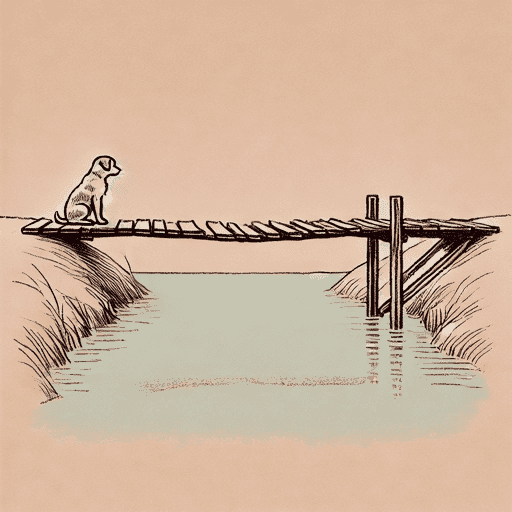
The natural landscape, particularly the flooding Rivière Bella Bella and the broken bridge, continues to function in the narrative as a parallel for the emotional forces of grief and rage affecting the characters. Homer’s grief-stricken plunge into the river is a literal immersion in the sorrow that has consumed him, while Gamache’s traumatic flashback in the shower links the physical sensation of drowning to the psychological horror of the crime. The river becomes a repository for death while simultaneously highlighting nature’s indifference to human tragedy. The broken, rotten bridge from which Vivienne fell is an emblem of her thwarted escape and a catastrophic failure of trust. As a transitional structure, its collapse represents the impossibility of her passage to a new life, transforming the site of her death into a symbol of thwarted possibilities.

Unlock all 69 pages of this Study Guide
Get in-depth, chapter-by-chapter summaries and analysis from our literary experts.
- Grasp challenging concepts with clear, comprehensive explanations
- Revisit key plot points and ideas without rereading the book
- Share impressive insights in classes and book clubs