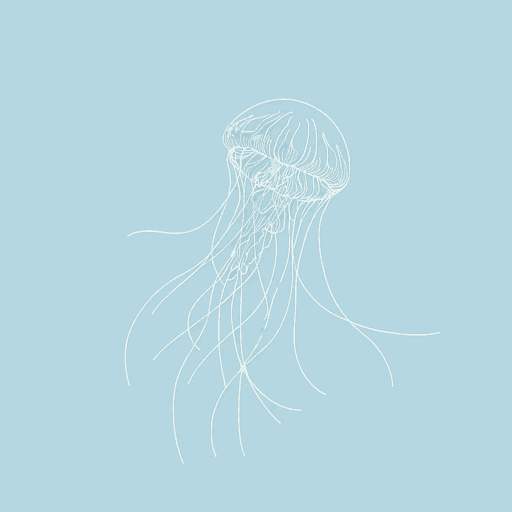
A Jelly-Fish
A Jelly-Fish
A modern alternative to SparkNotes and CliffsNotes, SuperSummary offers high-quality Study Guides with detailed chapter summaries and analysis of major themes, characters, and more.
Further Reading & Resources
Related Poems
“Poetry” by Marianne Moore (1919)
Beginning with the provocative line, “I too dislike it,” the poem “Poetry” is akin to a manifesto. Moore reveals her impatience with the view that poetry is an inherently superior form of language. She makes the case that “business documents and school books” also have importance. She rails against critics who insist on “a high-sounding interpretation” at the expense of “the raw material of poetry.” The poem combines striking images with an address to the reader in everyday, conversational terms.
“Invitation to Miss Marianne Moore” by Elizabeth Bishop (1937)
After being introduced to Moore in the early 1930s by a librarian at the New York Library, Elizabeth Bishop became Moore’s protégé, and the two developed a lifelong friendship, despite the gap of 24 years between them. They corresponded frequently by letter, sharing a fascination with sea creatures and other objects found at the shoreline. Bishop’s poem captures her love of Moore’s eccentricity and brilliance, with the repeated refrain “Please come flying” indicating the energy of her presence. The line “with your musical inaudible abacus” references Moore’s technical ability to create a poetic music through her unconventional syllabics.
“The Paper Nautilus” by Marianne Moore (1940)
Written more than 30 years after “A Jelly-Fish,” “A Paper Nautilus” was inspired by Bishop’s gift to Moore of a nautilus shell found at the shoreline. The older poet’s response contains an awareness of the perils of the literary celebrity she then enjoyed, noting that the shell is not for “writers entrapped by / teatime fame and by / commuter comforts.” Over the poem’s five syllabically crafted stanzas, Moore expresses her admiration and even identification with the eight-armed mollusk that constructs an intricate shell in which to keep her eggs safe.
Further Literary Resources
“The Marianne Moore Revival” by Adrienne Raphael (2016)
Coinciding with the publication of a new version of Moore’s Observations poems by Farrar, Strauss & Giroux, Raphael suggests that Moore’s poetry could be due for a resurgence of popularity. She cites a number of scholars who argue that the revisions Moore carried out in a 1967 version of her own early work actually made her poetry less accessible by paring it back to an extreme degree. In keeping the full original versions of poems such as “Poetry,” the new version demonstrates that a poet may not always be the best person to editorialize their own voice.
“Poetry Spotlight: ‘A Jelly-Fish’ and ‘The Fish’ by Marianne Moore” by Sean Murphy
Focusing on the two marine poems from early and later in Moore’s career, Murphy builds a persuasive case for Moore as a voice relevant to modern concerns about humanity’s environmental destruction. He also notes her “eccentric about town” image, comparing her to Andy Warhol as an artistic figure whose iconic style made her part of the popular consciousness in her own lifetime. The article’s image—the white-haired Moore in her sixties, preparing to throw the opening ball at a packed Yankees Stadium—certainly makes the point.
“The Eyes Have It” by James Fenton (2002)
British poet James Fenton’s reader-friendly poetry blog aims to lift the bonnet on Moore’s use of syllabics, demonstrating how the technique creates a visually arresting effect on the page. Considering how these poems would sound read aloud, he notes that most readers would never hear the number of syllables, but he suggests her use of end-rhymes, as in “A Jelly-Fish,” has the effect of “gently marking line-endings”.
Listen to Poem
“A Jelly-Fish” by Marianne Moore for Poems Aloud
Experience the poem interpreted by the poet, in the sonorous rendition.

Get in-depth, chapter-by-chapter summaries and analysis from our literary experts.
- Grasp challenging concepts with clear, comprehensive explanations
- Revisit key plot points and ideas without rereading the book
- Share impressive insights in classes and book clubs