52 pages • 1-hour read
A Lie Of The Mind: A Play in Three Acts
A modern alternative to SparkNotes and CliffsNotes, SuperSummary offers high-quality Study Guides with detailed chapter summaries and analysis of major themes, characters, and more.
Symbols & Motifs
Content Warning: This section of the guide includes discussion of gender discrimination, mental illness, illness or death, physical abuse, emotional abuse, and domestic violence.
Frankie’s Gunshot Wound
When Frankie comes to Montana, Baylor shoots him in the leg by accident. Frankie’s gunshot wound then becomes the main reason he needs to stay in Baylor’s home, which is a critical part of how the conflict of the play unfolds. However, Frankie’s gunshot wound is itself a symbol of how traditional masculinity is hampering new generations of men, who might try to improve their situation and their communities. Frankie’s purpose in going to Montana is to resolve the conflict between Beth and Jake, but Mike will not allow him in the house. Mike is too proud and territorial to allow any possibility of peaceful resolution, which is then exacerbated by Baylor shooting Frankie. Baylor and Mike represent the tradition of proud, competitive, and violent masculinity, while Frankie presents a new, more balanced masculinity that prioritizes conflict resolution over victory.
As the gunshot wound forces Frankie to stay and witness Beth’s family drama, it also restricts him to a couch, where he must fight with Baylor for control of a blanket. The gunshot wound, which stopped Frankie from resolving the conflict peacefully, thus also forces him into direct competition with the other man in the house. In the end, Jake, Baylor, and Mike all abandon Frankie to Beth, and Frankie is powerless to avoid this conclusion because of the wound. It shows his attempt to adhere to the traditional patriarchal form of masculinity ultimately futile and damaging.
The American Flag
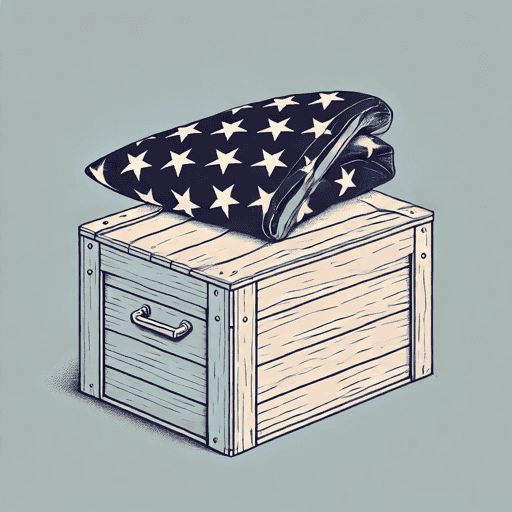
The American flag that Jake finds with his father’s possessions takes on a series of roles in the play, each of which embodies a certain element of nationalism. First, the flag is kept with Jake’s father’s things, representing the past and the military glory of the United States in World War II. In this role, the flag is purely symbolic of Jake’s father’s military service, which is only undermined by the dishonorable manner of Jake’s father’s death. Next, Jake takes on the flag as a form of protection, wearing it around his shoulders and bringing it with him to Montana. Here, he uses it as a symbol of protection or a talisman to ward against conflict, hoping that, as on the world stage, no one in the household will challenge what the American represents. The flag makes it to Montana, but Mike challenges it, taking the flag and turning it into reins with which to control Jake. This stage of the flag’s development highlights how nationalism can become a controlling ideology, forcing people into submission under a unified ideal rather than allowing them freedom as individuals. Finally, Baylor demands the flag be folded, which distracts from the conflicts of the play and symbolizes the death of an ideal, as the flag is folded this way to honor a deceased soldier.
In each instance, the flag represents a vision of America and American culture, which was shifting drastically in the 1980s. Between the Cold War, economic uncertainty, and changes in family values, the flag comes to represent an unknown future. The characters use the flag to achieve their own purposes, such as protection, control, and deflection, but the changing meaning of this symbol is an intentional hint toward the despair of the play’s overall perception of what it means to be American.
Forgetting
The characters in the play consistently forget key events from their own lives, including deaths, medical procedures, and Jake and Beth’s wedding. Memory plays a critical role in identity, as remembering events allows individuals to internalize and reflect on their actions and how other people affect them. Forgetting key events, then, acts as a barrier against personal growth and makes it difficult to avoid repeating potentially traumatic situations. Early in the play, Jake foreshadows the destructive consequences of forgetting when he forgets that he abused a goat as a child. Frankie sees the abuse of the goat as a key element in Jake’s character, but Jake does not remember, and thus cannot reflect on it. As such, Jake is stuck in a constant cycle between committing violent acts, forgetting his actions, and repeating the violence.
A critical clue into the family dynamics in the play is how both Meg and Lorraine forget that Beth and Jake are married. Beth and Jake’s marriage is essentially a repetition of the dysfunctional marriages of their parents, and Lorraine and Meg forget the wedding in the same way that they forget their own marriages. Lorraine still thinks of her husband as a military man, while Meg holds onto the romance of her early marriage with Baylor, forgetting the devastating dysfunction of these marriages overall. They forget Beth and Jake’s marriage because they do not want to confront the way their children are emulating them and repeating their past mistakes. The motif of forgetting, then, is a reminder to the audience that the key conflict for each character is a refusal to confront the past or grow from it.

Unlock the meaning behind every key symbol & motif
See how recurring imagery, objects, and ideas shape the narrative.
- Explore how the author builds meaning through symbolism
- Understand what symbols & motifs represent in the text
- Connect recurring ideas to themes, characters, and events