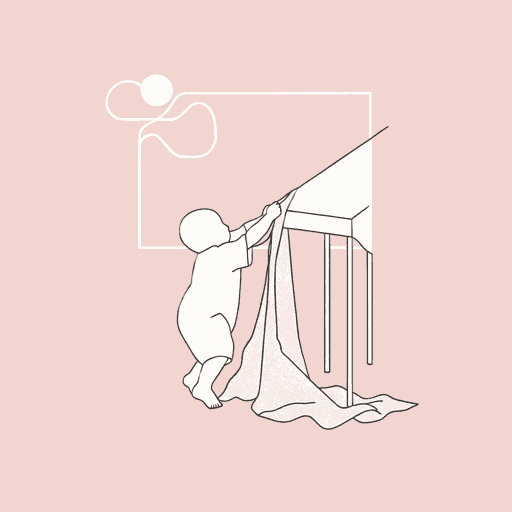
A Little Girl Tugs at the Tablecloth
A Little Girl Tugs at the Tablecloth
A modern alternative to SparkNotes and CliffsNotes, SuperSummary offers high-quality Study Guides with detailed chapter summaries and analysis of major themes, characters, and more.
Further Reading & Resources
Related Poems
"Branch Library" by Edward Hirsch (2005)
This short poem practices extended anthropomorphism through a sly speaker who uses an external perspective to suggest his interior mood. What appears as a superficially simple, playful, almost folktale-like narrative thinly covers absence and loss, uncertainty, and longing.
"At the Galleria Shopping Mall" by Tony Hoagland (2009)
Tony Hoagland documents another child’s very different experiment as she enacts her entry into American consumer culture. Hoagland invokes the witness of higher powers as well, using a speaker with a sense of history and irony. In this case, the narrative voice conveys even more certainty about the eventual outcome.
"Ars Poetica?" by Czesław Miłosz (1968)
This poem from Szymborska’s friend and once mentor, Polish poet Czesław Miłosz, proposes that poetry functions as a reminder of “how difficult it is to remain just one person” (Line 30), evoking Szymborska’s experiments with subjectivity. “[I]nvisible guests” (Line 32), readers, speakers, subjects, the spirits populating poetry, come to use the poet and inhabit his space. In the final stanza, Miłosz’s speaker wryly comments that poetry should only be written rarely (Szymborska reportedly wrote fewer than 400 poems in her lifetime), and only “under unbearable duress” (Line 35), and preferably when the forces of good intervene, and not the other kind.
"Filling Station" by Elizabeth Bishop (1965)
American poet Elizabeth Bishop creates a mood through objects and endows them with a certain amount of purpose and intention in this poem. The speaker also inhabits adult and child sensibilities, affecting an ironic stance.
Further Literary Resources
"Wisława Szymborska, Nobel-Winning Polish Poet, Dies at 88" by Raymond Anderson (2012)
Szymborska’s obituary, like the Nobel notices, introduced her work to many readers. Biographical context and information about her reaction to the Nobel award make this article a useful glimpse into the private world of this poet, who did not grant many interviews or travel extensively from Poland.
"Wisława Szymborska: The Puzzles of Translating Grief" by Clare Cavanagh (2013)
As half of her chief American translation team, Clare Cavanagh’s personal memories evoke a vivid figure of the poet.
"Subversive Activities" by Edward Hirsch (1996)
Back in 1996, Hirsch argues that Szymborska uses wit and individual perspective to undermine universally-accepted, enforced beliefs. Hirsch explores Szymborska’s work alongside her influences and some biographical information, providing context for American readers. Hirsch gives Szymborska’s work the framing necessary for understanding its subversive force.
"A Poetry That Matters" by Edward Hirsch (1996)
Hirsch interviews Szymborska for the New York Times after her Nobel Prize win.
"Wisława Szymborska" by Janusz R. Kowalczyk (2012)
This retrospective of Szymborska’s life and work includes useful biographic information, including a reference to Anna Bikont and Joanna Szczęsna’s biography of the poet, Commemorative Junk, Friends and Dreams of Wisława Szymborska, as yet not available in English. The article includes examples of her whimsical, haunting collages, along with photographs of the poet. A short film version of “A Little Girl Tugs at the Tablecloth,” with English narration, appears within this remembrance of the poet’s life and work.
"Wisława Szymborska’s Influence on Poetry" by Emilia Phillips (2018)
Contemporary poet Emilia Phillips discusses Szymborska’s view of poetry as a space of uncertainty and unknowing, connecting the sensibilities of her work to those of current writers.
"Wisława Szymborska on Learning to Write from Life" by Wisława Szymborska (2021)
This excerpt from the book How to Start Writing (and When to Stop) collects passages from Szymborska’s anonymously-published advice column for writers. Translated again by Clare Cavanagh, these jaunty but at times brutal responses to reader letters, originally published in the Polish journal Literary Life, offer insight into the humor and brilliance of a writer who maintained a few fierce friendships but who shunned public display.
Listen to Poem
Wisława Szymborska recites "A Little Girl Tugs at the Tablecloth"
The poet provides the voiceover narration for an animated version of her poem. For the poem in English, the same film appears above in the Kowalczyk article in translation.

Get in-depth, chapter-by-chapter summaries and analysis from our literary experts.
- Grasp challenging concepts with clear, comprehensive explanations
- Revisit key plot points and ideas without rereading the book
- Share impressive insights in classes and book clubs