A Swiftly Tilting Planet
48 pages • 1-hour read
Madeleine L'EngleA Swiftly Tilting Planet
A modern alternative to SparkNotes and CliffsNotes, SuperSummary offers high-quality Study Guides with detailed chapter summaries and analysis of major themes, characters, and more.
Chapters 11-12Chapter Summaries & Analyses
Content Warning: This section of the guide includes depictions of child abuse, physical and emotional abuse, racism, religious discrimination, ableism, animal cruelty, violence, illness, and death.
Chapter 11 Summary: “All These I Place”
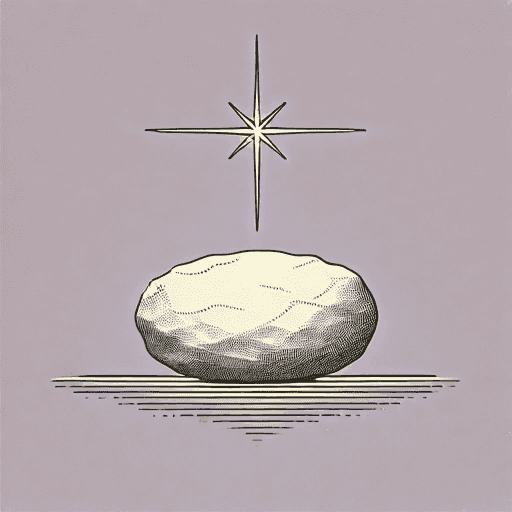
Charles Wallace awakens on the star-watching rock with Gaudior, who explains the wind pulled him from Chuck, and that Mortmain had the boy institutionalized. Gaudior urges haste, and they fly through time without Charles Wallace secured. They experience a penetrating spiritual and physical cold, then land in a Projection: a ruined, desolate city of cracked cement and tall windowless buildings where two gas-masked guards raise machine guns at them. Gaudior escapes with Charles Wallace, uncertain whether the guards could have harmed them. They land in springtime, and Gaudior grows anxious.
Meg kythes a vision of the star-watching rock in 1865, where a young woman sits with a young man who seems somehow wrong. Charles Wallace endures an agonizing Within-ing, feeling torn between opposing forces as he is forced into the body of Matthew Maddox, whose legs are useless after his accident. Matthew meets Zillah Llawcae at the rock. Matthew explains he asked Jack O’Keefe, the hired hand, to deliver his note to her. Matthew reveals his twin brother Bran is in pain and danger. He explains that five years ago his horse crashed into a fence and rolled over him, crushing his pelvis and legs and fracturing his spine. Bran had refused to pity him, instead demanding independence. Matthew lived vicariously through Bran until the war separated them.
A week later, Mr. Maddox announces that Bran has been wounded by a bullet in the leg and is returning home. Bran arrives limping and withdrawn, shutting Matthew out telepathically. After three months, nothing has changed. Zillah reveals Bran asked her to return his ring, but she refuses. Matthew tells her he saw Gwen kissing Jack, whom he distrusts for his cruelty after witnessing him kill a puppy. He urges Bran not to abandon Zillah. Eventually, Bran breaks down, confessing the war’s horrors: witnessing brother kill brother, seeing God withdraw from the battlefield. Matthew comforts him, and their connection is restored.
Bran announces he will join the Welsh colony in Vespugia, Patagonia, founded by their distant cousin Michael Jones and landowner Love Jones Parry. He recites a poem about Madoc, who fled Wales when brother fought brother, comparing it to the Civil War. Zillah declares she will marry Bran and accompany him, but her father, Dr. Llawcae, forbids it, insisting she wait until she is 18. When Mr. Maddox catches Gwen kissing Jack, he orders Gwen to accompany Bran instead.
After their departure, Matthew’s writing career flourishes. Letters arrive from Bran describing the colony, including Rich Llawcae, who loves Gwen, and Gedder, an Indigenous man who assists the colony but later seeks power and influence. Gedder pushes his sister Zillie—who resembles Zillah and Gwen—toward Bran. Matthew’s health fails, and in fevered dreams he encounters a strange boy whose dream merges with his. The boy warns him to stop Gedder and protect the bloodline. Matthew accuses Dr. Llawcae of selfishness for keeping Zillah tied to him instead of letting her go to Bran and, weeks later, secretly gives Zillah money from his earnings as a writer and a steamship ticket, urging her to go because she will tip the balance. She agrees and departs in secret.
Matthew finishes his novel about the primordial pattern of fratricide. Through kything, he witnesses events in Vespugia: Gedder and Rich quarrel on a cliff’s edge over Gwen. Rich disarms Gedder’s knife, and Gedder falls to his death trying to retrieve it. A final letter from Bran confirms Zillah’s arrival and Gedder’s accidental death. Rich is bringing the homesick Gwen home, and the store will become Maddox and Llawcae. The letter ends with a prophecy that Blue will right the ancient wrong.
Matthew is seized by a fatal coughing fit as darkness and a putrid stench overtake him. In the present, Meg wakes calling Matthew’s name. Unable to sense Charles Wallace or Gaudior, she goes downstairs and asks Mrs. O’Keefe if Zillah reached Vespugia. Mrs. O’Keefe says she forgets. Meg insists that there was a time when the past had not yet happened and that Charles Wallace may have changed the Might-Have-Been. Mrs. O’Keefe suddenly stands and demands they take her to Chuck before it is too late.
Chapter 12 Summary: “Between Myself and the Powers of Darkness”
Meg, the twins, and Mrs. O’Keefe run to the star-watching rock, where they find Charles Wallace lying pale and seemingly lifeless. As Dennys checks for a pulse, Mrs. O’Keefe begins reciting the Rune of St. Patrick. Meg joins her, her voice gaining strength and clarity.
From Charles Wallace’s perspective, light returns as he awakens on the rock with Gaudior. The unicorn explains Matthew died sooner than expected. Charles Wallace remarks on the strangeness and relief of being able to use his legs again. He rides Gaudior, who transforms from the size of a dragonfly to the size of a constellation, first moving among the fireflies and then through the galaxies. Charles Wallace feels himself both himself and the people he has been Within—Brandon, Chuck, Madoc, and Matthew—as Gaudior’s silver neigh rings out in farewell. A brilliant flash from the unicorn’s horn blinds the family. Sandy and Dennys wonder if it was lightning, though the night is clear and starry. Dennys reports Charles Wallace had no pulse, then suddenly it returned.
The group returns to the warm kitchen. At Meg’s request, Mr. Murry reads aloud the letter from Mrs. O’Keefe’s attic, its contents now altered by the change in the timeline. It describes the death of Mr. Maddox and mentions Bran and Zillah’s son, Matthew, who keeps the nickname Branzillo given to him by local Indigenous children. Mr. and Mrs. Murry note the letter seems slightly different from what they remember but attribute this to exhaustion.
Charles Wallace asks Mrs. O’Keefe what happened to her son, Chuck. She states he was institutionalized and died six months later. She adds that Chuck’s child later took after Duthbert Mortmain and died in the state penitentiary for embezzlement. The phone rings: The president reports that El Zarco, known as “the Blue-Eyed,” is establishing a peace congress and has invited Mr. Murry as an adviser. Meg questions the earlier threat of war, but the family is confused. Mr. Murry states El Zarco has always been known as a man of peace. Charles Wallace privately explains to Meg that the Might-Have-Been was changed: Because Matthew sent Zillah to Bran and Gedder died, El Rabioso was never born and only El Zarco exists.
Looking at Meg, Mrs. O’Keefe announces her baby will be born and asks to be taken home. After she leaves, Dennys observes her heart is failing. Charles Wallace tells Meg that, regardless of what happens, Mrs. O’Keefe saved them all by placing herself between them and the powers of darkness.
Chapters 11-12 Analysis
The novel’s climax frames heroism through a quiet, personal decision, embodying the theme of The Interconnectedness of Past, Present, and Future. Charles Wallace’s final Within-ing places him in the body of Matthew Maddox, a man whose physical paralysis contrasts with his temporal agency. The narrative builds toward a single, pivotal moment: Matthew’s choice to use his authorial earnings to send Zillah to Bran in Vespugia. His foresight that her union with Bran “will swing the balance” reveals a grasp of causality that transcends physical limitations (284). While Bran experiences the external world of war and colonization, the confined Matthew wields the power to shape the future. This dynamic subverts traditional epic hero narratives and suggests that history’s most significant turning points can be intimate, unrecorded choices made by seemingly powerless individuals. The future is secured through the actions of a writer living with a physical disability whose influence ripples through generations, reinforcing Love as a Transformative Force.
The climactic conflict reflects the theme of Dealing with Existential Threat, as acts of understanding, sacrifice, and creation resist the destructive influence of the Echthroi. Matthew’s novel, which traces the primordial pattern of fratricide, helps him perceive the recurring pattern of conflict shaping history. He recognizes that within his work, “myth and matter merge” (279), and his kythic dreams both inform its plot and allow him to perceive the real-world stakes. His writing thus becomes a tool for understanding and intervening in the destructive cycle. This act of creation directly opposes the Echthroi, whose goal is to un-name and un-make reality. Matthew’s death, accompanied by the sensory hallmarks of the Echthroi—a “rank stink like spoiling flowers” and encroaching darkness (289)—occurs after he has ensured that Zillah travels to Vespugia, preserving the Madoc line that ultimately shapes the future. The artist is thereby a key agent in the preservation of existence, showing how individual insight and sacrifice can influence events across generations, reinforcing the interconnectedness of past, present, and future.
These final chapters resolve the enigma of Mrs. O’Keefe, revealing her role as a willing participant in the generational struggle and embodying the theme of love as a transformative force. Initially presented as a cold and resentful figure, Mrs. O’Keefe is revealed to be scarred by her family’s past, including the actions of Duthbert Mortmain and the loss of her brother, Chuck. This history provides context for her final sacrifice. Her recitation of the Rune of St. Patrick functions as a deliberate transfer of sacred responsibility. Charles Wallace’s final words confirm this, stating that “it was herself she placed between us and the powers of darkness” (304). Her declining health in the resolution underscores the immense personal cost of this intervention. Having witnessed the destructive pattern within her own family, she accepts the burden of protecting others, completing a chain of responsibility that connects their disparate sufferings into a single, purposeful act.
The narrative’s resolution employs a subtle rewriting of reality, using an altered letter and the characters’ fragmented memories to explore the fluid nature of history. The climax prevents the war that once seemed possible and reshapes the timeline: The warlike dictator El Rabioso never existed, and in his place has always been the peaceful El Zarco. The president’s phone call and the revised letter from Vespugia provide the only tangible evidence of the temporal shift, yet the Murrys dismiss their memory of the original timeline as a trick of exhaustion. This technique presents a complex outcome in which the past itself has changed. The family’s inability to fully grasp what has occurred highlights the limitations of linear perception. Reality is presented as an interconnected weave of possibilities shaped across time. The quiet acceptance of the new timeline underscores how profoundly existence can shift without widespread awareness, leaving the truth of what was averted to be held only by a few.

Unlock all 48 pages of this Study Guide
Get in-depth, chapter-by-chapter summaries and analysis from our literary experts.
- Grasp challenging concepts with clear, comprehensive explanations
- Revisit key plot points and ideas without rereading the book
- Share impressive insights in classes and book clubs