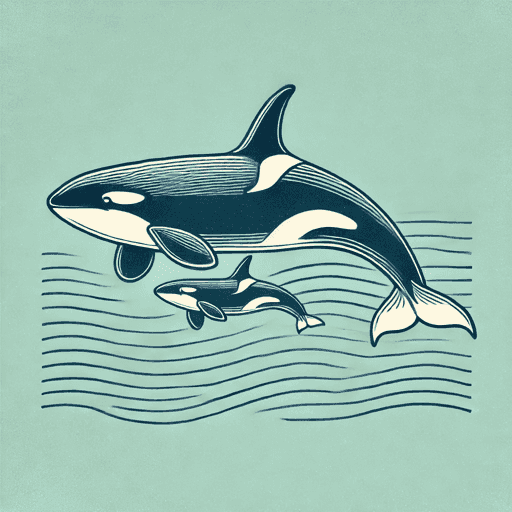
A Whale of the Wild
50 pages • 1-hour read
Rosanne Parry, Illustr. Lindsay MooreA Whale of the Wild
A modern alternative to SparkNotes and CliffsNotes, SuperSummary offers high-quality Study Guides with detailed chapter summaries and analysis of major themes, characters, and more.
Chapters 19-25Chapter Summaries & Analyses
Chapter 19 Summary: “Vanished Kinship”
The narrative shifts to Deneb’s perspective. Seeing the majestic blue whale gives him courage, and he’s certain that Vega is the bravest wayfinder ever because she dares to explore the ocean’s depths. He’s ravenous, but he remains confident that his sister will find salmon. After a few days of traveling alone, they detect a group of orcas in the distance. Deneb thinks the whales are their relatives and wants to go to them, but Vega hesitates. He suppresses his impatience and instead encourages his sister to take deep breaths. She recalls Greatmother telling her a story about the Vanished Ones, a branch of their family “who strayed into the wild and never came back” (131). She wonders if this pod could be them. Vega and Deneb exchange introductions with the other orcas, who invite the siblings to travel with them. Deneb befriends one of the younglings and plays with him.
Chapter 20 Summary: “Hunt”
The narrative moves back to Vega’s point of view. She’s relieved to be surrounded by other wayfinders even though she doesn’t quite understand the language her long-lost relatives speak. Seeing the large number of babies and younglings in the pod reminds Vega of Capella and Blood Cove, and she’s filled with anger that “the pain and loss of those long-ago captures are not over” (133). One night, the pod is filled with excitement when they detect a group of sharks feeding on a swarm of fish. To Vega’s astonishment, the whales hunt the sharks. One of the sharks tries to attack her, and Deneb and the other whales protect her.
Vega has never eaten shark before, but she decides to try it since she and her brother are starving and in the uncharted waters of the Blue Wilderness. After Deneb eats some shark meat, his consciousness drifts, and Vega sees “a long curving gash below his flipper” (139). The Vanished Ones leave the siblings behind. Vega spends two days tending to her brother. During this time, she senses something watching them from the shadows, but the dark presence is gone when Deneb heals. Exhausted, Vega falls asleep. She communes with her kinship’s wayfinders in her dreams and awakens with a new sense of clarity.
Chapter 21 Summary: “Homeward”
Vega tells Deneb that it’s time for them to return home. She realizes that they cannot find food for themselves in the ocean, and she secretly fears that “there might not be food for [them] at home either” (141). Still, she’s determined that, if they must perish, they should die in the home of their ancestors. She sets their course using the sun and the moon. Vega finds a flat fish to share with Deneb, but she worries that they will succumb to hunger sickness, an illness that leads to confusion, memory loss, and even death.
One day, they near Land’s End and see tiny fish making new homes in a sunken cargo ship. This is “the first hopeful sign” Vega has seen because salmon eat the little fish (143). Vega hopes that the absence of boats on the water means that there will be enough food for her family this year. The siblings return to the Gathering Place and announce their names as loudly as they can. Off in the distance, they hear Aquila and Altair respond.
Chapter 22 Summary: “Found”
Although the reunion is joyful, both Vega and Aquila are grieved that the rest of their family remains apart from them. Aquila explains that she became separated from the others because of the great waves that followed the sea shake. She is “terribly lean” because she nursed Altair to keep him healthy (147). Vega realizes that she must lead the four of them and that Aquila will succumb to hunger sickness unless she finds salmon for her cousin quickly. Aquila also understands that her and her baby’s lives hang in the balance. Filled with fierce love and pride for her family, Vega inwardly swears, “I will go as far as it takes and kill whatever I must to keep you alive” (149). She decides that the salmon will most likely be near the largest mountain, which is called the Mother of Rivers. She doesn’t know if she will be able to chart a course through the reshaped landscape, but she subdues her doubts. Taking the wayfinder’s position, she leads what’s left of her family away from the Gathering Place.
Chapter 23 Summary: “Hunger”
The narrative shifts to Deneb’s perspective. The youngling tries to keep himself and Altair hopeful by singing and telling stories. When Aquila becomes too frail to produce milk and despairs of reaching their destination, Deneb offers an encouraging and steady presence. One night, he keeps watch so that Vega can rest. All of the familiar sea marks are changed, but Vega manages to find the path. At last, they see the Mother of Rivers and “a swirling moon” of Chinook salmon (158). The four orcas eat their fill, and Deneb exults, “[Vega] is the queen of all wayfinders! We will never be hungry again!” (159).
Chapter 24 Summary: “Salmon”
The narrative moves to Vega’s point of view. She is filled with gratitude to her relatives for following her despite their pain and with pride in her wayfinding skills. Suddenly, Vega realizes that the salmon should be much more difficult to hunt. She sees that the mouth of the river is blocked, preventing the salmon from going upstream to lay their eggs. Understanding that “everything [she] love[s] will be lost without” the salmon (161), she tries to open the path to the river. A group of longboat riders removes some of the rubble, and Vega uses her echolocation to find a weak point in the obstruction. She determines that a woman with “pearl-colored hair” is a “human wayfinder” and guides her to the weak point (164). Together, Vega, Deneb, and the humans clear away the tree trunks and boulders holding back the water. Vega guides her family to cover as the river bursts free.
Chapter 25 Summary: “Kinship”
Vega tries to warn Aquila that they will “make a wasteland of the sea” if they eat all of the salmon (168), but the starving whale pursues the fish up the river, further demolishing the barrier. The water sweeps away Altair. Deneb hurries after his little cousin while Vega goes after Aquila. As the lake behind the barrier rapidly drains away, the two whales are at risk of being stranded on dry land. Aquila is terrified that they may never find salmon again, but Vega convinces Aquila to return to the sea with her by reminding her of her baby.
Vega and Aquila find Altair and Deneb helping humans who fell into the water when the barrier broke. While the younglings play, Aquila apologizes to Vega for doubting her abilities as a leader. Vega declares to her cousin, “You will be my hunter and I will be your wayfinder, and we will scour the sea to find our mothers and greatmother, our whole kinship” (175). She can’t be sure where the rest of their relatives are, but her adventures have proven that she is capable of more than she ever knew. Gathering her family around her, Vega leads the way forward.
Chapters 19-25 Analysis
In the novel’s final section, the challenges Deneb faces cause him to grow in strength and courage. Parry uses first-person narration to offer insight into the deuteragonist’s thoughts, allowing the reader to see his efforts to be mature and brave despite his youth: “I’m hungry, but I’m much too big to complain about it. So I don’t. Not one bit” (128). The shark hunt in Chapter 20 marks a key moment for Deneb’s characterization: “‘I saved you,’ Deneb says, ‘Like Uncle Rigel would’” (139). As this excerpt illustrates, Deneb’s valiant deed is motivated in part by his admiration for his uncle, and his selfless defense of his sister is foreshadowed by his earlier efforts to rescue the Seal-eater and the drowning humans. Deneb’s injury raises the novel’s suspense and underscores that he is no longer the youngling who was afraid to leave his pod and follow Vega. From keeping watch so Vega can rest to rescuing Altair from the swift current, Deneb’s actions in these chapters depict his growth into a strong and steady supporter who can help his sister bear the burden of leadership.
Vega’s struggle to ensure her and her family’s survival advances her development into a confident and skilled wayfinder. Seeing how the Vanished Ones thrive in the ocean helps her understand that surviving in a changing environment means being willing to change, too: “We don’t eat sharks, is what I almost say. We have never eaten them before. But here we are. In the wild. With nothing else to eat” (138). The themes of survival and familial bonds intersect with the protagonist’s growth because Vega’s powerful love for her family fuels her determination to protect them: “I will not let you sink, I silently promise. I will go as far as it takes and kill whatever I must to keep you alive” (149). This fierce love helps Vega endure the many hardships that her pod faces in these chapters and to keep striving toward her goals of finding food and the rest of her family. The characters’ return to the Salish Sea allows Parry to illustrate how their home has been changed by the natural disaster: “Vega calls out sea marks as we go past them, but I don’t recognize a single one. Old pillars have tumbled. Tangles of broken trees drift by. Giant kelp float over deep water, ripped from their holdfasts” (156). Environmental changes force the protagonist to hone her attention to detail and other leadership skills so that she can safeguard her family’s survival.
The novel’s climax revolves around the Chinook salmon, further cementing their significance as a motif of survival. At first, Vega and her relatives are overjoyed to see the school of fish after the weeks of starvation they endured because the abundance of fish means that the whales will live: “This is the food that feels right in my belly. The food I was born to eat [….] We will never be hungry again!” (159). However, the survival of the salmon themselves is threatened due to changes in their environment, and the protagonist’s climactic epiphany is the realization that more than her and her family’s lives are at stake: “Look to the water. What touches the water touches us all” (161). By helping the salmon complete their migration, Vega preserves hope for her pod’s future and the many other species that depend upon the fish. As the salmon’s thematic meaning evolves, Vega gains a deeper appreciation of how interconnected the survival of all creatures in her ecosystem is and the fragility of this precious balance.
The return of the longboat riders advances the theme of Human Influence on Natural Habitats and secures the novel’s happy ending. Humans and nature work in harmony through the longboat riders’ cooperation with Vega and Deneb in Chapter 24. Their teamwork is foreshadowed by the sense of kinship the protagonist feels toward the longboat riders during their introduction in Chapter 11. Crucially, Vega would have been unable to “open the river’s mouth” without the humans’ assistance (164), and the humans would have struggled to shift the “thick and heavy” rubble without the whales’ might (164). This expresses the importance of collaboration, solidarity, and respect when it comes to solving ecological problems. Through the longboat riders’ and the orca’s cooperation, Parry offers the affirming message that humans can have a positive influence on the environment.
The theme of The Importance of Familial Bonds guides the protagonist’s development and the novel’s resolution as Vega looks after her little pod and renews her vow to reunite her scattered relatives. Parry portrays the characters’ commitment to one another through suspenseful key moments, such as when Vega risks becoming “trapped, away from [her] family, away from the salty water of the sea” to rescue Aquila (171). Despite the many obstacles that still lie ahead of the pod, Vega remains determined to “scour the sea to find [their] mothers and greatmother, [their] whole kinship” (175). Placing further emphasis on the family’s strength and unity, the novel closes with the phrase that serves as the theme’s motif: “We swim away together—side by side and fin by fluke” (175). The novel’s ending is open-ended yet hopeful as the protagonist’s quest for the rest of her kinship continues, a resolution that emphasizes the importance of familial bonds.

Unlock all 50 pages of this Study Guide
Get in-depth, chapter-by-chapter summaries and analysis from our literary experts.
- Grasp challenging concepts with clear, comprehensive explanations
- Revisit key plot points and ideas without rereading the book
- Share impressive insights in classes and book clubs