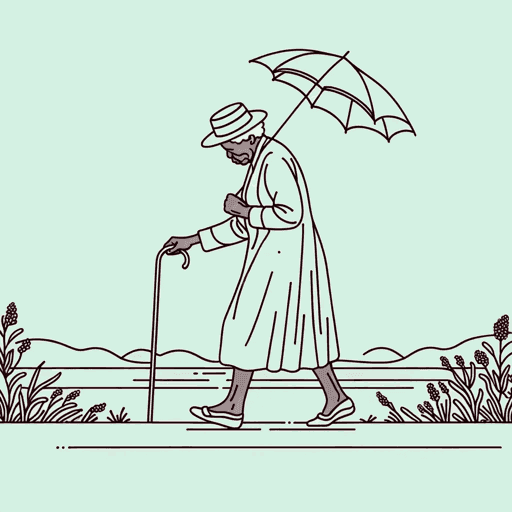
A Worn Path
A Worn Path
A modern alternative to SparkNotes and CliffsNotes, SuperSummary offers high-quality Study Guides with detailed chapter summaries and analysis of major themes, characters, and more.
Themes
The Power of Love and Devotion
Long before Welty reveals Phoenix’s motivation for making the long and difficult journey to Natchez, readers sense a vague yet essential “something” that propels Phoenix forward. So much narrative detail focuses on the what and how of Phoenix’s journey that the why remains artfully obscured until the final reveal at the doctor’s clinic: Phoenix risked her life traveling miles across the rural landscape for her grandson. She temporarily forgets the reason until prompted by the nurse’s questions, but her unreliable memory is less of an obstruction than the wild landscape. Her body and force of habit sustain her purpose and carry her forward, revealing the power of love and devotion as the primary theme of “A Worn Path.”
The story shows that love can be tough and enduring. Phoenix embodies these qualities in the way she interacts with the environment and other people. Later in the story readers learn that she makes the lengthy trek “as regular as clockwork” (147). Everything she does is for her grandson, and she is willing to repeatedly jeopardize her own well-being for the sake of his survival. The repetitive quality of her journey suggests that love is a dutiful task that takes priority over the caretaker’s personal comfort and preferences. Phoenix accepts her responsibility for her grandson with grace and fortitude; as she tells the nurse, “We is the only two left in the world” (148). This statement implies that the boy’s parents are either dead or cannot care for him for an unspecified reason. Welty does not provide any background on the grandson’s family history. That stylistic choice is one of the many ambiguities of the story. Regardless, in this story love is not ambiguous, though it is multifaceted.
While Phoenix’s love makes her tough, it also leaves her and her grandson highly vulnerable. The severe esophageal scarring that results from swallowing lye can prevent a person from eating or drinking and, if not dealt with sufficiently, can result in gradual starvation. The fact that Phoenix journeys to town on foot to procure the medicine through charity suggests she lives in poverty. If food and hunger are already potential issues, the problems for her grandson multiply. Yet the vulnerability of Phoenix’s love also proves a major source of strength. She believes that despite the risk her grandson faces, it will not set his life back:
My little grandson, he sit up there in the house all wrapped up, waiting by himself […]. We is the only two left in the world. He suffer and it don’t seem to put him back at all. He got a sweet look. He going to last. He wear a little patch-quilt and peep out, holding his mouth open like a little bird. I remembers so plain now. I not going to forget him again, no, the whole enduring time. I could tell him from all the others in creation (148).
Phoenix recognizes the risk they both face, evident in her description of the boy as “a little bird,” vulnerable and dependent. But above all else, her affection shines through in this passage. Her account alternates between her grandson’s temporary helplessness and his endurance. She also stresses that though her memory is fading, his uniqueness will make it impossible for her to ever forget him. Her love is a force that pushes through danger, poverty, physical limitations, and social barriers.
The Violent Legacy of Slavery
In the story, slavery has been abolished for over half a century, but its legacy of violence and oppression still saturates the landscape. Some writers like Frederick Douglass and William Faulkner describe slavery and racism as poisons that infect African Americans and white Americans in different ways. African Americans were denied individual freedom and basic human rights, while white people suppressed their humanity by using violence to assert racial superiority. After the Civil War, the Black Codes and Jim Crow laws attempted to keep African Americans subjugated to a lower quality of life. Welty’s story is set in this postbellum, pre-civil rights era.
Phoenix Jackson makes a brief remark that suggests she was born into slavery: “I never did go to school, I was too old at the Surrender” (148). “Surrender” refers to the Confederacy’s surrender to the Union Army and the end of the Civil War in 1865. The statement implies that she could not attend school prior to the Civil War. Most enslaved people were prohibited from an education unless it was granted as a special favor. During Reconstruction in the postwar South, the US government established programs that gave many formerly enslaved African Americans the opportunity to pursue a formal education. Phoenix’s remark suggests that her age disqualified her from this opportunity.
Other passages allude to slavery in different ways. When she approaches a steep hill, Phoenix says to herself, “Seem like there is chains about my feet, time I get this far” (143). The remark is both general (she is tired and feels like something is keeping her feet from moving) and highly suggestive, given that shackles and chains were used to restrain the enslaved and prevent escape.
Phoenix’s encounter with the white hunter is another allusion to slavery that also highlights the prevalence of racism at the time. Welty introduces the character and their meeting in the following way: “A white man finally came along and found her—a hunter, a young man, with his dog on a chain” (145). Though the scene is set up as a chance meeting that Phoenix ultimately uses to her advantage, in this context a white man carrying a gun and walking through the woods with chained dog evokes images of slave hunters who tracked runaway slaves with guns and dogs. Additionally, he is preceded by the black dog, which comes at Phoenix and causes her to fall into a ditch. Black dogs and black cats are often depicted as omens of evil in folklore. The two dogs fight and growl while Phoenix and the hunter speak, creating an atmosphere of danger. Before parting ways, the hunter points his gun in Phoenix’s face to scare her for his own amusement. Again, the passage showcases Welty’s narrative skill: The interaction between them can be read at surface level, but the imagery and action invite readers to extract deeper connotations.
The moral and historical ramifications of slavery and white supremacy permeate the atmosphere of “A Worn Path.” Ultimately, the importance of these themes comes from the way Phoenix transcends them. She refuses to be intimidated by the white hunter or submit to his expectations and stereotypical views of African Americans. Her interactions with the (presumably) white townspeople show the same determination to achieve her goal despite social obstacles and prejudice.
The Difficulty of the Hero’s Journey
The hero’s journey is a timeless theme discernable in countless stories from many cultures. It begins when a character (the hero) receives a call to adventure that will entail great challenges. The hero is transformed during the journey and attains “treasure” that will benefit the hero and/or their community. Joseph Campbell’s book The Hero with a Thousand Faces (1949) outlines the three essential components of this journey: departure, initiation, and return. The departure includes a refusal of the hero’s call, supernatural aid, and crossing a threshold. Initiation includes a series of trials the hero must overcome. The return involves the hero’s return to the community and their responsibility to share any “treasure” or wisdom gained. The hero’s journey can manifest in numerous ways and include many variations, but the basic framework remains the same.
“A Worn Path” engages the hero’s journey in orthodox and unorthodox ways. The story contains the basic ingredients but is situated in a real historical time and place. Additionally, it does not reach the neat conclusion that characterizes the typical hero’s narrative, as the story ends before Phoenix returns home to share the medicine with her grandson.
Phoenix, the hero, is a humble figure who is also extraordinary in her determination and love for her grandson. The “call” to adventure is her grandson’s throat condition, which readers do not know about at the beginning of the story. The medicine is a necessity that requires Phoenix to risk herself for a greater cause. Though she does not really resist the journey, she is tempted at several points to stop and give up. She finds aid in the spring’s restorative sustenance, which has a timeless quality. She crosses the threshold by successfully traversing the forest and arriving in town. Her trials include the various challenges—physical, emotional, and social—that she must overcome before reaching Natchez, but they continue in the doctor’s office. The staff grow impatient with her, and she temporarily forgets her purpose. The “treasure” she attains is the “soothing medicine” for her grandson’s throat. This medicine will keep her grandson alive and sustain the “community,” which in this case is only Phoenix and her grandson. That they are “the only two left in the world” raises the stakes (148).
Welty ends the story before Phoenix arrives home. She has only just begun her long journey back in the final sentence: “Then her slow step began on the stairs, going down” (149). Readers may infer that since Phoenix makes this journey “as regular as clockwork” (147), then she can do it again. Welty, however, creates ambiguity by omitting any assurance that Phoenix returns home safely. As an avid reader of fairy tales and myths, Welty was familiar with the basic components of the hero’s journey. Her manipulation of this narrative arc in “A Worn Path” helps explain why this story brought her acclaim and success.

Unlock every key theme and why it matters
Get in-depth breakdowns of the book’s main ideas and how they connect and evolve.
- Explore how themes develop throughout the text
- Connect themes to characters, events, and symbols
- Support essays and discussions with thematic evidence