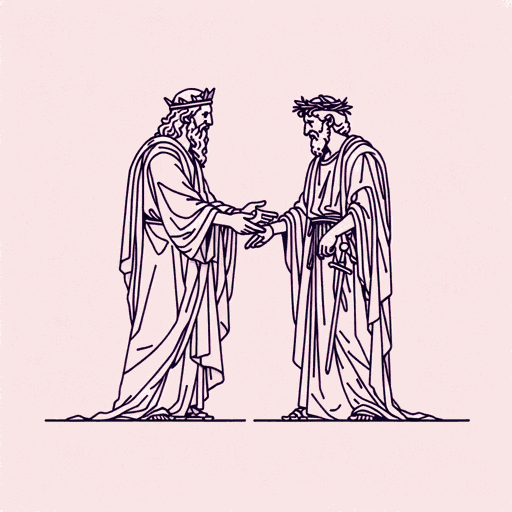
Absalom and Achitophel
20 pages • 40-minute read
John DrydenAbsalom and Achitophel
A modern alternative to SparkNotes and CliffsNotes, SuperSummary offers high-quality Study Guides with detailed chapter summaries and analysis of major themes, characters, and more.
Poem Analysis
Analysis: “Absalom and Achitophel”
“Absalom and Achitophel” opens with the speaker offering some supposedly solemn praise for ancient “pious times” (Line 1) during which polygamy was still freely practiced (Line 2), recounting how King David of Israel has fathered many sons by many different wives and concubines. From the beginning of the poem, the reader is introduced to the form of Dryden’s famous heroic couplets—rhyming line pairings that imitate the style of classical Greek and Roman epics like “The Aeneid”. These heroic couplets remain the meter for the entire poem and are a crucial formal element in the satiric voice; the couplets create humor through the contrast between their apparent solemnity paired with the sarcastic irreverence of the content. Dryden’s opening praise for polygamy and King David’s lusty ways also signals that this poem is, at its core, satirical, despite its important political points.
The description of Absalom draws attention to both one of the poem’s protagonists and the central dramatic conflict. King David’s favorite son is one of his illegitimate offspring: Absalom, a young man who is full “of manly beauty” (Line 22) and who has demonstrated his battle prowess “in foreign fields” (Line 23) in defense of his father’s kingdom. Absalom is the apple of his father’s eye and has been spoiled throughout his life by his father’s indulgence. However, the speaker warns that Absalom may not be quite as perfect as he seems and that King David glosses over his son’s failings: “What faults he had (for who from faults is free?) / His father could not, or he would not see” (Lines 35-36). In presenting this portrait right at the poem’s opening, Dryden introduces the key relationship at the heart of the poem: the bond between fathers and sons and, by extension, between kings and their subjects. The description of Absalom foreshadows the trouble that he will soon bring to the kingdom of Israel; Lines 35-36 hint that he is a flawed son who would benefit from stricter discipline from King David. This relationship between King David and Absalom is a stand-in for that of King Charles II and his illegitimate son, the Duke of Monmouth, suggesting that just as King David was too indulgent towards Absalom, so too has King Charles been too indulgent towards his own offspring.
In the following sections, descriptions of the rebellious undercurrents in Israeli society reflect the problems plaguing England in Dryden’s day. Both political and religious tension threaten to divide Israel. Politically, there are Jews who wish to undermine or even overthrow the monarchy in the name of greater liberty. The speaker criticizes these men as being foolishly driven by “wild desires” (Line 55) that will only lead them to a more primitive existence in “woods and caves” (Line 55). Meanwhile, those who remain loyal to the king and his authority are praised as “the sober part of Israel” (Line 69), since they remember the “ugly scars” (Line 73) of past civil discord and have no wish to return to that anarchy. The description of these Jewish political groups mirrors the ongoing divide between the pro-Parliamentary faction in England—eventually known as the Whig Party—and traditionalists who uphold the King’s authority (the Tory Party). Dryden’s mistrust of populist rhetoric that espouses democratic ideals remain a key element throughout the poem.
The religious tensions are reflected in the speaker’s descriptions of would-be fanatics who resent the suppression of their sect and who wish to take back control. The speaker speaks of “Th’ inhabitants of old Jerusalem / [Who] Were Jebusites” (Lines 85-86), with “Jebusites” sounding very close to Jesuits, the name of a hugely influential Catholic priesthood known for their undercover missionary work in Protestant England. The speaker’s mention of a potential plot to assassinate King David—“Some thought they God’s anointed meant to slay / By guns, invented since full many a day” (Lines 130-131)—is a reference to the persistent rumors of a so-called “Popish Plot” in England to kill or overthrow the king and restore a Catholic monarch to the throne.
Achitophel, “Sagacious, bold and turbulent of wit: / Restless, unfixt in principles and place” (Lines 153-154), is a stand-in for Anthony Cooper, the Earl of Shaftesbury, who was the ringleader for the movement to exclude King Charles II’s brother James from the line of succession. Although Achitophel has been a capable public servant in the past, he is “unfixt in principles” (Line 154) because he is too desirous of power to care about what is right or good for his country. He decides to stir up the Jews against the king, lending “the crowd his arm to shake the tree” (Line 203) to feed popular discontent. His persuasion of Absalom is rooted in the same appeal to a self-serving ethos: He urges Absalom to seize his chance at legitimization and inheritance of the crown, flattering him as “Thy longing country’s darling and desire; / Their cloudy pillar, and their guardian fire” (Lines 232-233). Achitophel uses his rhetorical prowess to both flatter and lead the young man astray into rebellion.
Absalom, for his part, gives a lengthy response acknowledging the justness of his father’s reign and his own good treatment as his son. Nevertheless, he soon gives in to his pride and joins Achitophel’s plot because he is “too covetous of fame” (Line 309) and “Made drunk with honour, and debauch’d with praise” (Line 312) by Achitophel’s smooth-tongued rhetoric. Both of King David’s main opponents—Achitophel and Absalom—are thus portrayed as entirely self-serving, with no real political vision or principles. These unflattering portraits, as representations of the Earl of Shaftesbury and the Duke of Monmouth, urge the poem’s reader to reject both men as insincere political players who are unworthy of any form of power. Likewise, the poem ridicules Absalom’s and Achitophel’s supporters as morally bankrupt men, such as Zimri (“Stiff in opinions, always in the wrong” [Line 547]) and the corrupt Shimei (“During his office, treason was no crime” [Line 597]). Dryden thereby mocks the Whig members of Parliament who dare to support the bill excluding James from the Stuart succession.
Dryden’s disdain of mob rule is apparent in the poem’s descriptions of how many of the common Jewish people flock to Absalom’s cause after hearing his speeches. The crowds “are dazzled with surprise” (Line 686) when they hear Absalom’s flattering speeches, and they are easily misled into embracing him as “their young Messiah” (Line 728). The speaker warns that “Nor is the people’s judgment always true / The most may err as grossly as the few” (Line 781-782), adding that sometimes, “faultless kings [are] run down, by common cry / For vice, oppression and for tyranny” (Line 783-784). Such passages outline Dryden’s objections to the political theorists of his day who advocated for limited or no monarchy in favor of more popular political rule: The mob is, Dryden suggests, unfit for making serious political judgements and cannot be trusted for accurate estimation of their leaders.
King David’s impassioned, self-defensive speech at the poem’s end is, by contrast, an explicit justification of monarchy. King David insists that “Kings are the public pillars of the state / Born to sustain and prop the nation’s weight” (Lines 953-954), and he directly correlates kingship with legality: “The law shall still direct my peaceful sway / And the same law teach rebels to obey” (Lines 991-992). In contrast to the self-serving rhetoric and motivations of Achitophel and Absalom, King David insists that his decisions are always made selflessly, for the good of his subjects and the kingdom as a whole: “For gods, and god-like kings their care express / Still to defend their servants in distress” (Lines 997-998). King David’s phrase “god-like kings” (Line 98), which the poem uses as an epithet for King David himself (Line 1030), links the earthly authority of a king to that of the heavenly authority of God, suggesting that monarchy is a divinely ordained form of government.
To reinforce this connection, the poem ends with a description of how “Th’ Almighty, nodding, gave consent; / And peals of thunder shook the firmament” (Lines 1026-1027), in an explicit endorsement of King David’s words. The poem ends with King David’s defense of monarchy, the final lines assuring the reader that “Once more the god-like David was restor’d / And willing nations knew their lawful lord” (Lines 1030-1021); Dryden thereby alludes to how the Exclusion Crisis ultimately ended in failure for the rebels, suggesting that the continued Stuart monarchy is the only way to ensure England’s stability and prosperity.

Unlock all 20 pages of this Study Guide
Get in-depth, chapter-by-chapter summaries and analysis from our literary experts.
- Grasp challenging concepts with clear, comprehensive explanations
- Revisit key plot points and ideas without rereading the book
- Share impressive insights in classes and book clubs