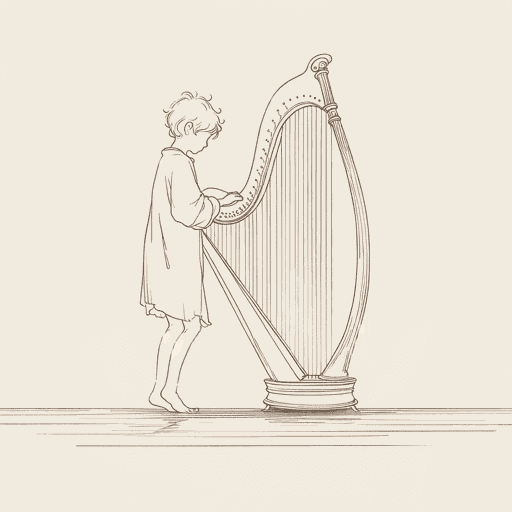
Adam of the Road
Adam of the Road
A modern alternative to SparkNotes and CliffsNotes, SuperSummary offers high-quality Study Guides with detailed chapter summaries and analysis of major themes, characters, and more.
Summaries & Analyses
Quizzes
NEWReading Tools
Games
Important Quotes
“A road’s a kind of holy thing,’ Roger went on. ‘That’s why it’s a good work to keep a road in repair, like giving alms to the poor or tending the sick. It’s open to the sun and wind and rain. It brings all kinds of people and all parts of England together. And it’s home to a minstrel, even though he may happen to be sleeping in a castle.”
(Chapter 4, Page 53)
Roger says this to Adam on the first day they are traveling together. This is the first mention of the road as a minstrel’s home and introduces the idea of home to Adam. It foreshadows his struggle to find a place where he feels at home.
“When at length it came, what Adam said made no sense at all to Roger. ‘It will be pretty hard,’ said Adam, ‘on Hugh.’”
(Chapter 7, Page 92)
Prior to this quote, Roger confesses that he lost all his money and the warhorse to Jankin, and he is waiting for Adam to say something. Adam’s response to this information demonstrates his heart and his generous nature. Adam’s first thought is not for himself but for his friend who genuinely loves the horse.
“Grown-ups were queer, even Roger. If they told you anything, they expected you to remember it forever after, but when you told them something, half the time they forgot it so thoroughly that they did not even remember that they had ever heard it.”
(Chapter 8, Page 96)
This passage shows the contrast between how adults and children think and the level or lack of respect a parent holds for a child’s words. Adam is pointing out the Bishop of Lichfield to Roger because Adam remembers that his friend, Perkin, admires the Bishop. Though he told Roger this previously, Roger doesn’t remember it. This shows that Roger does not listen to Adam as an equal but as a child.
“‘I don’t like that Jenkin,’ declared Adam. ‘He wanted to get Nick! Hugh said he’ll probably ride Bayard to death. Would he, Roger, do you think?’”
(Chapter 8, Page 105)
Adam says this directly after meeting Jankin in the cookshop in London after leaving the de Lisle estate. This passage is significant for a few reasons. First, this is the first time a character openly dislikes Jankin, the antagonist. Second, it foreshadows Jankin’s stealing Nick. Third, it directly characterizes Jankin as one who has the potential to mistreat animals.
“A magpie, very big and black and white, flashed across the road in front of them. ‘One for sorrow,’ said Roger, half to himself. ‘Two for mirth,’ answered Adam quickly. ‘We’ll see another one in a minute. You watch that side of the road and I’ll watch this.’ He could not bear to think of sorrow when they were so happy. Even wet, even footsore, they were happy. His quick eyes saw a rabbit sitting up on its hind legs among the ferns, they saw a man with a cow far down the road ahead, they saw a lark rise out of the field. They forgot to look for the second magpie.”
(Chapter 9, Page 112)
This passage foreshadows the unfortunate events that are about to befall Roger and Adam. Roger is already forlorn due to losing his money and Bayard to Jankin, but Adam is still unaffected. Seeing one magpie is a symbol of sorrow, which is about to enter Adam’s life through the loss of Nick.
“Then he pressed his finger lightly on Nick’s moist cool nose and scratched a little the silky hollow between his eyes. Nick licked his hand again, and he pulled it back into bed because that last kiss had been a little too wet. He could not know that he was saying goodbye to Nick.”
(Chapter 9, Page 121)
This is the last time Adam and Nick interact until the second-to-last chapter of the book. This passage contains a shift in the story that the readers are aware of, even though the characters do not know it yet. The readers do not know how or why Adam is saying goodbye to Nick, only that something is about to happen. This is also the last line of the chapter, ending it on a cliffhanger.
“‘Son,’ said Roger, and that alarmed Adam because Roger called him ‘Son’ only when his feelings were deeply stirred, ‘I am afraid the dog is gone.’”
(Chapter 10, Page 126)
This quote is how Adam learns that Nick is gone. This passage introduces the inciting incident, Nick’s absence, and provides more depth to Roger and Adam’s relationship. This is the first time Roger calls Adam “Son,” which is significant because Roger is not a demonstrative father. Roger does not call Adam “Son” again until the last line of the book.
“It sounded very definite. Even the names of the places along the way gave Adam confidence. They would find Nick again. Of course they would. He stepped out stoutly.”
(Chapter 10, Page 135)
In this passage, Roger has a plan for where they will most likely find Nick and Jankin, comforting Adam and assuring Adam that they will recover his dog. This quote demonstrates Adam’s childlike innocence and naive trust in the adults around him. He believes Roger, and his confidence stems from that trust.
“‘There he is!’ shouted Adam. ‘Roger, I see him!’ Without waiting for an answer, off he shot down the lane, splashing through mud puddles and leaping over piles of trash. Roger, who had not been paying attention, turned his head, but not quickly enough to see where Adam had gone. As far as he was concerned, there were now two missing, a dog and a boy.”
(Chapter 11, Page 142)
This passage contains the second inciting incident of the story, Adam’s getting separated from Roger. This shows Adam’s immaturity, as he dashes away without consulting his father or making sure that Roger knows where he is going. It also shows Adam’s eagerness to find Jankin and Nick.
“So Adam pushed his way along the path by the river, seeing nothing, thinking of nothing but Jankin and the little dog ahead. Even after Jankin gained on him and got out of sight entirely, Adam plodded on.”
(Chapter 11, Page 144)
This quote highlights the first theme of Hope, Perseverance, and Determination in the Face of Adversity. Adam is exhausted by his 12-mile walk to Guildford, but he is unwilling to lose sight of his goal: Nick. He refuses to be discouraged when he loses sight of Jankin. Even when he feels he has nothing left, he perseveres.
“Somewhere ahead of him, pushing through the forest, were Jankin and Nick. Somewhere behind him, beyond the river, was Roger. And here he was himself, alone, wet, without harp or shoes or wallet, and deathly tired. He would just wait here till Roger caught up with him.”
(Chapter 12, Pages 149-150)
This passage is the first time Adam is truly on his own since the start of the book. He always had Nick or Roger with him, and now he has neither. This quote touches on the theme of childlike innocence. In his immaturity and self-focus, Adam believes that Roger knows exactly where he is and will find him.
“For the first time it occurred to Adam that perhaps Roger did not know where he was. After all, he had just shouted and run, and it had been a very twisted way he followed, in and out among the barrels and back lanes, and along the winding river path. Perhaps Roger did not know where he was! Perhaps he was hunting all over Guildford!”
(Chapter 12, Page 152)
In this passage, Adam wakes up in the upstairs bedroom of John and Jill Ferryman. When he fell asleep, he firmly believed that Roger would be with him when he woke up. Now, he is facing the reality that Roger is not omniscient and does not know where Adam is, leaving him alone and defenseless. This passage is an essential part of Adam’s coming of age: He realizes that he has to think ahead and take responsibility for his actions.
“The road, Roger had said, was home to a minstrel, but, thought Adam, which road?”
(Chapter 13, Page 164)
This quote reintroduces the symbol of the road as a minstrel’s home. Adam’s asking himself this question demonstrates that he is beginning to think for himself and determine his own definition of home. This quote highlights the themes of Losing Childlike Innocence and Coming of Age as well as Longing for a Sense of Home, Belonging, and Fulfillment.
“But Daun William seemed so positive, so satisfied with his picture of what had happened that Adam did not like to question it. After all, he was only a little boy, and the merchant was grown-up and rich and wise.”
(Chapter 13, Page 165)
In this chapter, Adam runs into a merchant he met previously, who tells Adam what most likely happened to Roger and Nick. This quote displays the tension between Adam’s childlike innocence and his desire to think for himself. Adam is accustomed to listening to adults and accepting their decisions but is beginning to realize he may disagree with them.
“Adam thought he knew now why Roger said the road was home to the minstrel. It was because people were kind.”
(Chapter 13, Page 166)
This quote reinforces the symbolism of the road as a minstrel’s home. It also develops the theme of Losing Childlike Innocence and Coming of Age. Adam is beginning to determine what the home means to him and whether the road can be his home as well as Roger’s. This quote is also ironic, as the merchant’s party is robbed on the road only a few pages later, shattering Adam’s idea that all people are kind.
“Robbers. Stopping a good merchant who was going about his business without harming anybody! A knight, who had vowed to be chivalrous and protect the weak! Somebody ought to go after them. The sheriff or the bailiff or somebody. Besides, they had his harp. With a wag of his head Adam set off resolutely down the road to find the sheriff.”
(Chapter 13, Pages 172-173)
Here, Adam escaped from the robber knight who kidnapped Daun William and his men, and Adam is deciding what to do next. This passage shows many sides of Adam’s character. First, Adam is losing his childlike innocence by realizing that not everyone is kind and that there is injustice in the world he believed was good and pure. Next, it demonstrates Adam’s bravery and determination. He decides to find the sheriff and set things right himself instead of assuming someone else will rescue the men or simply accepting his losses and continuing his journey.
“Every day he sang with the choir at matins and evensong. And every day he went out to look for Roger and Nick. If he didn’t find them soon, he thought despairingly sometimes, he just could not stand it! He did not want to be a parish clerk. He was a minstrel.”
(Chapter 17 , Page 226)
In this chapter, the parish priest in Winchester has been taking care of Adam since Adam fell and injured his head. Now that he is recovered, the priest expects Adam to become the next parish clerk. In this passage, Adam’s hope, perseverance, and determination are being tested, but he continues to search for Roger and Nick. He is also coming of age and realizing who he is and who he wants to be, which is a minstrel, not a parish clerk.
“Adam, after his purchase, had still a few pennies in his purse, and so he paid for dinner for them all. It took all the money he had, but he did not care. They were minstrels together, and they were starting even!”
(Chapter 17 , Page 230)
Adam just met the de Vesey family and agrees to travel to London with them. This passage shows his generous heart as well as his naivety. He decided to trust the de Veseys simply because they are minstrels, and he is willing to put himself at risk for these people he does not know.
“Worst of all was the knowledge that flared in his mind like a flash of lightning and jabbed his heart with terror: Lawrence had stolen the food that they had just eaten. Adam had never been so frightened in all his life. He had never before been on the wrong side of the law.”
(Chapter 18, Page 243)
Here, Adam and the de Vesey family are being chased as thieves because Lawrence stole food. In his childlike innocence, Adam did not realize that the food he ate was stolen, and he is now dealing with the consequence of his naivety. This is another important moment in Adam’s coming of age as he loses his childlike innocence.
“Long before morning Adam decided that he would not go on with the de Veseys, even if he could find them again. They were the wrong kind of minstrels. He did not want to be like them any more than he wanted to be a parish clerk; he was going to be a real minstrel like Roger.”
(Chapter 19, Page 251)
When Adam thinks this, he is alone, hiding under a bridge after being caught by the night guard with the de Veseys. Adam is learning to think for himself and decide whom he wants to be, losing childlike innocence and thinking more like an adult. He is now wise enough to see the difference between the de Vesey family and Roger and is able to decide which minstrels he would rather imitate.
“He liked Matthew, but he did not want to go back to the de Lisle House without Roger. Idling about the great, empty house when the de Lisles were away was no life for a minstrel. His place was on the road.”
(Chapter 21, Page 280)
After spending a long and unfulfilling winter in the mostly empty de Lisle house, Adam returns to the road in search of Nick. He is finding a sense of home, belonging, and fulfillment on the road, just like Roger does. He is also deciding where he belongs and what kind of lifestyle he wants to live, which is part of his coming of age.
“He marveled, as he looked at the school boys, how young they were, and he remembered with amazement that less than a year ago he himself has been as young as that.”
(Chapter 21, Page 282)
In his search for Nick, Adam visits his old school. This passage demonstrates Adam’s growth and self-awareness. When he left St. Alban’s, he was childlike and immature. Now, returning, he notices how much being on his own in the world changed him.
“His heart was filled with a deep content to be out on the road once more. He sang over the song that he had made about it. a road—how clearly he remembered Roger’s saying it—was a kind of sacred place.”
(Chapter 21, Page 282)
“The Senior pointed a long finger at him. ‘That’s where you’re wrong, my young rooster,’ he said, ‘This one is different. For the first time the Commons are going to Parliament—two citizens or burgesses from every city and borough town. The Warden was with the Sheriff of Oxford when the message came, and he saw it. ‘The which concerns all,’ says Kind Edward, ‘should be approved by all.’ And that, my fellow-scholars, if you could but see beyond the black letters in the books you bury your long noses in, is more important than any examinations you may or may not be passing.’”
(Chapter 23, Page 312)
This passage provides an important historical context. Adam lives in England during the reign of King Edward I, who called the first-ever Parliament that included common people. This quote grounds the story within a broader perspective than simply the details of Adam’s journey.
“He looked down at Adam, who stood happy and sturdy and tall in his home-made blue and red, with his dog at his side and a bagpipe under his arm. Roger’s mouth twitched at the corners, but his gray eyes deep under his square brow were tender. ‘You have done well, son,’ he said.”
(Chapter 23, Page 317)
This passage is the last paragraph of the book, when Roger, Nick, and Adam are finally reunited. All three themes converge in this quote. Adam’s hope, perseverance, and determination paid off, and he achieved his goal of finding his father and his dog. He lost much of his childlike innocence and learned to think and act like a man. He found a sense of home, belonging, and fulfillment, both within himself and within his relationships with Nick and Roger. Roger sees these changes in his son and rewards him by treating him as an equal, instead of a child. Roger even calls Adam “Son,” showing that the changes he sees in Adam deeply move him.

Unlock every key quote and its meaning
Get 25 quotes with page numbers and clear analysis to help you reference, write, and discuss with confidence.
- Cite quotes accurately with exact page numbers
- Understand what each quote really means
- Strengthen your analysis in essays or discussions