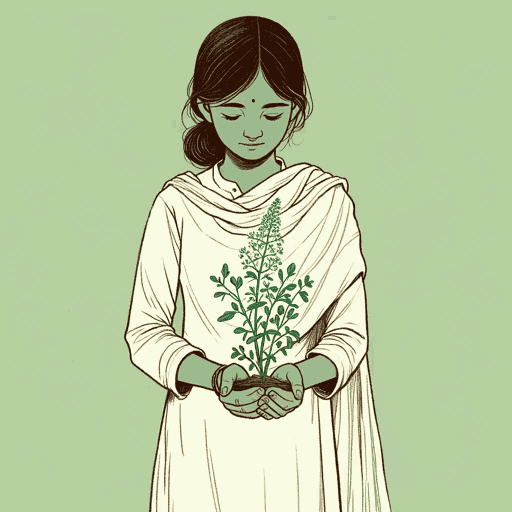
Ahimsa
52 pages • 1-hour read
Supriya KelkarAhimsa
A modern alternative to SparkNotes and CliffsNotes, SuperSummary offers high-quality Study Guides with detailed chapter summaries and analysis of major themes, characters, and more.
Summaries & Analyses
Quizzes
NEWReading Tools
Symbols & Motifs
The Charkha
The first major change in Anjali’s life is the transition to wearing khadi, or homespun clothing, which is made on a charkha, or loom. To her, the charkha symbolizes the freedom movement in India and, correspondingly, symbolizes her mother, who drew her into the movement. In fact, learning to use the charkha and seeing her mother spin thread is what begins to warm Anjali to the idea of her mother as a freedom fighter, even though she’s resistant at first. Anjali’s successful use of the charkha foreshadows her interest and full-scale investment in the movement. Her reaction to using the charkha shows her excitement and the spark of interest in being part of the freedom movement: She “looked proudly at the thread. She had actually done it. She had made the beginnings of homespun clothes. Just like Gandhiji” (62).
When Anjali is at her lowest, she spots the charkha in her home, which reminds her of her imprisoned mother, and pushes it away from her, damaging it slightly. This action represents her frustration with the freedom movement, feeling like it has taken too much from her. Additionally, at this point in this novel, with Ma and Keshavji in prison, Anjali alone must lead the efforts to integrate her school. This places an enormous amount of pressure on her, but she feels like her continued involvement in this effort will encourage her mother to persevere through her time in prison.
The loom is likewise a symbol of knowledge. When Anjali questions Gandhi’s use of “Harijan” in front of Keshavji, he welcomes the new information and compares it to the charkha, saying, “Like the cloth on that loom, we must take this new knowledge and better ourselves, row by row by row” (125). The loom symbolizes the notion of remaking India anew, helping Anjali realize “that it isn’t we Dalits who are backward. Who need to be saved, who need to change. But rather it is the rest of India” (126). By making clothing from Indian cloth, the freedom movement seeks to weave a new history in their country.
Peacocks
Anjali first developed a superstition around peacock feathers when she was eight years old and had had a particularly rough day at school. From then on, “she would search for a peacock feather and just know things would get better” (21). For much of the novel, Anjali holds onto this belief, looking for the symbol of a magic peacock feather as a sign that her life will come back together. The motif appears at critical moments, as when Anjali enters the basti on their first day of lessons, “[c]lutching a newly shed peacock feather” (112). It gives her hope that this moment, about which she’s still nervous, will be positive. The feather gives her comfort, and, sure enough, the lessons go well as the students learn their numbers.
When peacocks become scarce, Anjali thinks about how her grandmother believed that “peacocks left when times were bad” (184). She has this thought shortly after she and Irfaan fight during the Hindu-Muslim riots, and it marks the beginning of a struggle in which she has fewer and fewer people to turn to, as her mother and Keshavji are soon in prison and Mohan soon leaves after being beaten. Her continued search for a peacock in these moments symbolizes Anjali’s desire for some proof that things will turn out okay, rather than the uncertainty with which she must live, not knowing whether her loved ones will return to her.
Anjali finally spots a peacock feather when she escorts her mother out of prison, illustrating how “[s]he didn’t need any superstitions to make her feel better today” (289). Instead, she relies on herself and her community to both sit with and live through uncertainty, especially when it seems like “[f]reedom was in the air” (289).

Unlock the meaning behind every key symbol & motif
See how recurring imagery, objects, and ideas shape the narrative.
- Explore how the author builds meaning through symbolism
- Understand what symbols & motifs represent in the text
- Connect recurring ideas to themes, characters, and events