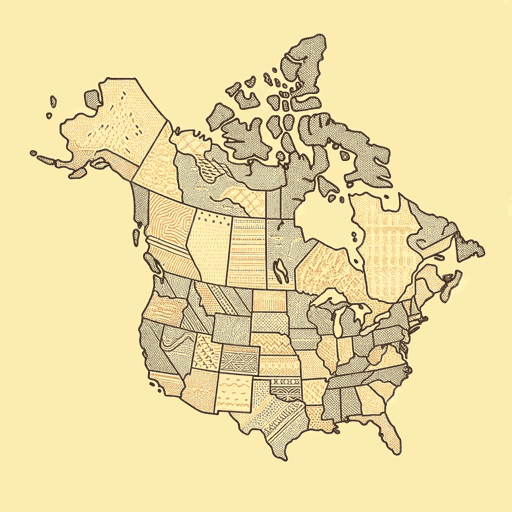
American Nations: A History of the Eleven Rival Regional Cultures of North America
American Nations: A History of the Eleven Rival Regional Cultures of North America
A modern alternative to SparkNotes and CliffsNotes, SuperSummary offers high-quality Study Guides with detailed chapter summaries and analysis of major themes, characters, and more.
Summaries & Analyses
Quizzes
NEWReading Tools
Games
Important Quotes
“Such calls for unity overlook a glaring historical fact: Americans have been deeply divided since the days of Jamestown and Plymouth.”
(Introduction, Page 2)
Woodard maintains that calls for the United States to return to a state of unity are historically false. The United States was never a cohesive whole. Instead, from the beginning, it was divided into different cultural regions, which the author refers to as “nations.” He uses Plymouth and Jamestown as examples not only because these were the earliest English colonies in the US but also because they epitomize the main dividing line in American politics: Yankeedom versus the Tidewater (later the Deep South).
“I have very consciously used the term nations to describe these regional cultures, for by the time they agreed to share a federated state, each had long exhibited the characteristics of nationhood.”
(Introduction, Page 3)
Woodard describes the different regions of the US as nations because these regions have different cultures, ethnic origins, histories, and symbols. He makes this point explicit for readers to underscore his basic claim that The Melting Pot Is a Falsehood.
“Our continent’s famed mobility—and the transportation and communications technology that foster it—has been reinforcing, not dissolving, the differences between the nations.”
(Introduction, Page 16)
Woodard writes that the movement of Americans has not erased the distinctions between the different regions, or nations. Instead, this movement has enhanced these differences. This is because settlers brought their original cultures with them and transplanted them in new areas.
“First, by spearheading the effort to snuff out the Protestant Reformation, the Spanish had earned the lasting hatred of the English, Scots, and Dutch, who regarded them as the decadent, unthinking tools of the Vatican’s conspiracy to enslave the world. This virulent anti-Spanish feeling became deeply ingrained in the cultures of Yankeedom, Appalachia, Tidewater, and the Deep South.”
(Part 1, Chapter 1, Page 27)
The author traces the anti-Spanish feeling in the US back to Spanish opposition to Protestant Europe in the 1600s. English settlers to different parts of the US brought this sentiment with them. Woodard argues that the oppressive treatment of Norteños in El Norte after the Anglo conquest was a continuation of this legacy, demonstrating the durability of regional animosities across time.
“Instead of conquering and enslaving the Indians (as the Spanish had), or driving them away (as the English would), the New French would embrace them.”
(Part 1, Chapter 2, Page 35)
The French had a very different relationship with Indigenous Americans than the Spanish and British did. The French coexisted relatively peacefully alongside Indigenous populations and often intermarried with them. As a result, New France is today the most embracing of multiculturalism of all the regions in North America.
“But the French gentlemen also studied the Mi’kmaq language on their own and sent three teenagers from their own families to live with the Indians so they could learn their customs, technology, and speech.”
(Part 1, Chapter 2, Page 38)
The French had a very open attitude toward the Indigenous Americans in New France and engaged in a cultural exchange with them. Unlike the English at Jamestown, who refused to learn from Indigenous ways, the French benefited from learning about Indigenous hunting techniques. As a result, the society developed in a multicultural way that was very different from the English societies in colonial North America.
“From the outset this was a society of a few haves and many have-nots.”
(Part 1, Chapter 3, Page 47)
The Tidewater, which originated with the settlement at Jamestown, was hierarchical from its inception. Its elite class subsisted on the subjugation of Indigenous Americans, indentured servants, and ultimately enslaved Black Americans. This would make it an ally of the Deep South, which eventually eclipsed the Tidewater in influence.
“The Greek and Roman political philosophy embraced by Tidewater gentry assumed [...] most humans were born into bondage. Liberty was something that was granted and was thus a privilege, not a right. Some people were permitted many liberties, others had very few, and many had none at all.”
(Part 1, Chapter 3, Page 55)
Woodard writes that the Tidewater conception of equality came from the Roman and Greek idea of “libertas.” This idea was very different from the more egalitarian German concept of “freiheit,” or freedom, that the Puritans believed in. Instead, the elite of the Tidewater, which would give rise to figures such as Washington, Jefferson, and Madison, believed that only the elite had the right to be free.
“These men possessed, in proportion to their number, a greater mass of intelligence than is to be found in any European nation of our own time.”
(Part 1, Chapter 4, Page 59)
Frenchman Alexis de Tocqueville, who wrote about America in the 1830s, said this about the early New Englanders. The founders of Yankeedom were well educated; many had graduated from Oxford or Cambridge at a time when this type of education was rare, particularly among non-elites. The emphasis Yankeedom placed on education would be a defining feature of its culture as it spread westward, bringing it into conflict with regions like Greater Appalachia, which tended to view formal education with suspicion.
“But what would cause Yankeedom eventually to be so loathed by the other nations was its desire—indeed, its mission—to impose its ways on everyone else.”
(Part 1, Chapter 4, Page 61)
Originating in Puritan New England, Yankeedom believed in its “errand in the wilderness”—that is, its responsibility to reform others along their lines. They believed that God had charged them with this “mission” (a word choice with religious connotations). As a result, they tried to refashion other parts of the nation, such as the South after the Civil War, eliciting the hatred of other nations.
“Uniquely among the people of seventeenth-century Europe, the Dutch were committed to free inquiry.”
(Part 1, Chapter 5, Page 67)
Woodard traces much of what characterizes the cosmopolitan city of New York to its founding as New Amsterdam by the Dutch. The Dutch were committed to scholarship and books, and they championed rationality and science. This belief in freedom of thought was transmitted to New York.
“From the outset, Deep Southern culture was based on radical disparities in wealth and power, with a tiny elite commanding total obedience and enforcing it with state-sponsored terror.”
(Part 1, Chapter 7, Page 82)
Woodard writes about the founding of the Deep South by enslavers from Barbados. They were committed to protecting slavery and to defending the privileges of the elite. They used the power of their government to do so, at times employing terror to put down potential revolts. Virtually everything about this culture stood in opposition to Yankeedom’s values, paving the way for The Regions at Loggerheads.
“The Borderlanders weren’t really colonists, brought to the Americas to provide some lord or shareholding company with the manpower for a specific colonial project. They were immigrants seeking sanctuary from a devasted homeland, refugees who generally arrived without the encouragement or direction of officials, and often against their wishes.”
(Part 1, Chapter 9, Page 101)
The Borderlanders, who founded Appalachia, were distinctive in their origins. They did not arrive in the Americas under the aegis of a political power. They were instead trying to flee the war and disorder of lowland Scotland, northern England, and Scots-Irish regions of Ireland. They were, as a result, eager to avoid authority and relied on themselves and their families rather than on the government. Here, Woodard implies that their skepticism of authority was in some sense justified, as the colonial powers had as little love for them as they did for those governments. This contextualization somewhat tempers Woodard’s later depictions of Greater Appalachia as unruly and uncouth.
“It was a profoundly conservative action fought by a loose military alliance of nations, each of which was most concerned with preserving or reasserting control of its respective culture, character, and power structure.”
(Part 2, Chapter 10, Page 115)
The way the American Revolution has commonly been portrayed is, Woodard asserts, not factual. It was not the unified action of the American colonies. Instead, it was largely led by Yankeedom, and the other nations either supported it or (in the case of New Netherland) resisted it to defend their own interests—not out of any sense of national unity.
“Outside Tidewater and the Deep South, many were alarmed by a document they regarded as counterrevolutionary, intentionally designed to suppress democracy and to keep power in the hands of regional elites and an emerging class of bankers, financial speculators, and land barons who had little or no allegiance to the continent’s ethnocultural nations.”
(Part 2, Chapter 14, Page 157)
The Constitution was largely a creation of Tidewater intellectuals and politicians, such as Jefferson. Rather than creating a democracy, it created a conservative society ruled by an elite. The other regions of the nation, such as Yankeedom, did not embrace this document.
“Yankee settler groups often viewed their journey as an extension of New England’s religious mission, a parallel to those undertaken by their forefathers in the early 1600s.”
(Part 3, Chapter 15, Page 176)
The Yankees who went west did so with the same sense of mission that their ancestors had. They wanted to transport their culture westward, so they established colleges, schools, and Congregational churches wherever they went.
“The Borderlander religious heritage was also far more emotional and spontaneous than that of Yankee Puritans or Anglicans of south English origins.”
(Part 3, Chapter 17, Page 198)
The Borderlanders were attracted to a spontaneous type of religious experience, and itinerant preaching and camp meetings became popular in their region. As a result, evangelical religions that stressed a personal relationship with Jesus spread through their region. Their religious conversion to evangelism eventually drove their regions away from Yankeedom and toward the Deep South, resulting in the modern Dixie bloc.
“Theirs was a democracy modeled on the slave states of ancient Greece and Rome, whose elites had been free to pursue the finer things in life after delegating all drudgery to slaves and a disenfranchised underclass.”
(Part 3, Chapter 18, Page 202)
As the conflict around slavery intensified in the antebellum period, the South not only defended slavery but celebrated it. The Deep South modeled itself on the democracy of ancient Greece and Rome, in which the elite enjoyed a freedom that depended on the labor of enslaved individuals. The South believed that their elites were freer than those of the North because of their reliance on enslaved Black Americans.
“The coast blended the moral, intellectual, and utopian impulses of a Yankee elite with the self-sufficient individualism of its Appalachian and immigrant majority.”
(Part 3, Chapter 20, Page 223)
Woodard traces the unique culture of the Left Coast to its founding by Yankees and Appalachians. The Left Coast had the utopian ideals of Yankee culture, and it also possessed the freedom-loving nature of Appalachia. Its culture was an amalgam of these other nations.
“But foreign occupiers have always found it difficult to fundamentally change a culture. The people of Tidewater, the Deep South, and Confederate Appalachia resisted the Yankee reforms as determinedly as they could, and after Union troops withdrew in 1876, whites in the ‘reconstructed’ regions undid the measures.”
(Part 3, Chapter 21, Page 238)
The Yankees tried to impose their ways on the South and reform it after the Civil War. However, the nations of the South resented the Yankees’ efforts. Following the war, they undid the Yankee reforms, such as protections for the formerly enslaved Black population, and returned to their traditional ways.
“Indeed, the Far West’s hostility to federal power has been the glue that’s held this authority-averse region in an otherwise unlikely alliance with the continent’s most authoritarian nation, with lasting repercussions for North America and the world.”
(Part 4, Chapter 22, Page 253)
The Far West has long opposed government intervention despite the government’s involvement in colonizing the region. The region also continues to rely on corporate intervention and has consequently been in an alliance with the Dixie bloc, though the Far West has a more libertarian streak than the Deep South.
“It is fruitless to search for the characteristics of an ‘American’ identity, because each nation has its own notion of what being American means.”
(Part 4, Chapter 23, Page 261)
People have debated what it means to be American and have come up with ideas such as individualism and the Protestant work ethic. However, Woodard writes that there is no one American culture, so the quest to define American culture is not going to bear fruit. That he brings this up in the context of a discussion of immigration implicitly responds to concerns that such immigration will fundamentally alter the national character; there has never been a single national character, Woodard argues, so this fear is fundamentally misguided.
“Their emphasis wasn’t on the social gospel—an effort to transform the world in preparation for Christ’s coming—but rather on personal salvation, pulling individual souls into the lifeboat of right thinking before the Rapture swept the damned away.”
(Part 4, Chapter 24, Page 264)
The South developed a kind of Personal Protestantism that was very different than the Public Protestantism of the North. In the North, Public Protestants turned to social reform—to changing the world around them. In the South, on the other hand, the focus was on personal salvation. Rather than trying to change their society, southerners believed in order and authority in the face of change.
“While it forced key societal changes, the Second Reconstruction did not alter the Dixie bloc’s Private Protestant values. Many whites in Appalachia, Tidewater, and the Deep South became further entrenched in a Southern evangelical worldview that resisted social reform or the lifting of cultural taboos, and increasingly sought to break down the walls between church and state so as to impose their values and moral code on everyone else.”
(Part 4, Chapter 25, Page 278)
Woodard traces the cultural wars of the current day to the civil rights era. Despite the movement’s apparent success in securing rights for Black Americans, the Dixie bloc remained unchanged in certain fundamental ways. In the aftermath of the civil rights movement, the region was committed to resisting social reform and to breaking down the barriers between church and state.
“But one thing is certain: if Americans seriously want the United States to continue to exist in something like its current form, they had best respect the fundamental tenets of our unlikely union.”
(Epilogue, Page 318)
In the Epilogue, Woodard writes that the US cannot continue in its current divided form but must return to the basic tenets of our union. These include the separation of church and state and the ability to hold open debates in Congress. However, Woodard’s contention that much of the US never really accepted these tenets to begin with casts doubt on whether this compromise is possible.

Unlock every key quote and its meaning
Get 25 quotes with page numbers and clear analysis to help you reference, write, and discuss with confidence.
- Cite quotes accurately with exact page numbers
- Understand what each quote really means
- Strengthen your analysis in essays or discussions