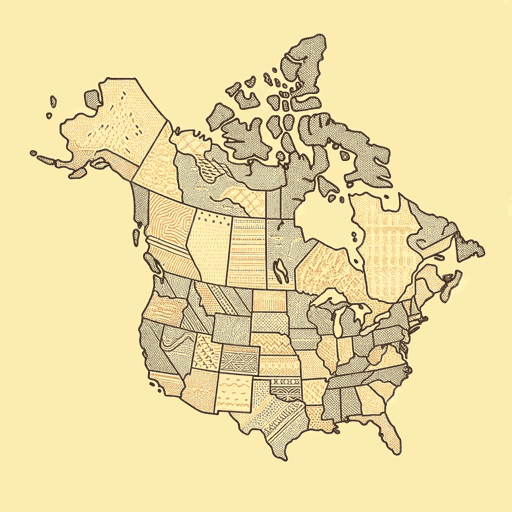
American Nations: A History of the Eleven Rival Regional Cultures of North America
American Nations: A History of the Eleven Rival Regional Cultures of North America
A modern alternative to SparkNotes and CliffsNotes, SuperSummary offers high-quality Study Guides with detailed chapter summaries and analysis of major themes, characters, and more.
Summaries & Analyses
Quizzes
NEWReading Tools
Games
Index of Terms
Alliances
Woodard uses the term “alliances” to refer to the coalitions that form between and among different sections of the country. An alliance is generally a political agreement between nations to cooperate and push forward a common military and political agenda. Woodard is using this term instead to refer to informal coalitions between different parts of the country. For example, Yankeedom, New Netherland, and the Left Coast form the “Northern alliance,” while Appalachia, the Deep South, and the Tidewater form the Dixie bloc. These nations did not sign or agree to a formal alliance, but they have common cultural heritages or interests and often work together politically.
Deep South
The Deep South is one of the 11 nations Woodard identifies and one of two key regions in his discussion of The Regions at Loggerheads (the other being Yankeedom, the Deep South’s long-time rival). Woodard’s use of the term is more expansive than the common definition, as it encompasses not only Alabama, Mississippi, Louisiana, Georgia, and eastern Texas but also Florida, South Carolina, and parts of Tennessee, North Carolina, and Arkansas. What these regions have in common is the legacy of slavery and, more specifically, a particularly brutal and caste-based form of slavery imported by planters from the West Indies; the region is, according to Woodard, committed not only to white supremacy but also to hierarchical society broadly, as it views the privileges of an elite few as hinging on the subjugation of the masses. The region gained power as cotton supplanted tobacco (more common in the Tidewater) as the US’s principal cash crop but was defeated in the Civil War. In the 20th and 21st centuries, it has found allies in Greater Appalachia and the Tidewater, although their interests do not always coincide.
El Norte
El Norte refers to the region on either side of the US-Mexico border (stretching further into each country’s interior in some regions than in others) and is one of the 11 nations Woodard’s book identifies. Its first European settlers were Spanish, and it remains heavily Hispanic not only in population but in culture. In US politics, it represents an unaligned region that Woodard projects will have greater sway as the Hispanic American population grows. Woodard suggests that El Norte is likely to align itself with Yankeedom due to the Deep South’s commitment to white supremacy, though in the years since the work’s population, Hispanic Americans have arguably moved increasingly toward the Republican Party, which dominates in the Dixie bloc.
“The Errand in the Wilderness”
The “errand in the wilderness” refers symbolically to the Puritans’ drive to make the world around them conform to their way of being. The Puritans founded Boston as a “city upon a hill,” or a model to the rest of the world of what a society should look like, and their descendants have extended to other areas this impulse to remodel the world.
When Puritans went west, to areas in the Midwest and to areas of the West Coast north of Monterey, they brought along this desire to impose their utopian vision on the world around them. They did not merely venture into the wilderness, as did the Appalachians, but rather recreated their well-ordered, middle-class villages, self-governmental systems, and Protestant work ethic wherever they went. This has put them at odds with several of the US’s other regional groups, which are variously more individualistic, more elitist, or more skeptical of governmental power.
Far West
The Far West is one of the 11 principal nations Woodard identifies and the last to be colonized. It is bordered on the north and south by First Nation and El Norte, respectively; in the US, its eastern boundaries lie in the Great Plains and its western boundaries at the mountain ranges that run through California, Oregon, and Washington. Its harsh environment means that large-scale agriculture and urbanization are possible only with substantial government and corporate support; consequently, the region compromises on its general ethos of individualism when self-preservation is at stake. Woodard notes that while the region has generally sided with the Dixie bloc in recent political history, there are some signs it is moving toward Yankeedom; since the book’s publication, this trend has continued, with Nevada and Arizona emerging as swing states.
First Nation
“First Nations” is a term often used to refer to the Indigenous peoples of Canada who are not Inuit or Métis. Woodard, however, uses it to refer to the uppermost regions of Canada, including those with sizeable Inuit and Métis populations, as this area has largely preserved its Indigenous character across time. This region, one of the 11 nations Woodard identifies, plays a key role in his argument about The Resurgence of Cultural Minorities, as Indigenous peoples have recently gained more autonomy from Canada at large.
Greater Appalachia
Greater Appalachia is one of the 11 American nations Woodard profiles. Though its origins lie in Scottish, Scotch-Irish, and Northern English immigration to the Appalachians, it has since expanded to include the Ozarks and parts of Ohio, Indiana, Illinois, Oklahoma, and Texas; in addition, its individualistic streak would have an influence as far west as the Left Coast, where some residents of Greater Appalachia eventually settled. The original settlers of Appalachia were often poor, lacking in education, and highly resistant to authority, causing friction with several other regional groups. Perhaps relatedly, the region’s allegiances have been fluid throughout much of US history; during the Civil War, much of Greater Appalachia sided with the Union, but it has more recently become part of the “Dixie bloc” due to both religious affinity and the perceived economic threat posed by people of color.
Left Coast
The Left Coast, one of the 11 nations Woodard identifies, consists of the western coastal regions of the US and Canada north of Monterey. Its utopian culture is similar to that of Yankeedom but incorporates an individualist strain from the residents of Great Appalachia who moved there during the Gold Rush. In the 20th and 21st centuries, it is one of Yankeedom’s staunchest allies, making it a key member of the “Northern alliance.”
Midlands
The Midlands is Woodard’s term for the nation founded by English Quakers and Pennsylvania Dutch; it also attracted substantial German and Scandinavian immigrant populations. It encompasses parts of New Jersey, Delaware, Maryland, Pennsylvania, Ohio, Indiana, Illinois, Missouri, Iowa, Nebraska, Kansas, and South Dakota and extends into Ontario, Canada. Culturally, it is tolerant of diversity, skeptical of government, and pacifist in temperament—a combination of traits that does not wholly align with either Yankeedom or the Deep South. The Midlands thus emerges as one of the “swing” regions in Woodard’s account, although some states in this region (Iowa, Ohio, etc.) have shifted in a more Republican direction since the book’s publication.
Nations
Woodard refers to the different cultural and political regions of the United States and Canada as nations rather than regions. His intent is to stress that these areas are not merely just parts of the United States but are separate from each other, with their own cultural histories, belief systems, and politics. He writes that “a nation is a group of people who share—or believe they share—a common culture, ethnic origin, language, historical experience, artifacts, and symbols” (3). Unlike smaller, more cohesive nations, the US is divided into areas that are culturally so different that they are more like different nations.
New France
New France, one of the 11 nations Woodard highlights, is largely synonymous with modern-day Québec but also encompasses southern Louisiana and parts of New Brunswick. Woodard describes it as the most liberal and tolerant nation in North America and notes that in Canada, it has grown increasingly autonomous in recent years.
New Netherland
New Netherland consists of modern-day New York City and its surrounding areas. Founded by the Dutch as a trading outpost, it has a long history of multiculturalism coupled with a commitment to enterprise. Although the latter has at times led it to support conservative political causes, in the 20th and 21st centuries, it has become a core member of the “Northern alliance” alongside Yankeedom and the Left Coast.
The Tidewater
The Tidewater, or modern-day Virginia and Maryland along with parts of North Carolina and Delaware, shared some of its early history and culture with the Deep South. The English who settled there were largely royalists and thus committed to a hierarchical class structure; they also practiced slavery, albeit with more social mobility than would become common in the Deep South. The Tidewater was an influential region in colonial and early America, but its influence declined as cotton came to dominate the economy and as residents of other regions expanded westward. Due to similarities in culture and history, it has often found itself in somewhat ambivalent alliance with the Deep South, and Woodard describes it as part of the modern-day “Dixie bloc”; however, some states in this region (e.g., Virginia) have moved in a more Democratic direction since the book’s publication.
Yankeedom
Yankeedom is one of two nations that Woodard argues have driven conflict within the US (the other being the Deep South, its ideological opposite). Yankeedom originated with the Puritan settlers of New England but later spread across the upper Midwest and into the Canadian Maritime. While the region’s particular religious beliefs have changed over time, its core commitment to creating a moral society has not; it values education, enforces cultural cohesion, and promotes government as a means of solving social ills. This culture has often brought it into direct conflict with the Deep South; it was the center of abolitionism in the 19th century, for example, and in the 20th and 21st centuries, its “Northern alliance” with New Netherland and the Left Coast has squared off against the “Dixie bloc.”

Get in-depth, chapter-by-chapter summaries and analysis from our literary experts.
- Grasp challenging concepts with clear, comprehensive explanations
- Revisit key plot points and ideas without rereading the book
- Share impressive insights in classes and book clubs