And Then, Boom!
51 pages • 1-hour read
Lisa FippsAnd Then, Boom!
A modern alternative to SparkNotes and CliffsNotes, SuperSummary offers high-quality Study Guides with detailed chapter summaries and analysis of major themes, characters, and more.
Important Quotes
Content Warning: This section of the guide contains descriptions of child abuse, starvation, and extreme poverty.
“I flew like Superman. Once.”
(Page 17)
This quote from the beginning of the novel alludes to the climactic moment when Joey flies through the air during the tornado. Framing this experience as a superhero action allows him to reframe this helpless moment as one of power and freedom, recontextualizing a highly chaotic, dangerous experience as something freeing and triumphant.
“It’s almost impossible to live with an itch.”
(Page 21)
In this quote, Joey tries to relate to “the itch” that his mother feels to run away from her life and family. However, he qualifies his statement with the word “almost” to hint that others—like him—are resilient enough to face their troubles even if his mother is not.
“All I wanted was to hold the butterfly, but every time I got close to it, it took off.”
(Page 23)
Joey recounts this anecdote and uses it to symbolize his relationship with his mother, who wears a butterfly-themed scarf and thinks of herself as being free like a butterfly. In this scene, Joey attempts to catch a literal butterfly but cannot get close to the fragile creature. This dynamic symbolizes the ineffectual dance of his relationship with his mother, who refuses to engage in any form of emotional closeness with him and eventually abandons him altogether.
“Grrr! Slap! Ouch! Shhh.”
(Page 27)
Joey uses comic book-style onomatopoeia to describe his mother’s violence toward him. In this short impressionistic quote, he captures the entire sequence of verbal and physical abuse, his pained reaction, and his mother’s callous order to remain silent in the aftermath of the incident. Even as he illustrates his helplessness in the face of this treatment, his comic-book language gives the scene a more remote feel, allowing him to maintain emotional distance from the pain. This stylization shows how he uses language as a coping mechanism when direct description is too painful.
“Anyone who saw me thought I was just throwing rocks into the water. No one knew I was imagining throwing them at Mom.”
(Page 36)
This moment reveals Joey’s concealed and suppressed anger at his mother for her many abuses and injustices. By masking his deep distress as a mundane activity, Joey maintains his covert approach to the world, and the contrast between external appearances and internal emotions underscores his isolation and the weight of his unprocessed pain.
“It’s amazing how easily you can make a truth into a lie and a lie into a truth.”
(Page 48)
In this bitter moment, Joey reflects on the fact that language is so adaptable that he can use it to recontextualize his poverty and hide it from his friends. This line also highlights Joey’s inability to focus on Addressing the Social Stigma of Poverty, for he compromises his moral center in order to maintain the secret that he and his grandmother are living in their car.
“If you’re here, you’re family.”
(Page 56)
Uncle Frankie’s welcoming phrase signals his unconditional support of Joey and his grandmother, standing in contrast to Joey’s unstable past. The line offers the boy a rare moment of safety and acceptance and redefines the very concept of family to include a broader support network that transcends blood. The sentiment that goes unspoken is that Frankie proves to be a much more reliable family member that Joey’s mother ever was.
“If I doodled poverty, I’d draw a reticulated python twisted into the shape of the infinity symbol.”
(Page 77)
Joey personifies poverty as a python that wraps around him and squeezes him in its suffocating, inescapable grip. The infinity shape also combines with this oppressive idea to emphasize Joey’s belief that his poverty and desperate circumstances will never end.
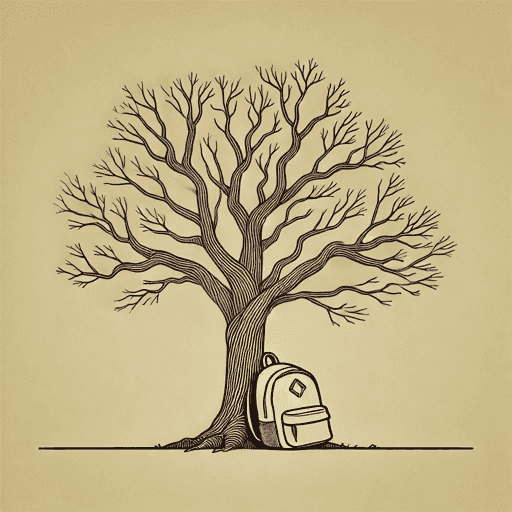
“Yes, and because oaks are like us. Each season, they face storm after storm. Some real doozies. But they keep standing. Growing. Adapting. Surviving.”
(Page 103)
This simile likens Joey Oak and his family to the oak trees that are their namesake. The scene explicitly emphasizes the trees’ ability to weather difficulties, and it is clear that Joey internalizes this image of himself as well. The sequence of present participle verbs reinforces the idea that Joey’s resilience is present and continuous.
“No! I shout. No! No! No! This doesn’t add up! You’re lying! You always lie! Let me see Grandmum!”
(Page 109)
Faced with the reality of his grandmother’s death, Joey’s outburst shows that his first panicked reaction is to deny this news with a level of rawness that suggests an internal tornado of grief. His defiant repetition of “No!” conveys his desperation, and when he accuses his mother of lying, his accusation shows his fundamental distrust of her.
“I get it. I understand the Itch. It’s all about leaving behind everything and everyone that reminds you of anything bad.”
(Page 138)
In this moment, Joey drives away from town with his mother and gains a new understanding of her psychology and her inability to deal with people and places that evoke negative emotions or require challenging work. By seeking to understand the metaphor of “the Itch,” Joey shows his deep empathy for his mother. Rather than expressing his anger toward her neglect, he tries to rationalize and apologize for her egregious behavior.
“BOOM! Mom got The Itch. She left me.”
(Page 147)
This moment marks a major turning point in the plot when Joey’s mother abandons him entirely. His abrupt statement mirrors the sudden, explosive nature of his mother’s departure. The onomatopoeia “BOOM!” likens her choice to the impact of a sudden disaster, such as a bomb going off. By expressing this catastrophe in comic-book terms, Joey finds a way to process the magnitude of his mother’s chaotic damage.
“It’s pretty cool having a superhero for a teacher. Over and over again, Mrs. Swan uses her powers to change things for the better.”
(Page 172)
Joey frames Mrs. Swan as a superhero, emphasizing that her steady care and advocacy feel extraordinary to someone like him, who lacks critical adult support. The metaphor underscores the quiet power of kindness and the heroism that comes from caring for both the physical and emotional needs of the students.
“So just like that, my money’s gone.”
(Page 189)
This line conveys how fragile Joey’s financial situation is as he realizes that even small expenses can have enormous consequences. The phrase “just like that” captures the helplessness that Joey feels in the face of his economic precarity, and he expresses his fear and anxiety over how quickly the squeeze of poverty returns.
“Doomsday threw a right hook! Turned off the electricity.”
(Page 197)
In this line, Joey uses the imaginary supervillain persona of Doomsday to put a face to his battles against critical hardships that result in a cascade of misfortunes. Due to the loss of power, he also loses his food supply when all the food in his fridge spoils, leaving him on the brink of starvation. By turning his material losses into part of a battle narrative, he uses bombastic language that helps him maintain emotional distance and gain the motivation to “fight back” against his circumstances.
“Crunch. Squish. Ooze. Slime slips between my fingers.”
(Page 207)
Joey uses onomatopoetic language to describe his physical disgust and aversion to the experience of dumpster-diving in order to mitigate his hunger. This language frames the dumpster-diving as a comic book episode. By likening his endeavor to a battle, Joey gains some distance from this degrading episode, placing it in a context that gives him hope for a happy ending.
“I tell myself kibble is kinda like cereal.”
(Page 212)
Joey rationalizes eating dog food by comparing it to cereal, highlighting how hunger distorts his reality and pushes him to do things that he would not normally do. In this moment, he uses language as a coping mechanism to reframe the idea of the food and make it more palatable and less humiliating.
“I pretend the entire show is just for me. Because it’s my twelfth birthday.”
(Page 220)
In this moment, Joey creates a private fantasy to make up for the fact that he is spending his birthday alone, starving, with nobody to celebrate him or make him feel loved. This act of self-recognition contrasts with the neglect that he has experienced from the adults in his life and highlights the tragedy of his situation.
“And then, BOOM. The funnel cloud touches down on the ground.”
(Page 232)
This climactic moment when the tornado touches down mirrors the other “BOOM” moment when Mom abandons Joey, solidifying the metaphorical link between tornadoes and her decision to abandon him. The “BOOM” also echoes comic book language, but in this case, it marks an escalation in physical danger that mirrors the emotional turmoil Joey has been facing.
“I’m hiding in my safe space…as the tornado turns into Mom.”
(Page 235)
In this scene, Joey explicitly fuses the natural disaster with his own personal trauma, transforming the tornado into a symbol of his mother’s destruction. The grove of trees, Joey’s “safe space,” becomes psychologically loaded as it serves as a literal shelter and an emotional coping mechanism.
“I knew this moment would come. I knew the day Mom left. I just couldn’t admit it.”
(Page 246)
This line captures the painful clarity of hindsight when Joey must accept that his mom is not coming back for him. In this moment, he finally acknowledges a truth that he has suppressed, admitting that he has been using denial as a survival tactic and as a way to stave off the emotional toll of his mother’s abandonment.
“Outside my room, I hear workers use the words malnutrition, dehydration and so sad.”
(Page 248)
This eavesdropped moment makes Joey aware of how the adults in the hospital view his situation clinically and with pity. The juxtaposition of medical terms and emotion reveals that systemic neglect is both a physical problem and an emotionally charged issue. At this moment, Joey understands that he can no longer hide his starvation, and he paradoxically feels a release from the self-imposed burden of keeping his worsening crisis a secret.
“Olivia kept talking, but all I hear is brother.”
(Page 263)
When his new foster sister uses the word “brother” to refer to him, her casual acceptance of Joey overwhelms his senses, signaling that he has finally found a crucial sense of connection and belonging. His intense emotion marks a potential turning point in which he begins to imagine himself as part of a stable family structure.
“Give Joe and the dogs a minute to get used to all this, to get used to us.”
(Page 267)
In this moment, Mike notices that Joey will need some time to adjust to his foster family. Mike’s consideration signals that Joey has finally found a supportive and safe home that will allow him the space he needs to heal on his own timeline. This line shows that healing from trauma is a lengthy process that requires a lot of patience and community support.
“Even the strongest person needs help from others.”
(Page 287)
This line marks the completion of Joey’s character arc as he recognizes that receiving help does not make a person weak. After suffering so much and trying to survive on his own, Joey is ready to live his life more openly, seek help from his community, and maintain his self-respect through it all.

Unlock every key quote and its meaning
Get 25 quotes with page numbers and clear analysis to help you reference, write, and discuss with confidence.
- Cite quotes accurately with exact page numbers
- Understand what each quote really means
- Strengthen your analysis in essays or discussions