And Then, Boom!
51 pages • 1-hour read
Lisa FippsAnd Then, Boom!
A modern alternative to SparkNotes and CliffsNotes, SuperSummary offers high-quality Study Guides with detailed chapter summaries and analysis of major themes, characters, and more.
Symbols & Motifs
Content Warning: This section of the guide contains descriptions of child abuse and extreme poverty.
Storms and Tornadoes
Throughout the novel, storm-related imagery is often used to describe Joey’s mother, who stands as a deeply unpredictable and destructive force in the protagonist’s life. Just as his mother’s legal troubles initially lead to the loss of the Gingerbread House, the tornado in the novel’s climactic scene destroys Joey’s mobile home and catapults him unto utter chaos, standing as the culmination of his precarious life circumstances. Thus, the tornado is both a literal and symbolic force that functions as a metaphor for Joey’s mother and the emotional chaos she brings into his life.
Long before it finally appears in truth, the tornado itself is foreshadowed throughout the novel. Several characters mention storm preparations, and Nick explicitly warns Joey that everyone must run to the shelter if a storm comes. Likewise, Grandmum reminds him to grab the accordion folder of important documents if there is ever a storm. The threat of a storm looms over Joey, foreshadowing an irresistible, external force that will one day upend his life. Joey also associates this image with the unpredictability and destruction that his mom brings to his life, and storms therefore become a visual equivalent of her dangerous presence; both are sudden, overwhelming, and capable of leaving long-term damage in their wake.
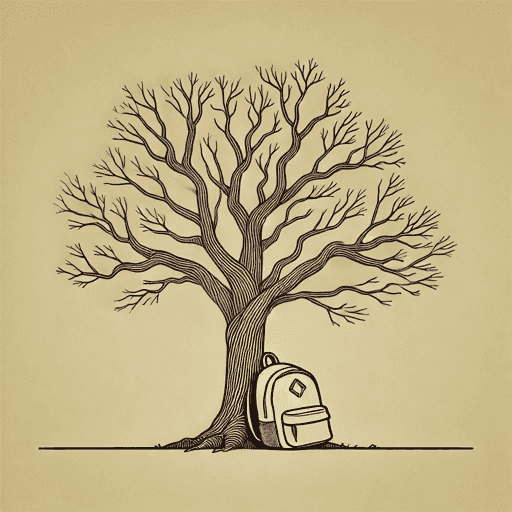
Joey’s understanding of the tornado mirrors his understanding of his mother as a force of nature that he must endure. There is a fatalistic quality in his relationship with his mother and with the storm, for he only focuses on how to survive these circumstances. This outlook reflects a deep emotional defense mechanism, suggesting that Joey has learned to anticipate and manage damage and chaos. The tornado therefore becomes a symbolic shorthand for his resignation to living with trauma. However, when the tornado snaps the rope tying him to the oak tree, it symbolically separates him from his mask of oak-like stoicism, ridding him of his misguided determination to endure trauma without help.
Superheroes and Supervillains
The motif of superheroes runs throughout the novel, providing Joey with a narrative framework for understanding his life and the people around him. Superhero language and comic book logic help him process experiences that are otherwise too painful or complex to confront directly. The superhero stories give Joey hope and “something to believe in” (19). He sees the people who protect and support him like Grandmum, Nick, and Hakeem as superheroes. Likewise, he also has a tendency to personify the misfortunes that come his way, seeing them in the context of attacks by supervillains like Doomsday. These metaphors help him to distinguish between those who hurt and those who help, offering a sense of clarity in a world often defined by emotional confusion.
Joey also uses the onomatopoetic language of comic books to describe the emotional shock of traumatic events, as when his mother hits him. Sound effects allow him to describe the moment without naming it directly, and this approach gives him emotional distance and allows him to protect himself from the rawness of the memory. In one poem, Joey recounts a scene of physical abuse in mere seconds by invoking the sounds “Grrr! Slap! Ouch! Shhh!” (27). These comic-book sound effects imply a scene in which his mother yells at him, hits him, hurts him, then demands his silence. When he frames his worst experiences as coming from a villain named Doomsday (a personification of all the things that go wrong in his life), Joey reimagines his life as a structured narrative in order to cling to the belief that he is not just a victim of random hardship, but a protagonist in his own superhero origin story. This mindset opens the possibility of transformation and redemption, and he chooses to hope that there is a purpose to his suffering and that his difficult life will lead him to a better outcome.
The Luckies
Even at his lowest point, when he is starving and alone, Joey cannot help but look after a family of abandoned dogs, which he collectively names the Luckies. Joey acknowledges that the dogs are symbolic of his own experience. Just as Joey has been abandoned, the dogs have been callously discarded by their owners. Taking care of the Luckies therefore becomes a way for Joey to express the empathy that he himself craves to receive, and he builds a little community for himself even when his friends are away for the summer. By feeding, sheltering, and loving these animals, he offers them the safety and constancy that his grandmother provided him and that he now lacks.
The Luckies also represent sacrifice, especially when Joey sacrifices his own health and safety to continue caring for the dogs when he has run out of food. The dogs continue to grow even as Joey starves. It is clear that unlike his mother, who lacks the resilience to face hard things, Joey is willing to suffer significantly to do what is right for the dogs. By the end of the novel, he considers the Luckies to be his family and refuses to be separated from them in foster care. In this way, he builds a family for himself despite his mother’s abandonment.

Unlock the meaning behind every key symbol & motif
See how recurring imagery, objects, and ideas shape the narrative.
- Explore how the author builds meaning through symbolism
- Understand what symbols & motifs represent in the text
- Connect recurring ideas to themes, characters, and events