Assassination Vacation
50 pages • 1-hour read
Sarah VowellAssassination Vacation
A modern alternative to SparkNotes and CliffsNotes, SuperSummary offers high-quality Study Guides with detailed chapter summaries and analysis of major themes, characters, and more.
Chapter 1Chapter Summaries & Analyses
Chapter 1 Summary
Vowell recounts seeing the musical about the Founding Fathers, 1776, at Ford’s Theater, where Lincoln was assassinated. Although the interior of Ford’s Theater had “collapsed” (22), by 1968 the National Park Service had restored the theater’s interior to what it was when Lincoln was assassinated. She sees the irony in being present at Ford’s Theater during Act II of 1776, which focuses on the debate over enslavement between the Founding Fathers, since it was a similar debate that motivated the pro-enslavement John Wilkes Booth to assassinate Abraham Lincoln.
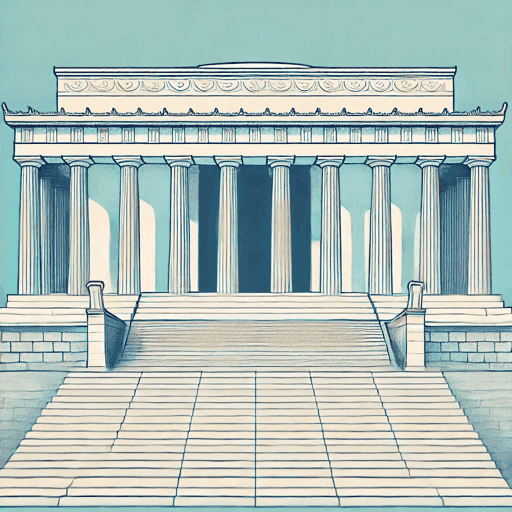
At the Lincoln Memorial, two of Lincoln’s speeches—the Gettysburg Address and the Second Inaugural—are engraved on the wall. Vowell describes the Second Inaugural as “prophetic, biblical, merciful, tough” (26). She also wonders how Booth could kill the person who gave such a speech. Even so, Vowell reflects that, given the number of death threats Lincoln received, “the fact that Lincoln got to serve his whole first term is a kind of miracle” (28).
Next, Vowell has a meal at Wok & Roll, a Chinese restaurant in Washington, DC that exists at the site of Mary Surratt’s boardinghouse, where Booth and his co-conspirators plotted Lincoln’s assassination. A famous actor, Booth may have also been a spy for the Confederacy during the US Civil War. Originally, their plan was to kidnap Lincoln and exchange him for important Confederate prisoners-of-war. The objective changed to assassination after the Confederate general Robert E. Lee surrendered at Appomattox, Virginia on April 9th, 1865, ending the Civil War.
Booth wanted to kill not only Lincoln, but also have his co-conspirators kill Vice President Andrew Johnson and the Secretary of State, William H. Seward. Johnson’s would-be assassin, George Atzerodt, could not bring himself to even make the attempt, while Seward’s designated assassin, Lewis Powell, managed to stab Seward while he was recovering from an illness, but was driven off by Seward’s sons and another man. Seward would recover from his wounds. The bloodstained and damaged bedsheet from the night of the assassination attempt is still at the William Seward House in Auburn, New York.
Vowell recounts showing her friend Bennett a plaque commemorating the house where Seward was nearly assassinated. Despite being a history buff, Bennett is disappointed, with “Stewart plaque” becoming “[their] synonym for disappointment” (34). At Saxman Village near Ketchikan, there are two totem polls, each one dedicated to Sewart and Lincoln, made by the Tlingit native people of Alaska. The totems were made because Seward was responsible for the decision to purchase Alaska from Russia.
William Powell’s skull was buried at Geneva Cemetery in Florida, next to the grave of his mother. Vowell visits the grave with her sister Amy and nephew Owen. She also visits the “former home of Henry and Clara Rathbone […] at 712 Madison Place” (43-44) which is in the present-day the Office of the President’s Council on White House Fellowships. Henry Rathbone and Clara Harris were sitting with Lincoln the night he was assassinated and Rathbone was stabbed in the arm when he tried to stop Booth from escaping. Henry and Clara married and moved to Germany. Haunted by accusations that he failed to save Lincoln, Rathbone “went slowly insane” and “shot and killed Clara in Germany just as Booth had shot Lincoln” (44).
Instead of the Rathbones, originally the Lincolns’ companions for the night were supposed to be General Ulysses S. Grant and his wife. They were attending a comedy, Tom Taylor’s Our American Cousin. Booth timed shooting the president “to coincide with a surefire laugh line” (46). After Lincoln was shot, a surgeon in the audience, Charles Sabin Taft, tried to treat Lincoln in the Petersen boardinghouse. There, Lincoln died. At the National Museum of Health and Medicine, the tools and the bullet used in Lincoln’s autopsy remain on display.
After Booth shot Lincoln, he jumped to the stage, shouting the state motto of Virginia, “Sic semper tyrannis!” (“Thus always to tyrants”) (52). Vowell and her friend Klem follow the historical trail of Booth. The “first stop” (53) is Clinton, Maryland where the Surratt House Museum is on the same site that Booth stopped while trying to escape authorities. During the Civil War, Maryland stayed in the Union, but it was a “no-man’s-land with the North at its door and the South in its heart” (56).
Vowell also notes that when Timothy McVeigh bombed the Murrah Federal Building in Oklahoma City, he wore a t-shirt that had a picture of Abraham Lincoln with the words, “Sic semper tyrannis,” under it. The shirt was purchased from a “pro-Confederate magazine” (57), Southern Partisan. The same magazine was praised by a Missouri senator, John Ashcroft, who later became the attorney general under George W. Bush.
On her trip in Maryland, Vowell visits the Dr. Samuel A. Mudd House, where “Booth arrived […] in the middle of the night, seeking medical care for his broken leg” (59). Historians have debated whether or not Mudd was a knowing accomplice, even though he was convicted and imprisoned for aiding Booth and was pardoned for treating his fellow prisoners “during a yellow fever outbreak at the prison” (60). Samuel Mudd’s grandson Richard advocated for clearing his grandfather’s name. However, Vowell argues that Mudd knew Booth was an assassin, but she admires the efforts of his descendants “to redeem the reputation of a relative who’s been dead for more than a century” (62).
Vowell relates to the Mudds since her own ancestor, John Vowell, participated in 1863 in a pro-enslavement massacre in Lawrence, Kansas led by a pro-enslavement guerilla fighter, William Clarke Quantrill. It was Quantrill who also planned to assassinate Lincoln and celebrated Booth’s murder of Lincoln.
Next on Vowell’s itinerary is Fort Jefferson at Dry Tortugas National Park, where Mudd and several other co-conspirators with Booth were imprisoned. Named after Thomas Jefferson, Fort Jefferson was an unfinished coastal fort meant to guard passage into the Gulf of Mexico that was converted into a federal prison. All of the Booth co-conspirators who were not executed in Washington, DC were imprisoned there. Conditions at Fort Jefferson were “harsh” (71).
Mudd medically treated fellow prisoners when Fort Jefferson experienced an outbreak of yellow fever, which killed one of the co-conspirators, Michael O’Laughlin. Vowell recounts how a park ranger named Mike explains to her that Mudd only tried to escape once he had Black guards. Mike also informs Vowell that some visitors believing in Mudd’s innocence come to see his cell as if on a “pilgrimage” (76). Vowell compares Fort Jefferson to Guantánamo Bay, where the US government is keeping “more than six hundred prisoners of the War on Terror” (80). As with the prisoners at Fort Jeferson, there are allegations of the poor treatment of prisoners.
Booth was “shocked” that his action was not seen “as a courageous act of southern patriotism” but instead as a “treasonous crime of an evil lunatic” (81). Vowell argues this was because, despite Booth’s own racism and support of enslavement, he had been inspired by the execution of John Brown in 1859. Booth “adored Brown’s fight-picking, gun-toting methods” (83) and noted the admiration Brown received across the North from the public and famous poets like Ralph Waldo Emerson. He even attended Brown’s execution at Charles Town, Virginia. Vowell visits Charles Town, where a house is now on the spot of Brown’s execution and a bird feeder is on the tree where Brown was hanged.
During the visit to Charles Town, Vowell happens to be staying at the Washington Hilton hotel, where John Hinckley shot President Ronald Reagan and his press secretary James Brady in 1981. After Brady’s gun injuries made him a paraplegic, he and his wife Sarah founded the Brady Campaign to Prevent Gun Violence. By contrast, Reagan spoke to the National Rifle Association (NRA) in support, even though “backing an organization lobbying against (especially) the control of handguns is against the self-interest of every president” (85). Vowell notes that every 20th-century presidential assassination attempt except the assassination of John F. Kennedy was done with a handgun.
Vowell next visits the spot near Port Royal, Virginia where Booth died. Booth had been shot by soldiers in the barn where he was hiding. Near the site is a diner/gas station that sells Confederate memorabilia. She decides “to give this place the benefit of the doubt” (87) and assume that the Confederate memorabilia being sold is in recognition of a nearby Civil War battlefield. Vowell also notes that the state government sign at the site of Booth’s death carries Virginia’s state motto, Sic semper tyrannis, which is also what Booth shouted. For Vowell, this “feels like the stamp of approval” (88).
After this, Vowell goes to Green Mount Cemetery in Baltimore, Maryland where Booth was buried with a secret funeral by his family. She recounts a conspiracy theory that Booth was secretly working with the government of Lincoln’s successor, Andrew Johnson, and was given a new identity as Finis L. Bates and relocated to Texas. Later, under another alias, David E. George, he moved again to Oklahoma. The body of David E. George after his death was mummified and displayed at carnivals as the body of Booth. Even though the evidence for this is “dodgy” (91), Booth’s descendants in 1995 petitioned a court to exhume Booth’s body. The petition was denied because of the “strong historical evidence that Booth has been buried at Green Mount all along” (92) and because the exact location of his body is unknown.
At the Müller Museum in Philadelphia, a museum dedicated to the medical study of human remains, Vowell looks at a specimen labelled, “Piece of John Wilkes Booth, Assassin of President Lincoln” (93). She interviews the director of the museum, Grechen Worden. When asked about the Booth specimen, Worden admits she feels sorry for John Wilkes Booth, remarking, “‘He was a sorry figure. He just didn’t get the big picture’” (96). She also remarks that, while today Lincoln is viewed as a “saint” (96), people today have forgotten that many people hated Lincoln and wanted him dead. Worden also speculates that, like saints’ relics, people value the remains of a dead historic figure or loved one because it provides “a sense of connection to the past” (98).
In her home of New York City, Vowell remarks that she often sees reminders of Booth’s brother, Edwin, a famous Shakespearean actor. Their father, Junius, was also famous for performing in Shakespeare plays. After the assassination of Lincoln, Edwin “retired from acting out of shame when he heard that his brother was the president’s assassin” (102) but financial need caused him to return to acting. Despite being associated with Lincoln’s assassin, Edwin remained beloved by the general public.
Lincoln is buried beneath an obelisk at Oak Ridge Cemetery in Springfield, Illinois. At the cemetery is the Museum of Funeral Customs, which contains exhibits like a recreation of a 1920s embalming room. Brochures at the museum explain the fact that the embalming of Lincoln’s body promoted the recently formed embalming industry.
Lincoln’s house in Springfield has also been preserved and made a historical site. Vowell remarks that she nonetheless feels “closer” to Lincoln “sitting on [her] couch reading [her] paperback copy of his Selected Speeches and Writings” (111-112). The site historian Tim Townsend points out that the house’s décor reflects the tastes of Lincoln’s wife, Mary Todd Lincoln, instead of Lincoln himself. In response to Vowell’s questions, Townsend says that, when speaking with visitors, they tend to leave out the fact that Mary Todd was institutionalized for mental illness by her son.
Another site where Lincoln was memorialized is the Freedman’s Memorial at Lincoln Park in Washington, DC. At its dedication on April 14th, 1876, the formerly enslaved writer Frederick Douglass “gave a speech” (117). In his speech, Douglass did not shy away from unflattering details about Lincoln, pointing out that Lincoln “cared more about saving the Union than he did about freeing the slaves” (117). At the same time, Douglass declared, that the “‘infinite wisdom has seldom sent any man into the world better fitted for his mission than Abraham Lincoln’” (119).
Chapter 1 Analysis
As Vowell follows the trail and the life of John Wilkes Booth, she is confronted by The Tension Between Patriotism and History. This happens quite literally when, in Virginia, she finds a store where “displayed right alongside the Confederate flag paraphernalia is a bunch of American flag merch” (87). The clash between the US and Confederate symbols is part of Vowell’s efforts to reconcile the grimmer facts of the United States’ history with her own patriotism. The Confederate memorabilia implies that there are still people who dislike Lincoln and the emancipation of Black Americans, which speaks to the continuing threads of racism and discrimination in the USA.
Vowell’s narrative often suggests that the negative elements of American history only accentuate the heroic and the good elements. In her assessment of Frederick Douglass’s eulogy for President Lincoln, she claims Douglass showed “how time and circumstance and experience changed [Lincoln] and deepened him and emboldened him to not just say the right thing and not just personally do the right thing, but make right the law” (119). Vowell thus tends to suggest that the good outweighs the bad in American history, and her tone tends to lean more towards being celebratory than critical. This emphasis reflects Vowell’s own commitment to patriotism and further illustrates her claims that American history and its ideals are akin to a religious faith for her.
Both the Confederate flags and the historical memorabilia of Abraham Lincoln also reflect The Shaping of Civic Memory. Vowell raises the question of why historical relics and settings possess such a fascination when she writes about the restoration of Ford’s Theater to resemble what it was like at the time of Lincoln’s assassination. While Vowell does not provide an explicit answer, she does return to her comparison between the impulse to see historical items and to experience religious icons. She cites one park ranger describing the site of Fort Jefferson as “like a pilgrimage” (76, emphasis added). Another museum curator states, “the importance of the relic, the importance of the little sacred icon, is a sense of connection to the past. To look on a tooth, look at George Washington’s teeth, to look at instruments that were actually handled by Joseph Lister, there’s power in there” (98, emphasis added). A historical relic can give the past and one’s personal connection to that past or to a community or nation meaning.
Nonetheless, civic memory can be mistaken and oversimplify the past as well: Vowell points this out when she notes that John Wilkes Booth was “not the raving madman of assassination lore, but a calculating, philosophical racist” (23). The obscuring of Booth’s methodical approach and racism risks sanitizing who he was and what he was motivated by, which suggests that there can be a downside to approaching the past with a religious or mythical attitude instead of a more objectively factual one.
Lincoln’s assassination and the life of John Wilkes Booth also inevitably lead Vowell to address The Impact of Political Violence in American History. When the curator reflects on how Booth “didn’t get the big picture” (96), this is part of a wider discussion of how Booth falsely convinced himself that the assassination of Lincoln would be a popular act. Nor could Booth predict how much of a “saint” (96) Lincoln would become in American history. Such an example reflects Vowell’s broader view of the futility and counterproductive nature of political violence. Booth’s murder of Lincoln neither reversed the emancipation of Black Americans nor secured him any lasting popular support in the national imagination of most Americans—all it did was give Lincoln a premature, violent death.

Unlock all 50 pages of this Study Guide
Get in-depth, chapter-by-chapter summaries and analysis from our literary experts.
- Grasp challenging concepts with clear, comprehensive explanations
- Revisit key plot points and ideas without rereading the book
- Share impressive insights in classes and book clubs