Assassination Vacation
50 pages • 1-hour read
Sarah VowellAssassination Vacation
A modern alternative to SparkNotes and CliffsNotes, SuperSummary offers high-quality Study Guides with detailed chapter summaries and analysis of major themes, characters, and more.
Important Quotes
“Until that moment, I hadn’t realized that I embarked on the project of touring historic sites and monuments having to do with the assassinations of Lincoln, Garfield, and McKinley right around the time my country iffily went to war, which is to say right around the time my resentment of the current president cranked up into contempt.”
(Preface, Page 6)
This passage is important for two reasons: It helps establish Vowell’s own personal and political perspective, and it also explains why Vowell is interested in presidential assassinations and what motivated the assassins. Further, it sets up Vowell’s own musings on The Impact of Political Violence in American History and why she opposes political violence, even in situations where she disapproves of the president.
“One thing the Spanish king’s Catholicism and my rickety patriotism have in common, besides the high body count, is that both faiths can get a little ethereal and abstract. Jesus and Lincoln, Moses and Jefferson can seem so long gone, so unbelievable, so dead. It’s reassuring to be able to go look at something real, something you can put your hands on (though you might want to wash them afterward).”
(Preface, Page 11)
Vowell’s use of the phrase “rickety patriotism” is critical to understanding Vowell’s own views of The Tension Between Patriotism and History. She genuinely holds positive and patriotic views of the United States and its history, but she is also cognizant of the negative aspects of US history, such as enslavement and atrocities against Indigenous Americans.
“The Declaration of Independence, the Constitution, the Civil War—when I really think about them they all seem about as likely as the parting of the Red Sea. But somehow, jumping up a foot to stare at my own face framed in Lincoln’s Springfield shaving mirror makes the whole far-fetched, grisly, inspiring story of the country seem more shocking and more true.”
(Preface, Page 12)
This passage conveys Vowell’s own sense of patriotism. For Vowell, the story of the United States is one of the conflict between American ideals and crimes. The Civil War and the ending of enslavement is one such example that Vowell finds an inspiring validation of the United States and its potential.
“This script as performed by these actors really does give the audience a feel for the anguish, embarrassment, and disappointment Adams and Jefferson went through yielding to the southerners’ edit. ‘Posterity will never forgive us,’ Adams sighs, caving in.”
(Chapter 1, Page 23)
Vowell’s description of this scene from the musical 1776 serves as another example of The Tension Between Patriotism and History. It illustrates a truthful but non-cynical view of US history that is characteristic of Vowell, although it elides the fact that Jefferson was himself an unrepentant enslaver.
“It is a comfort of sorts to know that the bullet hit Lincoln mid-guffaw. Considering how the war had weighed on him, at least his last conscious moment was a hoot.”
(Chapter 1, Page 46)
One of the recurring points made throughout Assassination Vacation is how Vowell seeks to humanize her historical subjects, especially the presidents. When she reflects on how Lincoln died laughing, she attempts to find some consolation in the idea that he died happy.
“This is where my grandfather paradox turns into the grandfather paradox paradox: to prevent my great-great-grandfather from doing wrong, I myself become a vigilante taking justice into my own hands, shooting somebody because | disagree with him. Which is, of course, wrong and exactly what he did.”
(Chapter 1, Page 65)
One of Vowell’s core beliefs is her opposition to political violence, especially in the context of The Impact of Political Violence in American History. Vowell expresses moral opposition to even the hypothetical of committing violence in order to try to prevent violence. This further suggests that Vowell disapproves of the actions of John Brown, even if she does not explicitly say so.
“So after I get home from the Dry Tortugas…I will click on the Guantanamo link at the Amnesty International Web site and see the headline ‘Human Rights Scandal’ and I will think of Dr. Mudd at Fort Jefferson, digging at the swamp that was his floor.”
(Chapter 1, Page 81)
Frequently, Vowell makes connections between US history and the actions of the George W. Bush administration. She is very open about how her disagreement with the actions of the Bush administration, especially in its treatment of terrorism suspects, its use of torture, and the Iraq War, color her view of history, reflecting The Tension Between Patriotism and History.
“Booth’s admiration of Brown was not ideological. Of course, the racist, pro-slavery, future assassin despised the actual cause Brown was fighting for by attacking the federal arsenal at Harper’s Ferry—namely, to spark a slave rebellion that would put an end to slavery. But Booth adored Brown’s fight-picking, gun-toting methods.”
(Chapter 1, Pages 82-83)
Vowell does not explicitly elaborate on her views on The Impact of Political Violence in American History. However, she does suggest that political violence is ineffective and destructive because it has repercussions, such as Brown inspiring John Wilkes Booth, even though Booth and Brown were on opposite sides on the issue of enslavement.
“It is interesting how, once one edits justifications for violence down to a length suitable for T-shirt slogans, political distinctions between left and right disappear. Emma Goldman, anarchist Russian Jewish advocate of free love and birth control sounds exactly like pretty boy white supremacist murderer John Wilkes Booth.”
(Chapter 1, Page 89)
Along with John Brown, a historical figure who continues to appear in Vowell’s discussions of The Impact of Political Violence in American History is Emma Goldman. Regardless of the motives, for Vowell political violence is always counterproductive and ruinous, regardless of motive and politics. This echoes Vowell’s description of how John Brown’s anti-enslavement violence nonetheless inspired the pro-slavery assassin John Wilkes Booth (82).
“But the importance of the relic, the importance of the little sacred icon, is a sense of connection to the past. To look on a tooth, look at George Washington’s teeth, to look at instruments that were actually handled by Joseph Lister, there’s power in there.”
(Chapter 1, Page 98)
When discussing The Shaping of Civic Memory, Vowell compares religious pilgrimages and historical tourism. This quote suggests that, just as religious relics help people connect to something spiritual or divine, historical relics serve a similar purpose in helping people connect to the past.
“The problem with the fog of history, with the way the taboo against speaking ill of the dead tends to edit memorials down to saying nothing much more than the deceased subject’s name, is that all the specifics get washed away, leaving behind some universal nobody.”
(Chapter 1, Pages 118-119)
One of Vowell’s goals through her informal narrative and her use of humor is to try to humanize historical figures, including both the assassins and their victims. In speaking of how some legacies get whitewashed, she also invokes The Shaping of Civic Memory, drawing attention to how the popular consciousness does not always retain accurate portrayals of past figures.
“With a century and change between the 1880 convention and now, I’ll admit I rolled my eyes at the ideological hair-splitting, wondering how a group of people who more or less agreed with one another about most issues could summon forth such stark animosity. Thankfully, we Americans have evolved, our hearts made larger, our minds more open, welcoming the negligible differences among our fellows with compassion and respect.”
(Chapter 2, Page 130)
Vowell often suggests that history does indeed repeat or at least rhyme. In another comparison between contemporary politics and history, Vowell compares the political divisions between Stalwart and Half-Breed factions of the Republican Party with the divisions between liberals over supporting the Democratic candidate Al Gore and the third-party candidate Ralph Nader.
“But Valesky inspired me to think about the claustrophobia of American culture in the eighteenth and nineteenth centuries, how women like me would have given anything for a freewheeling life with Drifter Magnet and Muffin Day instead of being doomed to a choice between Mother Superior and Husband Your Parents Picked.”
(Chapter 2, Page 150)
Vowell often uses humor to make important points about history. Here, she draws on humor and her personal perspective to illuminate the status of women in the United States before the 20th century.
“When Charles Guiteau looked in the mirror he did not see a raggedy homeless man, a wife beater, a dud. He saw the ambassador to France. He wasn’t out of work. No, sir. Charles J. Guiteau was ‘in the employ of Jesus Christ & Co.’”
(Chapter 2, Page 174)
Vowell suggests that assassins, ironically like presidents, are motivated by a “narcissistic creep” (7). This passage fits with Vowell’s view of presidential assassins’ motives, as she argues against the traditional historical narrative that Guiteau only sought revenge for being denied a civil service job.
“The unforeseen pleasant surprise about traveling around the country researching historical ugliness is that I seem to luck into a lot of present-day kindness, making the acquaintance of an embarrassment of knowledgeable nice people like Joan who are generous with their time, happy to share what they’ve learned.”
(Chapter 2, Page 183)
In her descriptions of The Shaping of Civic Memory, Vowell emphasizes the role of people like local volunteers and workers like curators in preserving history. While Civic Memory is shaped by people like architects and politics, it is also formed and preserved from below by such “knowledgeable nice people.”
“Though McKinley hesitated to go to war in the first place, he nevertheless warmed up to the idea of empire.”
(Chapter 3, Page 202)
Vowell argues that the history of US imperialism starts, in many ways, with the administration of President McKinley. In Vowell’s view and in another example of the past of the United States shaping present-day politics in the country, the legacy of this imperialism lives on in George W. Bush’s War on Terror and Iraq War.
“There is one thing that the assassinated Americans have in common. Fate seems to grant each man one last good day, some moment of grace and whimsy before he bleeds.”
(Chapter 3, Page 211)
One of Vowell’s recurring concerns is to try to humanize the figures she is describing, especially the assassinated presidents. In suggesting that each of her murdered presidents had “one last good day,” she seeks to depict them as more than just faceless victims or remote figureheads.
“Emma Goldman claimed to abhor violence, and yet her speeches and writings are full of sympathetic odes to killers and would-be killers, Czolgosz included. I’m more of a Ten Commandments, rule-of-law girl myself.”
(Chapter 3, Page 218)
Vowell does write sympathetically about Emma Goldman, describing Goldman’s own writings as “enchanting” (218). Nor does Vowell blame Goldman for inspiring Leon Czolgosz’s assassination of President McKinley. Still, as part of her overall opposition to violence, Vowell clearly disapproves of Goldman’s relationship with the advocacy of violence.
“I do believe that anyone coming here has the right to say whatever they want, however foolish, insane, or mean.”
(Chapter 3, Page 221)
Vowell describes herself as “liberal” (130). She regards the Anarchist Exclusion Act as fundamentally incompatible with the founding ideals of America, arguing that free speech is always important to uphold. Her willingness to point out hypocrisy in American history speaks to The Tension Between Patriotism and History.
“Roosevelt took the melody he helped McKinley compose, the idea that the United States was poised for global domination, and then he went electric.”
(Chapter 3, Page 234)
One of the darker themes in US history that Vowell disapproves of is US imperialism. Although she traces the history of this imperialism to McKinley’s administration, she also argues that Theodore Roosevelt continued or escalated it. Like the other presidential assassins Vowell discusses, this highlights how overall futile Czolgosz’s assassination of McKinley was in terms of changing the overall trajectory of US history.
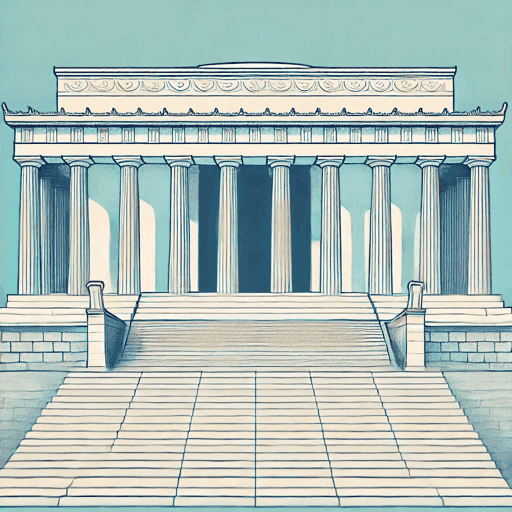
“Pleased that the shrine honoring his late boss would go up in what was then a remote location, Hay remarked that Lincoln ‘was of the immortals. You must not approach too close to the immortals. His monument should stand alone…isolated, distinguished, and serene.’”
(Chapter 4, Page 241)
Vowell frequently compares Lincoln to Jesus. Like Jesus, Lincoln in the context of the United States has become an object of historical veneration, much like how Jesus is a figure of religious veneration.
“What if this memorial, and, while we’re at it, all three branches of government, were more courageous and sympathetic and made more sense and aspired and again aspired? What if the pallid and the academic, the fictitious and the false were banished from this Mall and from this town?”
(Chapter 4, Page 245)
The Tension Between Patriotism and History permeates Assassination Vacation. With this passage, Vowell uses an architectural discussion of the Lincoln Memorial to discuss the United States in general and describe her love for the United States, despite its flaws and her hopes for its improvement despite her passionate disagreements with the current government and her feelings about certain crimes and atrocities in the country’s past.
“But loving this memorial is a lot like loving this country: I might not have built the place this way; it’s a little too pompous, and if you look underneath the marble, the structure’s a fake and ye olde Parthenon is actually supported by skyscraper steel. But the Lincoln Memorial is still my favorite place in the world and not just in spite of its many stupid flaws.”
(Chapter 4, Page 247)
Vowell lays down an allegory between the Lincoln Memorial and the United States itself. Like the Lincoln Memorial, she loves the United States and its history, in spite of its “stupid flaws,” speaking to The Tension Between Patriotism and History.
“A controversial politician widely blamed for the casualties and hardships of war, Lincoln was suddenly and forever upgraded to the persecuted savior who died so that the country might live.”
(Chapter 4, Page 249)
The Shaping of Civic Memory can mean a politician becomes, after their death or the end of their career, a secular saint in the eyes of history. This forms a contrast with Lincoln’s killer, John Wilkes Booth, who genuinely believed that his assassination of Lincoln would result in him being “greeted as an act of heroism” (82), but was very much mistaken.
“Because as Buddy Starcher would drawl, Friends, these creepy historical flukes offer momentary relief from the oppression of chaos and that is not nothing. They give order to the universe. They give meaning.”
(Chapter 4, Page 254)
Vowell argues that her fascination with small historical coincidences, such as those surrounding assassinations in US presidential history, is an attempt to find “order” in a chaotic universe. This connects with Vowell’s overarching discussion of how people connect to the past by visiting historical sites and viewing or handling historical relics, reflecting The Shaping of Civic Memory.

Unlock every key quote and its meaning
Get 25 quotes with page numbers and clear analysis to help you reference, write, and discuss with confidence.
- Cite quotes accurately with exact page numbers
- Understand what each quote really means
- Strengthen your analysis in essays or discussions