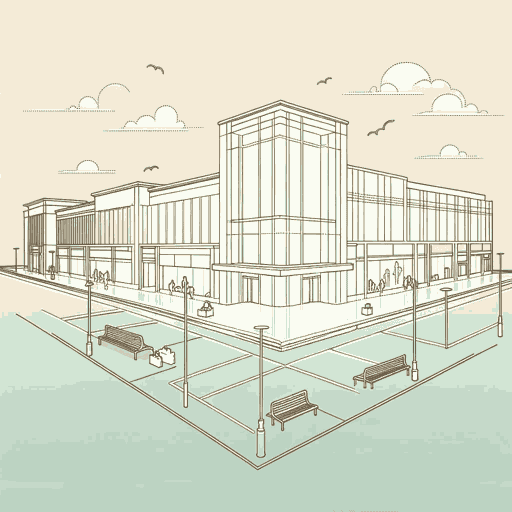
At the Galleria Shopping Mall
A modern alternative to SparkNotes and CliffsNotes, SuperSummary offers high-quality Study Guides with detailed chapter summaries and analysis of major themes, characters, and more.
Themes
The Painful Awareness of Coming of Age
Coming of age narratives have been an expression of Western literatures since Oedipus. These stories focus on a character of a certain usually young age who undergoes, often involuntarily and unexpectedly, a traumatic experience and who emerges from it with an entirely new set of assumptions about the conditions of their life, indeed about their very identity. Given the poem’s focus on a nine-year-old child, the expectation might be that the girl learns some traumatic truth. But the Millennial generation demands a different kind of coming-of-age narrative. It is the uncle, not the girl, who learns, who undergoes, involuntarily and unexpectedly, the difficult process of illumination. Comfortable in the artificial world of a shopping mall, armed with a credit card and keen to evaluate products based on their labels, not their quality, Lucinda is already a grown up, already a creature of conspicuous consumption. She illuminates for the poet a hard insight into what has become the American identity. She is Lucifer, the light bearer.
The nature of the insight, however, raises an additional question. Hoagland, ever the astute critic of his era and his culture, asks, using this moment in a mall, whether American kids grow up differently. Coming of age narratives traditionally have focused on difficult moments, emotional traumas, tragic and joyful—losing someone close, being betrayed by someone you trust, falling helplessly and completely in love, completing an education, at last leaving home—but here the turning point moment is decidedly less humane, less people-centered. Lucinda has already learned this, the speaker realizes in a dark and uncertain rush of unwanted insight. This is a distinctly American coming-of-age moment, a moment really available only to a culture unapologetically, unironically committed to wealth and the acquisition of things. This is not about a first kiss or a first funeral or first friendships—those are intensely emotional occasions for diving into the self. New millennium Americans are often depicted as too unapologetically shallow for that. Coming of age here means each of us will come to a moment when the acquisition of things, rather than their relationship with people, will define our identity. For Hoagland, that makes us not so much adults as American adults.
The Inevitability of Loneliness
“Loneliness” is the closing word of the poem. The reader inevitably wonders, how did we get so lonely? A poem that ostensibly recounts a happy trip to the mall involving an obviously precocious niece and an uncle might suggest a kind of celebration of family. After all, the poet could easily have made this a story of a father and daughter or a step-father and child or, really, any combination of adult and child. The uncle/niece relationship is not often an element of literary treatment, and that should offer the poem a reassuring, even joyous confirmation of the pull and stability of an extended family. The circumstances of how the uncle and niece come to be at the mall are never shared; rather we get this emotionally bonded twosome heading into what is a notoriously forbidding environment, the sprawl of a contemporary shopping mall, teeming with faceless strangers all engaged in the ruthless busy-ness of competitive shopping.
In the bond between uncle and niece, the poem might offer a counterargument to that environment of vast indifference and emotional sterility. Instead, as the two enter the mall, the two split. Not only physically—Lucinda trips off eager to use her credit card—but emotionally as well as the poet realizes he is too old to understand what his niece, already appropriating the determined shop-walk of those much older, already understands. In the end what starts as a bonding experience becomes a fragmented narrative, two isolates now on their own in a strange and forbidding vacuum, an un-world or maybe non-world of the Galleria. They are lost to that spiritual loneliness, lost to each other. That fragmentation is suggested by the poem itself. Hoagland constructs couplets, two-line units that tell a story, yes, but they tell the story in splintered bits. It is tempting to set a scene that Hoagland does not share: The uncle, too old to shop with any dedication, abandoned by his shop-crazy niece, left to wait for her return, maybe in the crowded food court, maybe by a decorative splashing fountain, but now alone, his niece alone as well but sustained by the giddy rush to shop, comforted by the company of the name brand things her credit card can acquire, happily unaware of her existential loneliness.
The Virus of Consumerism
It would mischaracterize Hoagland’s poem to suggest he (or the poem, for that matter) is incensed over the acquisitive nature of his contemporary America. “At the Galleria” is hardly an invective railing against spending as a measure of life worth or the relentless acquisition of material objects as a value unto itself. Hoagland is too laid back for that level of urgency. This is no diatribe; rather, Hoagland observes with a wry sort of regret that in the embrace of materialism something intangible, something that was once assumed, that is the community of others, has somehow, somewhere been lost. It is observational not argumentative. Taking his cue from the quiet irony and subtle pessimism of the social poetry of W. H. Auden, Hoagland recognizes that Americans, for reasons he cannot fathom, have come to prefer things to people.
Although Hoagland recognizes with bemusement the manifestation of frank and unapologetic consumerism that a mall inevitably represents, he cannot help but register a far more distressing realization as he watches his young niece so effortlessly navigate the mall. She is only nine—an age when for Hoagland’s generation kids were still curious about the world, about nature, about neighbors, about their family, about themselves, about everything. As Hoagland watches Lucinda move through the massive store aisles confidently armed with her parents’ credit card she swings like a “scythe” (Line 11), a reference that suggests the Grim Reaper, he struggles to understand how the virus of consumerism passed so quickly, infected so completely this child. In using the transformation myths from Antiquity as his point of reference, the speaker suggests that something vital, something wonderfully animated, something beautifully alive has been infected, that vitality chilled into irrelevancy by the apparently unstopped virus of capitalism, acquisition, and materialism. This is no hand-wringing despairing jeremiad—the poem suggests rather than indicts, observes rather than scolds, and the poet folds quietly into the implications of his own provocative observation.

Unlock every key theme and why it matters
Get in-depth breakdowns of the book’s main ideas and how they connect and evolve.
- Explore how themes develop throughout the text
- Connect themes to characters, events, and symbols
- Support essays and discussions with thematic evidence