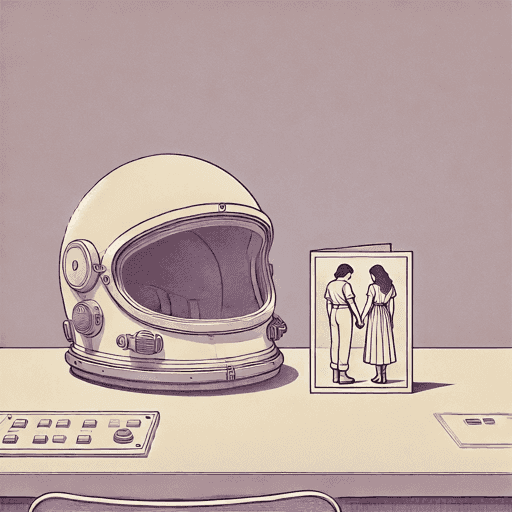
Atmosphere: A Love Story
58 pages • 1-hour read
Taylor Jenkins ReidAtmosphere: A Love Story
A modern alternative to SparkNotes and CliffsNotes, SuperSummary offers high-quality Study Guides with detailed chapter summaries and analysis of major themes, characters, and more.
Background
Content Warning: This section discusses anti-gay bias and gender discrimination.
Historical Context: NASA Through the 1980s
The National Aeronautics and Space Administration (NASA) is a US federal government agency established in 1958, combining four previously separate programs: the National Advisory Committee for Aeronautics (NACA), the Naval Research Laboratory’s Project Vanguard, the Army’s Jet Propulsion Laboratory (JPL), and the Army Ballistic Missile Agency. NASA was established in direct response to Sputnik 1, the first satellite, which the Soviet Union launched into orbit in 1957, beginning the era known as the Space Race.
From the 1950s to the 1980s, NASA jobs were primarily held by white men with military flight backgrounds. This included the men of the Mercury program (which launched the first American men into suborbital spaceflight), and the Apollo program, which landed the first men on the moon via Apollo 11 in 1969. However, the shuttle emergency in the late 1970s spurred major changes in spaceflight, including crucial technological advancements in the design of the shuttle to allow it to land like a plane, enabling reuse and safer spaceflight.
The other major change came when NASA officially opened astronaut candidate applications to women. Women had been part of the space program since the beginning, primarily in the areas of mathematics, computation, and engineering, as detailed in the nonfiction books Hidden Figures: The American Dream and the Untold Story of the Black Women Who Helped Win the Space Race (2016) by Margot Lee Shetterly (which was adapted into a film) and Rise of the Rocket Girls: The Women Who Propelled Us, from Missiles to the Moon to Mars (2016) by Nathalia Holt. However, NASA initially barred women from becoming astronauts.
As Atmosphere mentions, a previous program called The First Lady Astronaut program, or Mercury 13, attempted to train women astronauts in 1960 (the inspiration for Mary Robinette Kowal’s alternate history SF Lady Astronaut series). However, the program ended in 1962 when the federal government refused to certify the women candidates for flight training. This all changed when NASA accepted the first women candidates in 1977. Their training was completed in 1979.
Sally Ride became the first American woman in space in 1983 aboard the shuttle Columbia. A new documentary, Sally (2025), details her experiences in NASA, including the need to hide her 27-year romantic relationship with her partner, Tam O’Shaugnessey, which wasn’t publicly revealed until after Ride’s death in 2012. Though Ride’s success marked a major shift in the culture and profession of space travel, gender (and race) discrimination still persisted in NASA, particularly in the attitudes shared by military pilots (all white men).
Social Context: Anti-gay Prejudice in 1980s America
While prejudice against the LGBTQ+ community has been prevalent throughout modern history, historians argue that antigay prejudice reached its peak in the US in the 1980s. Mark McCormack has argued that this resulted from three interconnected factors: the AIDS crisis, the resurgence of conservative politics (particularly during Ronald Reagan’s presidency from 1981-1989), and the rise of the religious right, largely through the political organization called the Moral Majority, led by Jerry Falwell (McCormack, Mark. The Declining Significance of Homophobia: How Teenage Boys are Redefining Masculinity and Heterosexuality. Oxford University Press, 2012. pp 57-68).
The sexual revolution and counterculture of the 1960s had led to an increase in public-facing gay culture in defiance of longstanding legal and societal restrictions. However, the late 1970s and early 1980s saw the emergence of the HIV/AIDs epidemic, commonly linked with gay male communities. Conservative groups like Reagan’s Republican party and Jerry Fallwell’s Moral Majority, which vocally opposed many progressive issues (including abortion and the Equal Rights Amendment), used the HIV/AIDs crisis as supposed proof of their righteousness in opposing gay rights.
This opposition appeared in many places throughout society. In 1982, the US Army officially declared that being gay was “incompatible with military service” (Dept of Defense Directive 1332.14), and in 1986, the Catholic Church labeled being gay as “intrinsically disordered” with a “tendency […] toward evil” (Cardinal Joseph Ratzinger. “On the Pastoral Care of Homosexual Persons.” Dicastery for the Doctrine of Faith, 1 Oct. 1986). These attitudes were thus common in workplaces and among the public, often leading to loss of employment, isolation from the larger community, and ostracization from family. This forms the milieu within which Joan and Vanessa must hide their romantic relationship throughout Atmosphere.

Unlock all 58 pages of this Study Guide
Get in-depth, chapter-by-chapter summaries and analysis from our literary experts.
- Grasp challenging concepts with clear, comprehensive explanations
- Revisit key plot points and ideas without rereading the book
- Share impressive insights in classes and book clubs