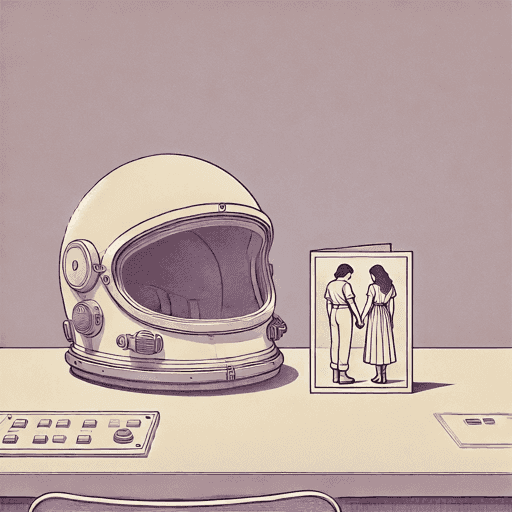
Atmosphere: A Love Story
58 pages • 1-hour read
Taylor Jenkins ReidAtmosphere: A Love Story
A modern alternative to SparkNotes and CliffsNotes, SuperSummary offers high-quality Study Guides with detailed chapter summaries and analysis of major themes, characters, and more.
Chapters 16-19Chapter Summaries & Analyses
Content Warning: This section discusses anti-gay bias, gender discrimination, death, and child abuse.
Chapter 16 Summary: “Spring and Summer 1984”
Joan’s training intensifies. Despite her exhaustion, she requests time in Mission Control, which initially surprises Antonio. While astronauts often devote non-space time to support positions at NASA, only a handful are placed in Mission Control. She insists that she’s the right person for the job because she’s unflappable and is “on good terms with everyone” (254), from the other mission specialists to the pilots. Antonio agrees.
One day, Frances asks if she can spend the weekend with Joan, explaining that her mother won’t notice her absence. She says that Barbara makes her grilled cheese for dinner every night and then puts her to bed while she and Daniel go out. By now, Frances is 10 years old and in fifth grade. When Joan asks Barbara about this, Barbara complains that Frances is rude, disrespectful to Daniel, and moody. Joan tries to explain that Frances feels left out of Barbara’s new life, but Barbara refuses to listen. Joan takes Frances to a movie, inviting Vanessa along as well.
Joan’s training continues, and she spends every available moment in Mission Control, increasingly certain that this is where she’s meant to be long-term. During this time, Donna becomes pregnant. Joan helps her hide it as long as possible because NASA will remove her from active assignments when they find out.
One evening, Barbara arrives to speak with Joan. She apologizes for never giving Joan the credit she deserves for helping her and Frances. Daniel helped her realize how much she relied on Joan and how embarrassed she felt about that, which led her to being defensive and mean sometimes. Now, Barbara wants to include Joan in her decision to send Frances away to boarding school in Dallas. Joan objects, horrified. Barbara justifies her choice, explaining that Daniel never wanted children but has tried his best with Frances, who has been rude and rebellious at every turn. They believe that Frances needs more discipline, and they need time alone. Joan talks to Frances, who claims to be happy about the decision, though Joan is doubtful.
On the day Frances leaves, Joan tries to hide her anger and depression. Barbara promises to visit the school for a parents’ weekend and to bring Frances home for Thanksgiving. Frances claims to be excited. After that, Joan throws herself into her training.
Chapter 17 Summary: “Fall 1984”
Joan and Vanessa meet Donna for dinner one night. They talk about their fears: Joan’s of spaceflight, Donna of her and Hank becoming parents. Joan notices Donna watching them and realizes that Donna knows they’re a couple and has possibly known for a long time. More importantly, she doesn’t seem to care. Joan feels safe in her presence.
Four days later, Donna gives birth to Thea. Vanessa and Joan arrive with gifts and congratulations. As Vanessa goes inside, Jimmy stops Joan to remark that he always sees them together first thing in the morning. Joan fears what he suspects and what he might say, but he doesn’t comment further, so she puts it out of her mind.
The night before Joan enters quarantine in preparation for her flight, Barbara calls to inform her that she won’t be hosting Thanksgiving. Instead, Frances will stay at the school over the holiday while Daniel takes Barbara to Europe. She insists that Frances continues to behave horribly and will be happier at school, which throws a party for the children who don’t go home. She accuses Joan of always taking Frances’s side because she’s like an immature child herself and can’t understand what it’s like for two adults in love to want to spend time together without rebellious children around. Joan wants to correct Barbara but knows she can’t.
Days later, Joan launches into space aboard the shuttle Discovery. She’s awed and dazzled by the view but becomes violently ill. She isn’t the only astronaut to experience disorientation and nausea, but her reaction is the most severe. For days, she vomits, aches, and fights “against a haze of confusion” (277) so severe that she sometimes can’t even count her fingers. In her misery, she finds herself thinking that humans aren’t meant to be in space and fears that she has spent her “entire life hoping for something it turns out [she] cannot stand” (278).
On the fifth day, she recovers. She looks down at the Earth and thinks about the absurdity of countries fighting against each other when they’re all humans, connected by their accomplishments in reaching space. She’s “overwhelmed with her own life’s meaning—and the fact that the only meaning it could have was the meaning she gave it” (280). She believes that the people she loves, specifically Vanessa and Frances, give her life meaning.
Chapter 18 Summary: “The Day Before Thanksgiving 1984”
At first, Joan thinks Barbara is bluffing, but she doesn’t back down. Joan demands that Barbara contact the school to tell them that Joan is taking Frances and has permission to make decisions about Frances’s welfare from now on. Barbara does so without hesitation, and Joan calls her a monster.
Hours later, Joan arrives in Dallas to pick up Frances. On the way home, they stop at a diner for strawberry milkshakes and PBJ sandwiches. She explains that Frances will be living with her from now on and that she’ll get her reenrolled in the public school. Frances cries and asks if Joan is sure she wants her around that much. Joan promises to love her and to want her around forever. Joan hopes that Barbara will regret her choices in the future and work to earn back Frances’s trust. If not, Joan intends to make sure that Frances never feels unwanted ever again.
Joan’s mission ends, and she returns home to her apartment the day before Thanksgiving. She listens to the messages from Frances on her answering machine. She calls the school and learns that Frances is alone with a single teacher. Frances cries, and Joan promises to come get her.
Joan finds Barbara at her home, preparing to leave for the airport with Daniel. She begs Barbara not to abandon her daughter. Barbara accuses Frances of being manipulative and Joan of being melodramatic. They argue. Barbara defends her choices to have a husband and money and a beautiful home. Saying she can’t deal with Frances and her mess anymore, she bursts into tears. She adds that Daniel wants to stay in Europe and that they intend to leave Frances at school in Dallas. When Joan furiously insists that Frances deserves better treatment, Barbara shouts that if Joan thinks she’s such a better mother, then she can take Frances.
For Thanksgiving, Joan, Frances, and Vanessa visit Donna and Hank, who are hosting a Thanksgiving potluck for the astronauts. Everyone teases Joan about being sick during her mission, and Joan jokes about it. She has never felt more at home than she does here. Later, Lydia privately thanks Joan for her advice about teamwork, saying that things are going well with Vanessa and the others in preparation for their mission.
Days later, Antonio calls Joan into his office. She has decided that she belongs in support positions at Mission Control. Antonio hoped to send her on another space mission despite her sickness, because her research capabilities are strong, but he agrees. He then cautions her about any perceptions of being “morally compromised,” which might lead her or others to lose their security clearance and jobs. Speaking vaguely, he says that he has no objections to anyone’s personal lives but that certain issues, such as “the appearance of sexual deviation” (299), might make an astronaut vulnerable to blackmail and thus unfit for duty. She understands what he’s implying.
Joan considers her options for two weeks without telling Vanessa. She suspects that Jimmy spread rumors about them or told Antonio directly. She can’t think of a safe way to continue without risking both her and Vanessa’s positions. The day before Vanessa leaves for her mission, Joan breaks up with her. First, she says that she can’t make their relationship work now that she’s responsible for Frances. When Vanessa fights against that, she admits that Antonio knows.
Vanessa says she doesn’t care. She prefers to lose her job and never fly the shuttle rather than give up Joan. Joan insists. She can’t be the reason Vanessa loses her dream and tells her to leave. Vanessa leaves. However, moments later, she calls from a payphone, and says, “No, Joan. […] My answer is no. Absolutely not. I don’t care what Antonio said. I don’t care what they can take from me [or] if they never let me set foot in the fucking space shuttle […] No. I will not leave you and Frances. I will not” (307).
Again she insists that she would rather lose NASA than Joan and Frances. Sobbing, Joan asks her to come back. They agree to find a solution after Vanessa returns from her space mission.
Chapter 19 Summary: “December 29, 1984”
In the shuttle, Vanessa again asks how long Lydia can survive without treatment. On the feed, Joan admits that they don’t believe Lydia will survive if they miss their current reentry window. However, if Vanessa doesn’t fix the latches, the shuttle will likely burn up on reentry and no one will survive. Vanessa doesn’t want to die. She wants to go home to Joan and Frances, but she can’t let Lydia die. She tells Mission Control that she intends to return to the main cabin and begin the deorbit against orders. She’s prepared to face any punishment when she returns.
Joan confirms Vanessa’s decision. Vanessa fears that she “has asked too much of the world, pushed it too far beyond its limits” (319), by trying to stay with Joan, but if Joan is with her over the feed now, that will be enough. Vanessa goes through the deorbit process. This step is easy. The hard part will be when the shuttle enters the atmosphere. As they wait for final reentry, Vanessa asks Joan to relay a message.
She wants to tell everyone she’s sorry. She promises that she wants to come home, she isn’t trying to die, but she can’t give up on Lydia. Joan assures her that everyone understands. Vanessa asks Joan to tell Frances that she tried, adding, “I don’t want anyone out there who can hear this right now—to wonder if it’s that I didn’t have anything to live for. I do” (324).
In Mission Control, Joan begins to cry and Jack gently suggests that she tell Vanessa what she needs to. Over the feed, Joan describes the color blue as the sensation of going home and having milkshakes and PBJ sandwiches and playing games with a 10-year-old girl in the kitchen of her bungalow. Vanessa says, “We asked for so much, didn’t we?” (327). She asks if Joan knows why David Bowie’s “Space Oddity” is her favorite space song and says it’s because of the line, “Tell my wife I love her very much” (327). Joan replies, “And then he says, ‘She knows’” (327).
Seconds later, Mission Control loses communication with the shuttle. This is routine, but Joan is still afraid. They wait the standard time for communication to come back, but the feed is silent. Joan repeatedly calls for the Navigator. She thinks she should have promised to quit NASA and offered to move somewhere more accepting, like San Francisco. She fears that it’s too late. She screams and begs Vanessa not to go. Everyone in Mission Control looks at each other, thinking the shuttle didn’t survive. The crew are all dead.
Suddenly, Vanessa’s voice crackles over the feed announcing that she’s about to land at Edwards and Lydia is alive. Joan exhales, thinking they didn’t ask for too much after all and might “get everything they wanted” (332).
Chapters 16-19 Analysis
The final chapters are a culmination of Joan’s journey and character arc in several crucial ways. First, she at last achieves her long-held ambition to travel into space. She not only receives a mission but is the first woman in Group 9 to get one. Supporting the theme of The Relationship Between Ambition and Sacrifice, this achievement indicates that her sacrifices—including tolerating the sexist attitudes of many around her and giving up time with her family—were worthwhile. Her hard work is rewarded. Joan’s experience in space is emotionally powerful for this reason and because it allows her to again reflect on her philosophy of human interconnectedness. Her view from space reminds her again that the separation of human beings into countries, opposing sides, or any other kind of division is meaningless in the face of their shared goals, hopes, and achievements.
Joan’s experience in space, which thematically alludes to the universality of The Need for Love and Belonging, also contributes to this theme by inspiring her to reexamine her priorities. Ironically, she discovers that her body can’t withstand the strain of space travel. Moreover, she wishes only to return to Frances and Vanessa. The very thing she has strived for proves less significant than she thought but underscores the depth of her familial commitment. This, combined with her reflection on humanity, leads her to conclude that real meaning comes not from her ambition for space travel but from the love and sense of community she feels for Vanessa, Frances, and her NASA family. Additionally, she has a life she would never have thought she wanted but is exactly what she needs. This is a significant aspect of her character growth, showing her acceptance of the unexpected turns in life that defy her plans and dreams.
This growth is especially apparent in her relationship with Frances. Several incidents, from Barbara sending Frances to boarding school through Joan choosing to take Frances in permanently, demonstrate Joan’s immense character growth. She has long professed that traditional domestic roles, such as marriage and motherhood, aren’t for her. Nevertheless, faced with Barbara’s parental neglect and her love for Frances, she chooses to take on that role without regret or hesitation. Moreover, having spent her entire life biting her tongue in Barbara’s presence, she finally speaks honestly about Barbara’s selfishness and neglect. By contrast, just as Joan demonstrates her growth, Barbara proves that she hasn’t changed or grown at all throughout the years the novel spans.
The way Joan handles Antonio’s veiled warnings also reveals aspects of her character arc. This situation embodies a clash between the theme of Navigating Gender and Sexuality Discrimination and the novel’s thematic examination of ambition vis-à-vis sacrifice. When the systemic anti-gay bias at NASA and within society threatens Vanessa’s ambition to be a shuttle pilot, Joan attempts to sacrifice their relationship to protect it. As before, her first impulse when confronted is to retreat. This response is understandable given the explicit, concrete dangers of being in a same-sex relationship at the time, when no employment protections were in place for the LGBTQ community. Joan and Vanessa both put their careers at risk by staying together. In addition, they face constant judgment and ostracization if Jimmy publicly outs them. Joan therefore decides that Vanessa’s career must take priority over their relationship.
Vanessa, conversely, is willing to sacrifice her career rather than lose Joan and Frances. In the complex interplay between ambition and the sacrifices an individual must make to succeed, Vanessa chooses to relinquish her ambition rather than sacrifice her love. This is an important lesson for Joan, one that she doesn’t fully grasp until the moment when she believes that Vanessa has died during reentry. At several points in these chapters, Joan and Vanessa reflect that they have “asked for too much” (299), encapsulating the conflict between all three themes: the discrimination they must navigate, the ambitions they must fight for, and the love and belonging they need.
The novel could have mirrored history, ending with a tragedy like the real-life shuttle disaster in 1986 when the shuttle Discovery broke apart during launch, killing all seven aboard, or the 2003 shuttle Columbia disaster, in which the shuttle disintegrated upon reentry, also killing all aboard. Instead, the narrative concludes with Vanessa’s safe return to Earth and Joan’s final thought that “maybe they had not asked for too much. Maybe they would get everything they wanted” (332). In refuting their fears that they asked for too much and must choose one thing or another, this conclusion argues that, at least sometimes, people who persevere and work hard for the life they want and deserve reap the reward of realizing that vision without compromising any of its most important parts.

Unlock all 58 pages of this Study Guide
Get in-depth, chapter-by-chapter summaries and analysis from our literary experts.
- Grasp challenging concepts with clear, comprehensive explanations
- Revisit key plot points and ideas without rereading the book
- Share impressive insights in classes and book clubs