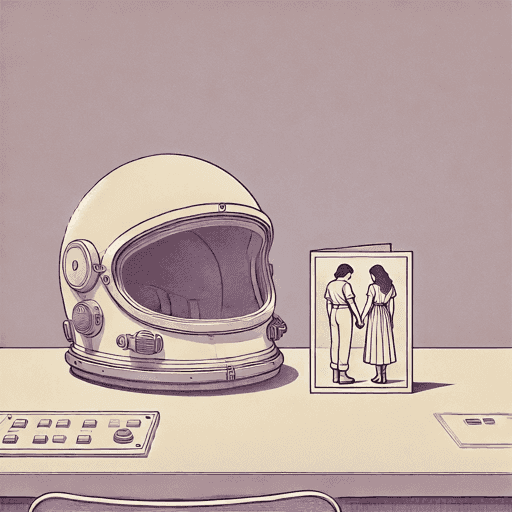
Atmosphere: A Love Story
58 pages • 1-hour read
Taylor Jenkins ReidAtmosphere: A Love Story
A modern alternative to SparkNotes and CliffsNotes, SuperSummary offers high-quality Study Guides with detailed chapter summaries and analysis of major themes, characters, and more.
Important Quotes
“So when Joan walks into the Mission control building that morning with a black coffee in her hand, she is at ease. She is not anxious or terrified or heartbroken.
All of that will come later.”
(Chapter 1, Page 3)
The novel opens on December 29, 1984, as Joan enters Mission Control to monitor the spacewalk aboard the shuttle Navigator. By juxtaposing Joan’s current calm with her impending anxiety and heartbreak, this passage ominously foreshadows the crisis that is about to occur and introduces tension and anticipation to the novel’s tone.
“After that, Barbara kept calling. Barbara needed money for an apartment. Barbara needed help finding out if she could get her tuition money refunded now that she was officially dropping out. Barbara needed Joan there when she finally told Mom and Dad. Barbara needed Barbara needed Barbara needed.”
(Chapter 3, Pages 28-29)
Joan reflects on her relationship with her sister, Barbara, whose constant need for help and attention has been the primary focus of Joan’s life. This passage concisely and accurately encapsulates their dynamic, including Joan’s consistent acquiescence to Barbara’s demands. The changes to this dynamic form a central element of the plot and Joan’s character growth.
“Didn’t Lydia understand that if one of them made it seem like it was okay, the rest of them would be sidelined as humorless? Didn’t Lydia get that this was how the men kept them separate and underestimated? With these small jokes that made them look petty if they got upset?”
(Chapter 3, Page 49)
Joan is frustrated by Lydia’s permissive attitude toward Jimmy Hayman’s crude, sexist jokes. Jimmy Hayman’s remarks exemplify the gender discrimination that the women face, and the differing ways that Joan and Lydia respond to that discrimination contributes to the theme of Navigating Gender and Sexuality Discrimination and to marking the two characters as foils for each other.
“Her parents’ marriage seemed fine to her. Good, even. They still loved each other. […] Still, when she thought about it, a gloom dared to take over. You could develop your personality your entire life—pursue the things you wanted to learn, discover the most interesting parts of yourself, hold yourself to a certain standard—and then you marry a man and suddenly his personality, his wants, his standards subsume your own?”
(Chapter 3, Pages 65-66)
Joan views the concept of marriage with disdain and fear. In Joan’s view, marriage merely enforces gender and sexuality stereotypes that require women to relinquish their own personalities and desires when they marry a man. She has no wish to participate in such a thing and considers herself incapable of such a sacrifice. Her views shift as the story progresses.
“Joan was always moved by the fact that everything—all matter on Earth and beyond, up past the atmosphere, going as far as the edges of the universe, as it expands farther and farther away from us—is made from the same elements. We are made of the same things as the stars and the planets. Remembering that connection brought Joan comfort. It also brought her some sense of responsibility. And what was kinship but that? Comfort and responsibility.”
(Chapter 5, Page 90)
For Joan, stars are a vital symbol that represent her personal worldview and philosophy about science and religion. They also represent the inherent interconnectedness of humanity, which contributes to the theme of The Need for Love and Belonging on both a global and personal level.
“Women couldn’t join the military as pilots, and now NASA will only take military pilots. Ergo, women can’t be NASA pilots. It’s a nice little work-around they’ve got themselves there.”
(Chapter 5, Page 91)
Vanessa succinctly summarizes the systemic gender discrimination built into the military and NASA, which tacitly bars women from becoming pilots. Just as the women astronaut candidates face sexist attitudes on a social level, as with Jimmy Hayman’s harassment, they all contend with sexism on an institutional level in the workplace, and each requires different strategies to manage.
“Marrying Adam Hawkins and being a wife? Waiting at home and making dinner every night? My mom is so good at that stuff, but I never looked at her and saw myself. I know that hurt her feelings. I knew that me choosing a different life didn’t quite make sense to her at first. But I think choosing that other life, her life, would have been very hard. I think it would have been one of the hardest things I’d had to do. I chose the only life I knew how to choose.”
(Chapter 6, Page 119)
Joan recalls when her parents hoped she would marry a neighborhood boy and her decision to reject his proposal. She disagrees with Vanessa that living a quiet life in the suburbs would be inherently easier, arguing that every kind of life has its own difficulties. As before, she reflects that she would find marriage stifling and believes that she’s ill-suited for such a life.
“The world clicked into place for Joan then: why men were so obsessed with women’s bodies, why they made so many mistakes just to get closer to one.”
(Chapter 7, Page 127)
Joan has long professed that romance and love aren’t for her, claiming that she simply doesn’t have the capacity for such things. However, during the excursion to the strip club in New Orleans, she suddenly realizes that she isn’t attracted to men but to women. This opens entirely new, unimagined possibilities for her.
‘She’s saying we’re outnumbered,’ Donna said. Joan looked at her. ‘NASA is run primarily by men. If we want to go up there, we have to convince a man to choose us. We have to be somebody the men here want to work with. We have to be smart.’”
(Chapter 8, Page 143)
Donna, Joan, and Lydia discuss the competition between the men and women astronaut candidates to earn a spot on one of the coveted space missions. They all agree that the system is unjust, requiring them to prove their worthiness to men. However, Joan disagrees with Lydia and Donna’s conclusion that this means they must play by the men’s rules to succeed, highlighting again the different strategies for navigating gender discrimination at NASA.
“Vanessa’s smile was so beautiful, the way it was lopsided, but the rest of her face was always perfectly symmetrical. The curls of her hair were the most gorgeous thing Joan had ever seen in her life, and she wanted to reach out and run her hands through them. To pull her close.
[…]
‘The whole sky makes sense to me now,’ Vanessa said, ‘Because of you.’
And Joan thought, Oh no. Oh no. Oh no. Oh no.”
(Chapter 8, Page 148)
Previously, Joan pretended not to understand Griff’s suggestion that she had feelings for someone in their group. Now, as she sits with Vanessa during the astronaut group camping trip, she suddenly realizes the extent of her own feelings. This is a significant development in the novel’s romantic plotline and Joan’s character development.
“He said he got something out of it, too. ‘Talking to you, hearing what you’re going through, it makes me realize how far I’ve come since I was your age. And hell, I might be a great astronaut. But if all I’m doing with what I’ve learned is using it for myself, what kind of legacy is that?’”
(Chapter 9, Page 150)
Aboard the Navigator, Vanessa reflects on a conversation she had with Steve. This is the first major introduction of the legacy motif, which carries throughout the rest of the novel. Legacy is an important aspect of Steve’s ambition and role as an astronaut. This conversation is particularly poignant because Steve is now dead and his mentorship is part of what allows Vanessa to survive the shuttle crisis.
“Joan knew then that Donna was not an idiot. And the Beatles were not nonsense. And that there had always been a place for her in this world. She had just been walking past it over and over again, never noticing that there was an unmarked door, waiting for her to discover it.”
(Chapter 10, Page 169)
Vanessa finally confronts Joan about the unspoken feelings between them, forcing Joan to be honest with herself and Vanessa. When they finally kiss and agree to begin a relationship, Joan reconsiders her assumptions about love and marriage. She realizes that she was always capable of love and the kinds of relationship she disdained in others, but she was simply too blinded by heterosexual norms to see it.
“Joan considered this. ‘The Jewish Philosopher Spinoza said that God did not necessarily make the universe, but that God is the universe. The unfolding of the universe is God in action. Which would mean science and math are a part of God.’
‘And we are a part of God because we are a part of the universe,’ Vanessa said.
‘Or better yet, we are the universe’”
(Chapter 11, Page 187)
Joan expands on her philosophical viewpoint about the relationship between science and religion, and the interconnectedness of humanity. Again, she uses the symbolism of stars to argue that all things are made of the same basic elements and are therefore all part of a greater whole, even arguing that humanity, the universe, and God are all essentially the same thing.
“Lydia grew more animated. ‘Little girls across the country will be made fun of at recess when they want to grab the ball, and teenaged girls who get straight A’s in science will be told to have a backup plan, and no one will dress as Sally for Halloween. Girls’ understanding of who they can be will be smaller. If this does not go well. Whether we meant to or not, we will have done that to them.’”
(Chapter 14, Page 224)
The motif of legacy reappears as Joan and Lydia discuss the path they might leave behind for young girls in the future. Joan hopes to carve a path that will make it easier for girls to become astronauts. Lydia fears that any failure, real or imagined, will tarnish that legacy and thereby destroy any chance for girls to follow them in the future.
“‘That it’s not about you,’ Joan said. ‘Choices like this are dictated by what is best for the mission, not the individual. And if you’re asking my advice, I think that’s where you sometimes go wrong. You’re not smarter or harder working than anyone here. Yes, you’re brilliant and driven, but you’re surrounded by people who are just as brilliant and just as driven. You’re not better than anyone on this crew. You cannot be. And you cannot want to be. If you are, you won’t be prepared to do the hard stuff, if you’re too worried about whether you’re winning some imaginary race. It’s about the collective, not the individual.’”
(Chapter 14, Page 240)
After Joan becomes the first woman in Group 9 to receive a space assignment, over Lydia, the two women discuss their differing views on competition both with the men and with each other. In focusing on the group over the individual, Joan highlights a key thematic component of The Need for Love and Belonging, which is each person’s responsibility to the group, as well as the comfort and support they get from the group.
“Her parents misunderstood her, the same way she’d misunderstood herself for so long. Joan wanted to tell both of them that they thought she didn’t want to get married, but the truth was that she wanted exactly what Barbara had. She wanted what they had. She wanted what Donna and Hank had. And what every marriage in the whole godforsaken country had.
The right to exist and to love and be proud and happy.
The right to live.”
(Chapter 15, Page 247)
At Barbara’s wedding, Joan lets go of the last of her disdain for marriage. She now realizes that while some relationships can be uneven and require undue sacrifice, others can be supportive and accepting, like Donna’s and Hank’s. She discovers that she wants that sense of belonging. However, she’s barred from it by the societal and systemic discrimination she faces, which devalues and demonizes same-sex desire.
“Because out of everyone on the crew, I am the most unflappable. Look at my heart rate and blood pressure stats during our sims—you can even go back and look at my stats from the initial assessments four years ago. I am also the person on the crew with the most consistent relationships throughout the astronaut corps. I am friendly and on good terms with everyone. […] In that CAPCOM chair, you need someone who is trusted, can remain calm, think quickly, and do what they are told. That’s me.”
(Chapter 16, Pages 253-254)
Having often undersold her own skills and retreating from difficult conversation, Joan now firmly advocates for herself and defends her skills and suitability for the CAPCOM role. This is a crucial element of her character arc. In a moment of dramatic irony, however, the audience knows that this very argument will place her in that role during the painful and terrifying climax, witnessing the shuttle crisis involving Vanessa firsthand.
“Donna stared at them. When they snapped out of it—when Joan finally saw Donna’s face—she could see that Donna was holding back a smile. Donna had a brightness in her eyes that Joan interpreted immediately.
Donna knew.
Donna knew and she had, perhaps, long known.
And she didn’t care.”
(Chapter 17, Page 267)
Joan reflects that she has been searching for a sense of belonging, acceptance, and safety. Now, when she realizes that Donna knows and has known about her relationship with Vanessa yet doesn’t judge them for it, she feels that she has found what she was seeking. This realization highlights the value of such acceptance, revealing the complex thematic interplay between Navigating Gender and Sexuality Discrimination and The Need for Love and Belonging.
“Joan wanted to tell her that she knew exactly what it meant to love someone. That she’d had kisses and dates and a whole life that Barbara knew nothing about. But that—also!—her opinion would still matter even if she hadn’t. Even if Joan had never fallen in love, she would still matter. She wasn’t a child just because her life looked different from Barbara’s. She wanted to tell her that there were many, many people in this world who had full, rich lives the likes of which Barbara couldn’t fathom because of her tiny little brain.”
(Chapter 17, Page 272)
Barbara’s misperception and judgment of Joan underscores the societal attitudes that she, like many, has absorbed, which devalues any way of life that differs from the idealized, traditional view of heterosexuality, love, and institutionalized marriage. Not only does Barbara disregard the idea of same-sex desire and love, but she also dismisses any other potential kind of life, believing that if it doesn’t look like hers, it must not be valid.
“Joan marveled at how easy Barbara’s inner life must be. How entirely undemanding of yourself it was to believe that everything happened to you. And everything was about you. And that your feelings were the only ones that mattered. Worse yet, to afford yourself the role of the victim always—regardless of how grotesquely it required you to twist reality—so that you never had to look in the mirror and admit you were the perpetrator.”
(Chapter 18, Page 285)
In their final confrontation, Joan sees Barbara for who she is. She has made excuses for her for most of their lives and kept her opinions to herself. Now, she realizes that Barbara’s self-centered, narrow view of life will never change. Unlike Joan, who undergoes significant character growth throughout the novel, Barbara refuses to change or grow.
“If Frances had spent the first ten years of her life unsure of where she belonged, Joan knew she would spend the next ten knowing she firmly belonged to her.”
(Chapter 18, Page 292)
After Joan brings Frances home from the boarding school and promises to take care of her forever, she reflects on the need and importance of belonging, especially within one’s family. Though Barbara made Frances feel unwanted, Joan will show her true belonging from now on. This becomes Joan’s most important role in life, thematically emphasizing The Need for Love and Belonging.
“‘Not as a matter of judgment, mind you, but because it opens people up to the potential for blackmail. People with large debts, for instance, or gambling problems would be a good example of the type of person we would have to rescind a security clearance from, rendering them unable to fly. People who have family members with ties to organized crime would be another example. Also, the appearance of sexual deviation would make any of our astronauts vulnerable to such a blackmail.’”
(Chapter 18, Pages 298-299)
Joan’s superior, Antonio, offers a vague warning to Joan that she understands is about her relationship with Vanessa. Though Antonio claims not to judge her personally, this conversation starkly reveals the sexuality discrimination codified into the federal government, which labels any non-heterosexual identity as a “deviation” that warrants dismissal.
“Joan and Vanessa had asked for too much, pushed too hard, believed too naively that they could have what they wanted.”
(Chapter 18, Page 299)
Joan and Vanessa each reflect that they have “asked for too much” from the world. This concept of too much reveals the clash between the three themes exploring discrimination, ambition, and love. Specifically, the universal need for love, portrayed in their romantic relationship, puts them at odds with the antigay discrimination in 1980s US culture and thus puts their career ambitions at risk. They fear that they must choose between love and ambition to survive.
“‘I didn’t ask for this!’ Vanessa shouted. ‘I didn’t ask to meet your niece and help you deal with your stupid sister and meet your parents and imagine a life where the two of us could have things that I never dreamed the world would let me have! I didn’t ask for that! That was you! […] And now, when one asshole scares you, you’re going to give it all up? No! I don’t accept it. I love you. And I love Frances, too, and you don’t get to take her away from me. Just because you’re scared. Or just because you think you know what’s best for me.’”
(Chapter 18, Page 307)
Joan and Vanessa argue in the wake of Joan’s effort to save Vanessa’s career by ending their relationship. In the choice between sacrificing career or love, they each come to a different conclusion, putting them in conflict. However, Vanessa’s argument prevails: She convinces Joan that giving up her piloting career is a minor sacrifice in comparison to their relationship. This establishes that The Need for Love and Belonging carries the novel’s most important thematic message.
“Maybe they had not asked for too much. Maybe they would get everything they wanted.”
(Chapter 10, Page 332)
Despite Joan and Vanessa’s fears that they’ve asked for too much from the universe, the novel ends on this hopeful note. Vanessa survived the shuttle crisis but defied orders to do so, which will result in her dismissal from NASA. With her career no longer at risk from their relationship, the novel’s conclusion implies that Joan and Vanessa can have the life they dreamed of together.

Unlock every key quote and its meaning
Get 25 quotes with page numbers and clear analysis to help you reference, write, and discuss with confidence.
- Cite quotes accurately with exact page numbers
- Understand what each quote really means
- Strengthen your analysis in essays or discussions