Average Waves in Unprotected Waters
30 pages • 1-hour read
Anne TylerAverage Waves in Unprotected Waters
A modern alternative to SparkNotes and CliffsNotes, SuperSummary offers high-quality Study Guides with detailed chapter summaries and analysis of major themes, characters, and more.
Story Analysis
Analysis: “Average Waves in Unprotected Waters”
Much of the narrative focuses on Bet’s quest to be seen, both by the world and herself. Tyler exaggerates her domestic situation with the inclusion of a developmentally disabled child and the exclusion of a husband/father, but Bet’s story still reflects the plight of a middle-class American housewife in the 1970s. Bet’s isolation and dearth of connection are literal, but she stands in for the thousands of women who experienced that vacuum, even with a partner and a child who could interact and communicate. Through Bet’s eyes, Tyler explores not only the unrealistic expectations of a woman/mother/wife but also the daunting proposition of letting go of those presumptions.
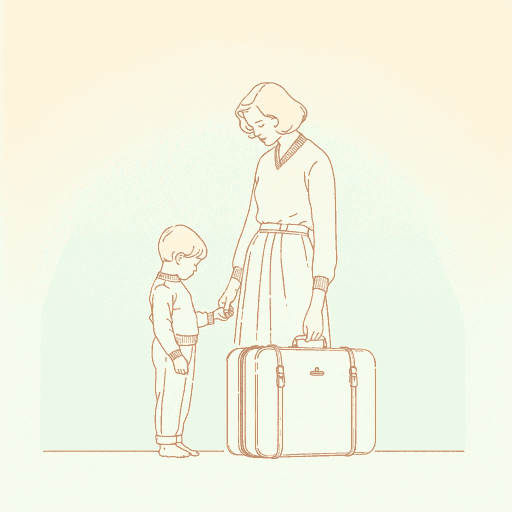
The first time readers learn Arnold’s name is in the third paragraph when Bet tells him they are “going out”; up until that point, she refers to him with pronouns only. This has an alienating effect, paralleling the distance Bet tries to create between herself and the situation as she steels herself to abandon her child. This also emphasizes that while Bet pursues The Search for Identity for herself, she erases her son’s, foreshadowing how Bet’s new life will come at a cost. In this scene, she dons her coat, then “[ties] a blue kerchief under her chin. Then she [goes] over to the table and slowly [spins], modelling the coat” (32). She uses Arnold’s name to get his attention, but her behavior and implied message are not really directed to him. Her actions fall more in line with a wife preening for her husband before going on a date. She wants to be admired, cherished, and complimented. Later she remarks that Arnold is unaware of all she does for him, “all the buttons and snaps [she’s] fastened” (32). Bet feels invisible and longs for someone to see that “there’s a whole lot to [her]” (35), a thought that parallels the way she later tries to convince the nurse that Arnold is special.
The irony is that Bet does not recognize her own value, nor does she see Arnold’s. She does not believe she is a good mother, always second-guessing her ability to identify Arnold’s cues or predict what will appease or upset him. Her “worn, beige knit that she usually [saves] for Sundays” symbolizes her self-concept (32). Bet has allowed her mind to deteriorate, just as her clothes—even her best dress—have degraded. Her ego is “beige” at best; at worst, she believes she is inferior to most people.
Bet spends much of the day trying to see Arnold as real or having a personality, but most of her descriptions of him portray him as an inanimate entity. She says his expression never changes, that he “[stands] inside his clothes, separate from them,” and that she cares for him as she would a doll (32). After she finally gets his jacket on, then notices it is not buttoned and the collar is awry, she thinks “that just [makes] him look more real” (32). At the train station, he “[stands] gaping at the vaulted ceiling, with his head flopped back and his arms hanging limp at his sides” (33). He climbs the steps to the hospital “in his little hobbled way,” like some kind of fantasy creature (35). Bet thinks of Arnold as something she must tend, fix, and coddle, something she can perfect if she just tries hard enough. Despite her fervent desire for the world to notice the depth of her character, she does not offer Arnold the same consideration. Her interactions with him complicate her characterization; she tries to be a good mother, but her ableism prevents her from seeing her son as a whole person. In a world that reduces women’s identities to wife and mother, Bet does not fully embody the maternal role. She is figuratively “at sea,” reflected by the text’s digressions about water and Bet’s tendency to go along with things or simply endure the waves rather than swim.
While Arnold is largely depicted through his mother’s eyes, Tyler subverts Bet’s descriptions of him toward the end of the story. The disembodied scream at the hospital—which could be Arnold or any of the other undifferentiated patients—is a site of resistance against the dehumanization present in the rest of the text and forces the reader to contend with the idea of a child left alone without his mother. The scream interrogates Bet’s earlier assertions that Arnold barely notices her and situates her as an unreliable narrator. Bet doesn’t know how to manage Arnold’s disability—an understandable situation—but the text asserts that leaving him in a hospital is not a humane solution.
Tyler’s fascination with the everyday lives of ordinary people is somewhat tempered by the fact that none of the characters enjoy significant relationships or connections. They interact with others in detached ways that contain them in their own bubbles of existence. Mrs. Puckett has been Arnold’s babysitter for years, but her connection to him and Bet still seems superficial. The taxi driver, ticket taker, and nurse are following their own agendas, with no interest in building rapport with Bet (or anyone else). In fact, some of them seem annoyed or even angered by her presence. Bet cites rebellion, not love, as her reason for marrying Avery, and she does not seem devastated—or even more than mildly affected—by his desertion. She implies a genuine relationship with her parents—she expresses remorse at their deaths—but since they are not alive, all she has from them is a few memories. This fragmented existence casts a negative pall on the characters, which is augmented by Tyler’s frequent use of drab colors like gray and brown. Part of this tone can be attributed to the fact that readers receive the story through Bet’s point of view. Since alienation and loneliness are two of her primary troubles, it makes sense that she recognizes that same disenfranchisement in others.
In the story’s final scene, Tyler places her protagonist in a situation she did not predict, which flips the narrative, twists one of the symbols, and reveals Bet’s “new identity.” When Bet discovers that the train she planned to take is 20 minutes late, she raises her voice in objection to the ticket taker, who “[looks] startled” (36). To him, the 20-minute wait is nothing, but Bet panics because she knows she cannot deal with the extra time to consider her recent actions. She needs something to distract her from her distress, and sitting essentially alone in a vacuous, “bombed out” train station leaves her raw and exposed. Bet’s last words in the story are, “What am I going to do?” (36), which she speaks aloud in the empty space. While she literally wonders what to do with the free 20 minutes, her words echo a bigger, more formidable question: What will she fill her days with now that she has surrendered her responsibility for Arnold? At this point, she realizes that she has not considered her future identity and may not possess the inner resources to carve a better life for herself. She may not be able to relinquish the trappings of existing gender roles. Bet’s final thoughts, that she will now “sit back and watch” the world (36), confirm this suspicion. The return train she will take no longer represents moving toward something new; now it is where Bet will sit passively and watch her life speed past her.

Unlock all 30 pages of this Study Guide
Get in-depth, chapter-by-chapter summaries and analysis from our literary experts.
- Grasp challenging concepts with clear, comprehensive explanations
- Revisit key plot points and ideas without rereading the book
- Share impressive insights in classes and book clubs