Average Waves in Unprotected Waters
30 pages • 1-hour read
Anne TylerAverage Waves in Unprotected Waters
A modern alternative to SparkNotes and CliffsNotes, SuperSummary offers high-quality Study Guides with detailed chapter summaries and analysis of major themes, characters, and more.
Themes
The Search for Identity
The most all-encompassing theme of the story is the struggle to define self-identity. In a world intent on labeling women in every way (daughter, wife, mother, submissive, inferior, etc.), Bet must push herself to step outside those designations and discover the fabric of her own selfhood.
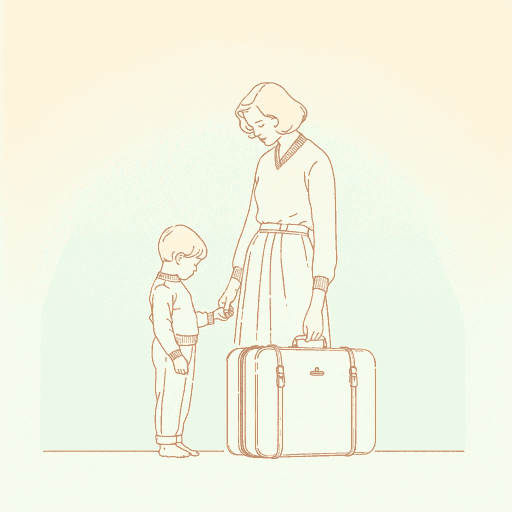
When readers first meet Bet, she is fully invested in being a mother. Her clothes are disheveled, she is physically and emotionally depleted, and she has no personality separate from her son. Every decision is focused on either meeting Arnold’s needs or presenting him favorably to the world. Unlike her ex-husband, she has not yet abandoned her responsibilities. On the train, she watches Arnold closely, even when he’s sleeping, and she is hypervigilant about potential threats to him. Readers have no indication that Bet could ever be anything else but a mother until she closes her eyes and remembers her childhood, literally and figuratively denying her role.
When Arnold’s head “[snaps] up” (34), Bet returns to her motherly duties, desperately trying to keep him entertained. Later, when the conductor has a confrontation with another passenger over money, Bet “[looks] gratefully” at her because the incident made Arnold laugh. This entire scene exemplifies Bet’s feeling of entrapment in her current identity. She is physically trapped between the conductor and Arnold, unable to escape her anxiety, and she is relieved when the incident provides a momentary reprieve instead of an escalation. For a few minutes, someone else is entertaining her son, and she feels grateful. She is still not able to voice her emotions, but a glance in the lady’s direction is a start.
The first time Bet airs her true desire is when she pleads with the taxi driver to wait for her in the hospital parking lot. She speaks quickly and repeats the request several times; she is desperate for him to understand. The subtext here, which of course the driver does not know, is that Bet is not simply imploring him to make a quick getaway from the hospital; she is begging him to help her leave motherhood behind. Shifting her identity from mother to single woman requires abandoning her child; ironically, while trying to carve out her own identity, Bet ends up dehumanizing Arnold, believing that he won’t care whether he lives at home or in a hospital, with or without a mother. This is acknowledged as a fallacy through the scream in the hospital, either Arnold protesting being left behind or a manifestation of Bet’s conscience. For her part, Bet does not find this action as easy as she envisioned, and she is panicky in the final scenes.
The identity Bet finally embraces is one of a bystander. She decides that “from now on, all the world was going to be […] just something on a stage for her to sit back and watch” (36). This new outlook allows her to transition from someone with all the responsibility to someone with no responsibility, someone who merely has to wait for the world to put on a “private play” (36) for her, instead of the other way around. While one can hardly blame her for wanting this kind of passive existence, it is hardly the kind of agency readers envision for Bet. The story’s anticlimactic resolution conveys Tyler’s implication that, while an individual’s definition of selfhood is essential, in the end, it may not be possible to completely transcend social ideology.
The Power and Effects of Memory
Throughout the story, Tyler delineates memory as powerful, no matter the circumstances. For Arnold, memory is an essential tool for building familiarity, which in turn helps him cope with the world. Even though Arnold’s newer brown corduroy jacket “had set [Bet] back half a week’s salary” (32), he would rather have his old red coat. Arnold does not understand that the red jacket no longer fits; he only knows that it is familiar. He remembers it as his jacket. When Mrs. Puckett gifts him the peanut butter cookies as he leaves, he is too distracted and stimulated to react to them. Later, in the taxi, as they approach the hospital, he reaches for the cookies. He does not associate the cookies with Mrs. Puckett, as she would probably like, but he does seek the comfort of his favorite cookies in a stressful time. Arnold’s memories are linked to concrete objects and likely reinforced through repetition, but predictability is key to his equilibrium. Arnold’s memories and their associations are also uncomplicated. Everything he encounters is either good or bad, unsettling or calming; there is no gray area. Like the coat and the cookies, the bus is a familiar experience, so Arnold enjoys the ride. The train is new for him, however, so he “[acts] a little nervous, bouncing up and down in his seat and flipping the lid of his ashtray” (33). He has no recollection of a train ride to draw on, so it is unpredictable and, therefore, objectionable.
Arnold’s unambiguous, binary world built on repetition and long-term memory directly contrasts with Bet’s complex existence full of conflicting emotions. For Bet, memories are complicated. In her apartment, she is disturbed by “that feeling of too many lives layered over other lives” (32). Here she personifies the walls, imagining they have memories of everyone who ever lived there. She bears the self-imposed burden of the “clutter” of all those layers, feeling that “nothing you could do to [the apartment] would lighten its cluttered look” (32). Bet allows these hypothetical memories to penetrate her mind and mood, which only adds to her sense of imprisonment. Her memories of Arnold’s infancy also exhibit negative emotions. She remembers how Arnold’s erratic movements “gave [Avery] chills” and made him sick, and how “she even knew how he felt, more or less” (33). This memory leads her into another sequence in which she recalls both parents wondering whose genetics caused Arnold’s condition. The guilt she felt then mirrors the shame she is feeling now; in the memory, she is the reason for her and Arnold’s tough circumstances, and now, on the train, she is preparing to be the reason his pain will worsen.
To escape her misery, Bet must think back to her childhood, a time she recalls as “beautifully free and spacious” (33). Although she acknowledges that time may have changed her perception of her parents, she allows herself to revel in the whimsy for a moment. True to life or not, the recollection of her father brings her a spark of hope and a reunion with her own fortitude. While Bet recognizes her memory’s fallibility during the happy moments, she never considers it during painful ones. This imbalance dilutes the confidence she gains from remembering her father and strengthens the self-loathing she garners from the recollection of Arnold’s infancy. Through these examples, Tyler portrays that memories can be comforting and inspiring, but they can also be harmful or even deceitful, especially for someone who does not challenge his or her internal philosophies.
Combatting Mental Health and Disability Stigma
Tyler combines her focus on ordinary people with differing portrayals of mental health concerns to shift the societal view of mental challenges. This plants the seed of a new norm: In one way or another, everyone has trouble adapting to the world’s challenges and needs support to get by.
Through the 1970s, mental health conditions were considered unacceptable and unmentionable. Psychological difficulties carried a huge stigma, and anyone labeled “handicapped” or “disabled” was an outcast. The obvious example of this negative typecast is Arnold Blevins. Arnold is nonspeaking and moves erratically, so “people stare at him” and Bet “would [like] to push their faces in” (33). While protective of her son, Bet spends much of her energy trying to make him presentable to the world—buttoning his coat, straightening his collar, et cetera—as a way of managing his condition. Between society’s stigma and the strain of raising a child with a disability alone, Bet can only see Arnold’s condition as a problem; she and her ex-husband blamed themselves for Arnold’s ways because “you can’t believe a thing like this will just fall on you out of nowhere” (33). This barrier toward accepting Arnold as he is rather than wishing for a different outcome leads to Bet’s decision to abandon him.
Throughout the story, Arnold is seen as “other,” and the only person besides Bet to show love for him is Mrs. Puckett, a “soft lady” who makes his favorite cookies as a going-away present for him (32). Even her motives are unclear, however. When Arnold shows no signs of gratefulness or even recognition of her, she “[flaps] her large hands and [gives] up, sobbing” (33). Tyler is ambiguous, though, as to whether this display of emotion relates to true love and acceptance of Arnold or to her own sense of guilt that, like Bet, she could not continue to protect him from the harsh world. Bet muses that “maybe [Mrs. Puckett] felt to blame that he was going. But she’d done the best she could” (32). Everyone who interacts with Arnold treats him as a “thing” to be tidied, prodded, entertained, tolerated, or feared, rather than a human with similar wants, needs, dreams, or aspirations.
In the mid-20th century, many people believed that if individuals with mental health conditions were allowed into society, they would be dangerous or violent. Psychiatric hospitals and institutions were established to provide a place for developmentally disabled people to go when they had no other options. However, many of these hospitals used unethical and inhumane means to keep patients calm and contained, essentially stripping them of any agency or identity. Tyler alludes to this type of establishment with Bet’s description of Arnold’s future home. Everything is white, gray, and sterile; there is a pervading smell of disinfectant; and “there [isn’t a sign that children [live] there” except for one small picture on a “vacant wall” (35). The nurse informs Bet that they keep residents isolated for six months, with no visits from family, to give them time to “settle in” (35). All the “little white cots” are the same, with no allowances for individuality or the comforts of a real home. This is not a place for nurturing children; this is a warehouse for entities no one else will claim. The hospital’s cold unsuitability is reinforced by the scream in the penultimate scene; while Bet hopes that she is doing the right thing for herself and Arnold, the disembodied scream insists otherwise. Whether the scream comes from Arnold or not, he knows that his mother—his only companion—is abandoning him.
Although Arnold’s situation is the primary example of how society others those with mental health conditions, Bet is isolated and struggling to cope with her situation as well. The years of being Arnold’s primary caregiver have worn her down, but through her memories, readers see that she has had a lifelong battle with self-esteem and self-worth. Bet’s alienation is more subtle than Arnold’s but nonetheless impactful. She does not seem to have any friends. Even Mrs. Puckett, Arnold’s babysitter, is no more than an acquaintance, as evidenced by the fact that Bet refers to her with a respectful title and last name instead of a first name. Her husband left her, her parents have died, and she does not have siblings, so she is effectively alone in the world. While Bet is capable of surviving this way—she has a job and has managed to finance their lives for nine years—she is far from thriving. She lives in her head much of the time, remembering times when she had a more interactive life or criticizing herself. Bet lives in a vacuum, isolated from context or anything that would challenge her beliefs. A 21st-century doctor might acknowledge her burnout and low self-worth and develop a treatment plan, but in 1977, she is just a tired mother who is out of options.
Bet’s final decision to “sit back and watch” the world illustrates her numbness (36). Before the mayor and his assistants arrive, she is struggling with the prospect of entertaining herself for 20 minutes. Like the station she describes, Bet is “nothing but a shell” (36). Enveloped in anguish, she sits down and cries, but as soon as she realizes they are “putting on a sort of private play,” she “[wipes] her eyes and [smiles]” (36). This is not the smile of a happy woman; this is the empty smile of a woman who has been provided another distraction from her suppressed pain. Up until this moment, Arnold has been Bet’s distraction, but now, she can shift her attention to the “play” of the world and avoid feeling for a little longer.
Arnold’s and Bet’s issues are disparate, but they both experience the negative effects of the stigma of being mentally unwell, whether overtly or not. Neither character fits into the 1970s version of “normal,” Arnold being disabled and Bet being an unmarried single mother. However, through their character development, Tyler suggests that they are normal, or ordinary. If readers can see Bet and Arnold as simply human, not subhuman, then they can accept that everyone is human. Everyone grapples with their own psychology in some way, and thus mental illness is not an anomaly.

Unlock every key theme and why it matters
Get in-depth breakdowns of the book’s main ideas and how they connect and evolve.
- Explore how themes develop throughout the text
- Connect themes to characters, events, and symbols
- Support essays and discussions with thematic evidence