Bat and the Waiting Game
48 pages • 1-hour read
Elana K. Arnold, Illustr. Charles SantosoBat and the Waiting Game
A modern alternative to SparkNotes and CliffsNotes, SuperSummary offers high-quality Study Guides with detailed chapter summaries and analysis of major themes, characters, and more.
Chapters 1-6Chapter Summaries & Analyses
Content Warning: This section of the guide includes discussion of ableism.
Chapter 1 Summary: “Skunk Kits”
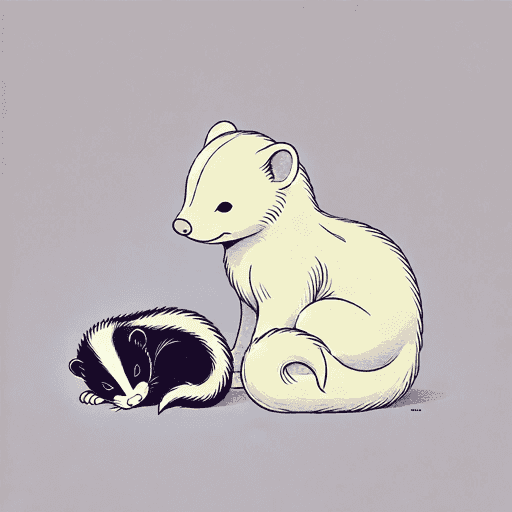
The story begins in the spring, one week after Bat’s mother agrees to let him care for an orphaned skunk named Thor until he is old enough to be released into the wild. Bat feels peace and contentment as he feeds the six-week-old kit and watches him sleep. Bat surveys his room, which contains a neatly made bed with a red and blue quilt and a brown dresser full of tidily organized clothes. The boy keeps his most important belongings on a bookshelf, including “his favorite possession, his animal encyclopedia” (3).
The previous Monday, a boy named Israel gave Bat a small sculpture of a skunk kit that he made in his mother’s pottery studio. Although the sculpture bears little resemblance to Thor, Bat feels “a warm good feeling” when he looks at the signature on the bottom of the piece of art because a “friend had given him a gift” (3). He keeps the sculpture on his bookshelf.
Chapter 2 Summary: “Dinner Conversation”
Bat likes to complete his chores, such as setting the table for dinner, while holding Thor. Laurence, a veterinary technician who works with his mother, made a sling for him that allows him to keep his hands free while carrying the skunk. However, Bat’s older sister, Janie, objects that it isn’t sanitary for Bat to handle dishes and cutlery while carrying an animal. Bat considers her logic faulty, but he takes a deep breath and puts Thor in his bedroom while he completes the chore because his mother made him promise that there would be “[n]o family disharmony” if he was going to raise the kit (6).
Bat expresses his frustration with his sister by slamming the dishes onto the table and giving Janie water instead of lemonade. She notices and taunts him with a smile, saying, “Thank you […] Sugar isn’t good for my voice before an important audition” (8). On Monday, Janie plans to audition for the Queen of Hearts in her school’s production of Alice in Wonderland. Janie criticizes her brother for having their mother cut up his enchiladas because he dislikes the texture of the cheese instead of practicing how to do this himself. He retorts that practice hasn’t improved her singing, even though he secretly thinks that she sings beautifully. When Janie criticizes how frequently Bat talks about Thor, he begins reciting facts, such as skunks’ life expectancy. His mother interrupts and suggests that they all have some of the brownies that Janie baked that afternoon.
Chapter 3 Summary: “Parts”
Bat’s parents are divorced. His mother is a veterinarian, and his father is a computer engineer. His full name is Bixby Alexander Tam. His first name is his mother’s maiden name, and his father shares his middle name. Bat likes how his name reflects both of his parents’ influences on his identity. Every other weekend, Janie and Bat stay with their father at his apartment. Bat starts to dislike these visits because he has to leave Thor at his mother’s home, since his father doesn’t like animals.
Early on Saturday morning, Bat brings Thor outside and feeds the kit a bottle of formula. Janie joins her brother, comments that the growing skunk looks cuter to her, and asks when the animal will start spraying. Bat explains that skunks “only spray if they feel threatened” (17), so Thor might never demonstrate that behavior. Janie teases that the skunk might spray if she tickles her brother, and Bat tells her not to in “a really calm voice” so that he doesn’t alarm Thor (20). Bat likes to help his sister with her hair, and he offers to put Thor in his room first when she invites him to help her with her curlers.
Chapter 4 Summary: “A Stinky Joke”
That weekend, Bat and Janie stay with their mother. Janie’s friend Ezra comes over to help her practice for her audition on Monday. He tells Bat a joke: “What do you call a flying skunk? [….] A smellicopter!” (21). Bat is so perturbed by the pun and the boy’s laughter that he needs to use some of his self-soothing techniques to calm down, such as taking deep breaths, bouncing up and down, and wiggling his shoulders.
His mother can tell that he’s upset, and she holds out her arms to indicate that she’s available if he would like a hug. Sometimes Bat doesn’t like to be touched, so she waits for him to step forward into her embrace. The boy rests his head against his mother’s stomach and relaxes at her familiar fragrance of “sunshine and peppermint and pine” (23). When he’s ready to end the hug, he taps her leg to signal this. When Dr. Tam invites him to garden with her, Bat remembers that he has to do a partnered research project for school. He excitedly proposes that he could grow vegetables that skunks enjoy for his project. His mother happily agrees and suggests that he ask Israel to be his partner. When Ezra makes another joke, Dr. Tam chimes in with a pun of her own, and Bat laughs.
Chapter 5 Summary: “Almost Late”
On Monday morning, Bat waits for Israel in the parking lot of the Saw Whet School because he doesn’t want someone else to ask his friend to be their research partner first. Dr. Tam waits with her son and suggests that they play a waiting game because waiting is one of the things that Bat finds most challenging. However, all of his attention is focused on his research project idea and his eagerness to talk to Israel. Bat’s teacher, Mr. Grayson, tells him good morning, and his mother squeezes the boy’s shoulder gently to remind him to return the greeting.
When his friend arrives, Bat is so excited that he shouts out his idea “right in Israel’s face” (28). Israel happily agrees to be his partner. Bat asks his mother to tell Laurence, who takes care of Thor while he’s at school, how much formula the skunk had for breakfast. Then he follows Israel inside the school building. Israel starts to explain why he was almost late for class that morning, but Bat interrupts to talk about skunks’ diet and his ideas for the project.
Chapter 6 Summary: “Carrot Division”
Usually, Bat visits the class pet, an angora rabbit named Babycakes, as soon as he enters Mr. Grayson’s classroom. However, he doesn’t have time to give the rabbit the carrot that he packed before class because he was waiting in the parking lot for Israel. Bat is unable to concentrate on the math lesson because of his “itchy feeling that Babycakes needed the carrot” (34), so he goes over to the rabbit’s pen. He tries to be silent to avoid drawing attention, but a few of his classmates stare at him.
As Bat is feeding the rabbit, Mr. Grayson calls his name, and the boy’s startled jump sends the frightened rabbit scurrying into his hutch. Mr. Grayson asks Bat to wait to spend time with the rabbit until the class takes a break, but the boy wants to make sure that the animal is all right first. Reluctantly, Bat breaks the carrot into pieces, leaves them in the rabbit’s enclosure, and returns to his seat.
Chapters 1-6 Analysis
Like many works of children’s literature, Arnold’s middle-grade novel offers young readers moral lessons. Chapter 5 establishes waiting as a motif of the novel’s thematic focus on Developing Patience and Empathy. Arnold introduces Bat’s struggles with patience, saying: “Waiting was one of the things that was very, very hard for Bat. Sometimes playing a game made time pass more quickly” (27). Although Bat demonstrates some restraint by practicing deep breathing exercises instead of arguing with Janie about Thor’s sling in Chapter 2, he tries to irritate his sister and makes hurtful comments about her singing “even though he secretly [thinks] that Janie had a beautiful singing voice” (10). Bat’s impatience leads him to interrupt Israel in Chapter 5: “‘Bat,’ Israel said, ‘I was telling you about why we were late!’ ‘You weren’t late,’ Bat said. ‘You were almost late’” (31). Although Bat isn’t trying to hurt his friend’s feelings, he doesn’t realize how moments like this gradually form a pattern and make Israel feel ignored. The novel’s early chapters establish that Bat needs to grow in patience and to learn how to develop empathy—considering situations from others’ perspectives.
By depicting the everyday life of a child with neurodivergence, Arnold examines The Need for Supportive Environments. The story opens in Bat’s home, the setting where he feels most supported and comfortable. By beginning the novel with descriptions of his neat and tidy bedroom, the author establishes that Bat thrives on routine and organization. This context encourages the reader to understand why Bat becomes distressed when his schedule is disrupted later in the story. The motif of Thor, who is also introduced in the first chapter, underscores the need for support because the skunk kit depends upon others’ support for his survival and because Bat’s caregiving responsibilities for the animal have a positive impact on the boy’s emotional regulation and overall well-being.
Dr. Tam quickly emerges as a key figure in the story’s thematic development through her loving care for Bat’s physical and emotional needs, such as her understanding that he “sometimes didn’t feel like being touched when he was upset” (21). She strives to provide a consistent, supportive home for her son despite the ways that the divorce necessitates a time of transition and adjustment, introducing Navigating Shifting Family Relationships as a central theme in the story. One way that Arnold illustrates the supportive nature of Bat’s home environment is by demonstrating that he’s free to engage in self-stimulating behavior (stimming) without judgment or pressure to behave neurotypically. For example, he regulates his emotions through repeated movements, a common form of stimming, in Chapter 4 Bat “let[s] himself bounce on the balls of his feet ten more times before putting his heels on the floor. He wiggle[s] his shoulders around the way that helped him relax, and his arms [drop] slowly to his sides” (22). Arnold’s story shows how families can foster environments conducive to the needs of children with autism and reflects humans’ universal need for support and understanding.
The Saw Whet school acts as another prominent setting in the novel that develops the theme of supportive environments. Mr. Grayson helps Bat and his other students feel comfortable by giving them autonomy to recognize and act on their needs: “Mr. Grayson had said that the class had an ‘open-door Babycakes policy,’ meaning that any time a kid needed to cuddle, he or she could go visit Babycakes, no permission needed, no questions asked” (34). Although there may be some inconsistencies in how the teacher applies this policy (such as setting Bat the challenge of waiting until break to feed Babycakes), Mr. Grayson’s classroom management style is rooted in trust and respect, and his mindful choices create a safe and supportive atmosphere for his students. Despite Bat’s attachment to his school and his teacher, he feels like an outsider among his classmates, as evidenced by his discomfort at the attention he receives from his fellow students when he goes to Babycakes’ pen in Chapter 6. The protagonist’s difficulty connecting with his peers makes his connection to Israel, his first close friend, even more significant. Israel remains an important character throughout the story, and the sculpture of Thor that he gives Bat acts as a symbol of friendship.
Arnold uses several literary devices to depict Bat’s experience of neurodivergence. Autism is characterized by a heightened sensitivity to stimuli like textures and scents, and imagery allows the author to show how physical sensations impact the ways Bat navigates his environment and regulates his emotions. He’s averse to certain textures, like the elasticity of “hot melted cheese” (8), but other sensations facilitate a sense of calm and well-being for him, like “the soft, warm weight of Thor in his hands” (1). The author’s use of imagery also supports the novel’s realism by helping her portray alexithymia, which refers to difficulty recognizing and describing one’s own emotions. This trait is often seen in people with autism. Accordingly, instead of naming Bat’s emotions, the narrator sometimes describes his feelings as physical sensations. For example, “a warm good feeling spread[s] through his chest and up his neck” when he thinks about Israel and the sculpture he gave him (3), and he has an “itchy feeling” when he wants to feed Babycakes (34). This usage of imagery is an example of how Bat’s perspective influences the third-person limited narration. It also demonstrates how Arnold employs literary techniques to help her audience better understand the point of view of a child with autism.

Unlock all 48 pages of this Study Guide
Get in-depth, chapter-by-chapter summaries and analysis from our literary experts.
- Grasp challenging concepts with clear, comprehensive explanations
- Revisit key plot points and ideas without rereading the book
- Share impressive insights in classes and book clubs