Bat and the Waiting Game
48 pages • 1-hour read
Elana K. Arnold, Illustr. Charles SantosoBat and the Waiting Game
A modern alternative to SparkNotes and CliffsNotes, SuperSummary offers high-quality Study Guides with detailed chapter summaries and analysis of major themes, characters, and more.
Symbols & Motifs
Thor
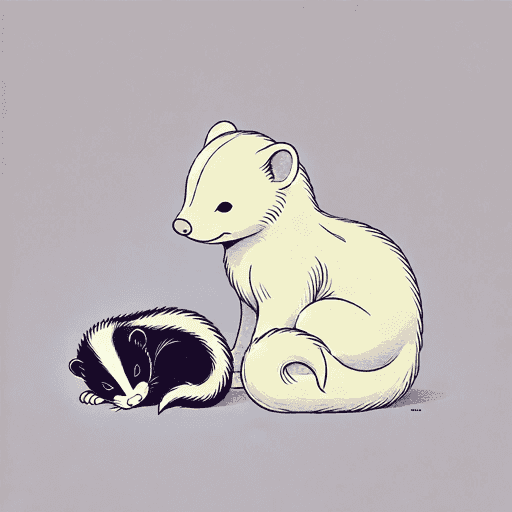
Thor serves as a motif of The Need for Supportive Environments. The orphaned skunk kit is only six weeks old at the start of the novel, so he depends upon the Tams for survival. Bat provides him with consistent, loving care, as evidenced by his attention to “Thor’s food dish, which Bat filled four times a day, and a water dish, which he changed and refilled every morning and night” (108). As Thor grows and his needs evolve, Bat’s support for the skunk evolves along with him. He provides the animal with more enrichment by building him a play pen and teaching him tricks, and he undertakes a research project devoted to providing the skunk with a healthy, varied diet. Thor can grow up safe and secure thanks to the Tam family’s support, especially Bat’s. As Bat cares for Thor, it also teaches him how to identify and meet the needs of his family and friends.
At the same time, Thor is an essential part of Bat’s support system, bringing him comfort, joy, and calm in ways compatible with his needs and preferences as a child with neurodivergence, from the soothing, self-stimulating behavior of petting his “soft, warm” fur to sharing knowledge he gained due to his special interest in skunks (1). The strong bond between Thor and Bat promotes both characters’ well-being and gives the novel one of its primary examples of the importance of supportive environments.
The Skunk Kit Sculpture
The ceramic sculpture of the skunk kit serves as a symbol of friendship, highlighting how his bond with Israel supports and changes Bat. One of the most important aspects of the boys’ relationship is the understanding Israel shows Bat. He demonstrates this insight into his friend’s character by creating a sculpture inspired by Bat’s love for Thor. When the sculpture first appears in Chapter 1, Bat observes that the “clay lump […] didn’t look much like a skunk kit” but merits a place on Bat’s shelf of important objects because it’s “a gift” from a friend (3). The importance Bat places on the sculpture reflects the value he places on his friendship with Israel.
The sculpture’s medium also holds symbolic meaning throughout the novel. The ceramic’s fragility reflects Bat’s fear that he’s damaged or even shattered his friendship with Israel after his outburst in Chapter 19: “Bat wondered if new, different mistakes would be better than the mistakes he had made […] not knowing how to be a better friend to Israel, maybe not being his friend anymore at all” (160). The sculpture’s “smooth, shiny” surface is markedly different from the soft, fluffy textures that Bat usually derives comfort from (3). However, he feels “a sweet warmth in his chest, almost as if the skunk kit was cuddled there” when he holds the object at the end of the novel (172). By taking the sculpture to the make-up performance, Bat shows that he understands that he can’t bring Thor everywhere and finds another way to regulate his emotions. The skunk kit sculpture represents Bat’s friendship with Israel and shows how their connection helps Bat grow in flexibility, empathy, and connection with other people.
Waiting
Waiting serves as a motif of the theme of Developing Empathy and Patience. Its inclusion in the title signals that patience is one of the main skills Bat needs to develop across the novel. Chapter 5, in which Bat eagerly waits for Israel in the school parking lot, mentions the eponymous waiting games and explains that “[w]aiting was one of the things that was very, very hard for Bat” (26). In part, exercising patience poses a challenge for Bat because he thrives on familiarity and struggles with uncertainty: “Sometimes life meant lots of waiting and not knowing” (111). The motif reappears during the baseball game in Chapter 12. At first, Bat loathes going to the stadium with his father because he associates baseball with “[l]ines to park the car, lines to get through the entry gate, lines to use the bathroom, lines to buy snacks and drinks, lines to get to your seats” (78). However, the game becomes a positive bonding experience for Bat and Mr. Tam when he considers his father’s perspective and makes an effort to enjoy their time together rather than simply waiting to go home.
Gardening provides another positive opportunity for Bat to practice patience. After planting the seeds, Bat has to “wait for the plants to grow” (103), and his excitement about feeding Thor healthy, homegrown vegetables makes this more bearable. As is the case for many children, patience remains a challenge for Bat at the end of the story, but he’s learned that some things are worth the wait.

Unlock the meaning behind every key symbol & motif
See how recurring imagery, objects, and ideas shape the narrative.
- Explore how the author builds meaning through symbolism
- Understand what symbols & motifs represent in the text
- Connect recurring ideas to themes, characters, and events