Bhagavad Gita
Bhagavad Gita
A modern alternative to SparkNotes and CliffsNotes, SuperSummary offers high-quality Study Guides with detailed chapter summaries and analysis of major themes, characters, and more. For select classroom titles, we also provide Teaching Guides with discussion and quiz questions to prompt student engagement.
Summaries & Analyses
Plot Summary
Chapter Summaries & Analyses
Key Figures
Themes
Symbols & Motifs
Important Quotes
Essay Topics
Quizzes
NEWReading Tools
Games
Key Figures
Arjuna
Arjuna is one of the key figures in the Bhagavad Gita. His conversation with Krishna is the main body of the text. Arjuna lacks understanding in many fields, so his attempt to learn more about theology, spirituality, and the universe helps the audience to understand these concepts. Arjuna’s inquisitive approach means that he functions as a vessel through which the audience can learn from Krishna. His role in the text is that of student. As the student, Arjuna allows the reader to learn alongside him.
Arjuna is also a prince and the leader of an army. He finds himself in a difficult position when he recognizes familiar faces in the opposing army just before he is about to do battle. This recognition inspires a moral conundrum. Arjuna does not know whether he can bring himself to kill anyone, yet alone members of his family. This moral quandary makes Arjuna a more sympathetic figure. His moment of doubt shows that he is not a ruthless killer. He is not a warlord bent on destruction and seizing the kingdom. Arjuna is actually a reflective, moral person who has doubts about his actions and wants to be certain that what he is doing is right. The pause before the battle allows Arjuna to ensure his deeds are morally sound before he continues. He is given permission to carry out the battle, and the length of time he commits to his moment of doubt shows how much he values morality and religion.
Arjuna transforms throughout the text. He begins as a noble prince who has sought Krishna’s help in conducting a battle to reclaim a kingdom that was wrongfully taken. The conversation with Krishna teaches Arjuna the true meaning of his actions. The battle he fights is not with the rival army but with his conscience. Arjuna as the doubting student is at war with himself. The conversation, the lessons, and the vision of Krishna’s true form change Arjuna. They show him the context in which he exists in the universe. The ending of the text is not a giant battle or declaration of war. Arjuna closes the story by dedicating his life to Krishna. His transformation into an educated, pious man is the story of the Gita.
Krishna
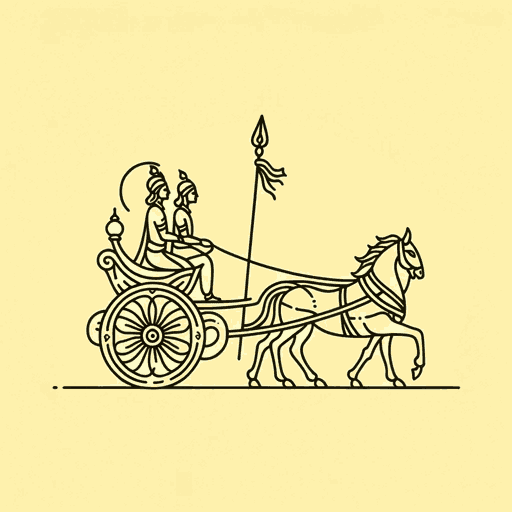
Krishna is a major figure in the Hindu religion and a key figure in the Bhagavad Gita. In the text he appears in a human form as a human male. He also plays the role of charioteer and counselor to Arjuna. His aim is to assist Arjuna and educate him in the nature of the universe and religion in the hope that these ideas will spread. The conversation between Krishna and Arjuna is the main part of the Gita in which Krishna explains how and why a person should live their life in a religious manner.
Krishna is a god. The concept of a god in Hindu literature and religion can seem strange and complex to Western audiences. Krishna is an incarnation of the god Vishnu. Gods can appear in different forms, and they appear as one another in Hinduism as a demonstration of the oneness of existence. Krishna’s unlimited power allows him to take any form and allows other gods to appear as him and vice versa. In the context of the Gita, Krishna is the omnipotent god and the most powerful being in the universe. He knows everything and wishes to pass some of this knowledge along to Arjuna.
Krishna plays the role of teacher. He is a patient and informed educator who guides his student Arjuna through complicated and occasionally conflicting ideas. He uses metaphors and analogies, such as the fig tree and the Field, to convey his ideas. When the lessons become slightly too esoteric, Krishna provides a demonstration of his power. He gifts Arjuna the power of divine sight, and this allows Arjuna to view Krishna in his true form. This vision is a privilege, and it convinces Arjuna of Krishna’s incredible power. The vision also signals Krishna’s success. The sight of the true form of the most powerful god convinces Arjuna of the importance of everything that Krishna has said. Krishna’s teaching changes Arjuna as a person. Krishna may be omnipotent, but his slow and methodical argument to Arjuna is more effective than simply inserting the information into Arjuna’s mind. Krishna’s lessons are shared through Arjuna, and they become a framework for future worshipers. The conversation shows that Krishna understands the value of Arjuna learning his lesson naturally. Krishna successfully convinces Arjuna of the importance of faith and providing a model for others to achieve enlightenment.
Dhritarashtra
Dhritarashtra is a blind king and a relative of those fighting on both sides of the battle. The story of how Dhritarashtra and his family came to control the kingdom through unscrupulous means is told in the larger story and history in which the Bhagavad Gita is situated. In the context of the Gita, Dhritarashtra functions almost entirely as a metaphor. He is the sinful man who cannot see the reality of the world. Dhritarashtra’s blindness has symbolic meaning in this respect. His blindness represents the ignorance of the world. Dhritarashtra’s status as a king and his limitations as a blind and ignorant man illustrate why people must worship Krishna. Krishna goes to Arjuna rather than Dhritarashtra because he sees the benefits of convincing Arjuna. Arjuna is a wise and inquisitive man who wants to know more. Dhritarashtra is old, immoral, and uncapable of seeing what is before him. Arjuna becomes the receptacle of learning, while Dhritarashtra is left alone to listen to Sanjaya.
Sanjaya
Sanjaya is Dhritarashtra’s counselor. He provides updates and advice for the old blind king. After the battle, Dhritarashtra asks Sanjaya for an update. Sanjaya does not explain what happened during the battle. The Gita is Sanjaya’s account of the conversation between Krishna and Arjuna, which took place on the battlefield before the armies met. Sanjaya is wise enough to understand that this conversation is more important than the battle itself. He understands the ramifications of what was said by Krishna and the importance of the advice and lessons passed down to Arjuna.
Sanjaya is framing device for the conversational narrative between Krishna and Arjuna. He also works as a narrative tool that allows the story to cut back to Sanjaya at certain moments. When Krishna reveals his true form to Arjuna, the narrative returns to Sanjaya. The complexity and the wonder of Arjuna’s vision are too complicated to be put into words, so the switch to Sanjaya neatly sidesteps this issue. Sanjaya’s role is to be the storyteller. Because he is the storyteller, he deploys narrative tricks. The use of these tricks, such as the cutaway from Krishna’s true form, emphasizes Krishna’s power and importance as well as the significance of his lessons.

Unlock analysis of every key figure
Get a detailed breakdown of each key figure’s role and motivations.
- Explore in-depth profiles for every key figure
- Trace key figures’ turning points and relationships
- Connect important figures to a book’s themes and key ideas