Big Dumb Eyes: Stories from a Simpler Mind
46 pages • 1-hour read
Nate BargatzeBig Dumb Eyes: Stories from a Simpler Mind
A modern alternative to SparkNotes and CliffsNotes, SuperSummary offers high-quality Study Guides with detailed chapter summaries and analysis of major themes, characters, and more.
Chapters 6-10Chapter Summaries & Analyses
Chapter 6 Summary: “My Sister the Alien”
Bargatze reflects on his youth in Lakewood, Tennessee. During Christmas in 1997, Bargatze’s younger sister, Abigail, was around nine years old and Bargatze was 18. Abby wanted to buy her family Christmas gifts, but she didn’t have much money. The Bargatze parents let Abigail use change from their change jar to buy everyone gifts. Abby bought mediocre gifts for their parents and middle brother Derek, but she tried hard to buy a nice gift for Bargatze—a DVD of the movie Men in Black—whom she especially wanted to impress.
When his brother, Derek, asked Bargatze about the movie, he responded, “Men in Black? Are you kidding me? I hate that movie!” (32). Abby heard this from the other room and was devastated. When Bargatze opened the gift the next morning, Abby burst into tears. Realizing that she heard what he said, Bargatze made up an excuse. He told her that he only said that he didn’t like it because he was afraid no one would get it for him for Christmas. He watched it with her that day and took her to see all the sequels for years to come.
Chapter 7 Summary: “The Ballad of Old Blue”
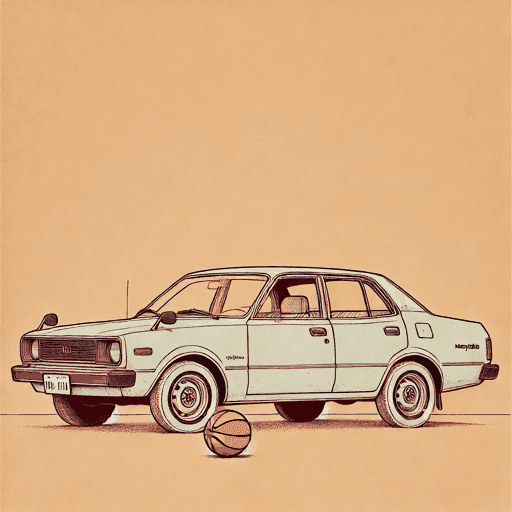
When Bargatze was in high school, he asked his parents for a car. The popular kids at school all drove nice cars, and Bargatze was especially jealous of his classmate’s new black Chevy Camaro. Bargatze’s parents got him a used Mazda 626 that he refers to as a “hunk of junk” (39). The stick shift was literally sticky, so Bargatze put a tennis ball over the top of it. Bargatze’s parents taught him how to drive the manual transmission in their church parking lot. Bargatze stalled the car repeatedly, frustrating his parents. Each time the engine died, he says, they went inside the church to say a prayer. Bargatze learned to imitate a teacher at his school, who used both feet—one on the brake and one on the gas pedal to drive. Bargatze continued to drive with both feet for years to come and considers himself a good driver.
Bargatze named his car “Old Blue” to give it personality so his friends would accept it among their much-nicer vehicles. One day, Bargatze accidentally backed into his classmate Brittney’s Saturn. Brittney was a popular cheer leader, and her Saturn was a good car for its time (the late 1990s). Brittney and Bargatze went to speak to Brittney’s father, but Brittney’s father was not angry at all, which Bargatze attributed to Old Blue’s charm.
Driving an old car helped Bargatze build character and appreciate what he had when he was young. Bargatze’s daughter is approaching adolescence, and Bargatze resolves to get her an old car no matter what she says. He also says that the car she drives must have “futuristic safety things that […] have been specially released only to my precious baby girl” (42).
Chapter 8 Summary: “The Perfect Sock”
Bargatze struggles more with insignificant decisions than with major decisions in his life. He has no trouble deciding on a payment plan for his house: He writes, “Easy. Whatever my wife says” (45). But he agonizes over which socks to put on each morning. Bargatze stresses the importance of a good sock. He prefers socks that are cushioned and don’t slip down throughout the day. No company has yet created a perfect sock.
Bargatze is also particular about belts and claims he wore the same belt for 20 years. He now switches between two belts in two different shades of brown, which he considers “a real sign of progress” (46). He also prefers to wear only one clothing brand at a time. Bargatze used to wear only Nike and then switched to Puma. He cites this transition as the type of change that he enjoys—“change with a whole bunch of same” (46).
Chapter 9 Summary: “The Time I Made the NBA”
Bargatze liked to play basketball in high school. He was a decent player but was cut from his school team every year (even the year that his dad is the assistant coach). Instead of playing for the school, Bargatze played for his church’s team, which was part of the Nashville Baptist Association, or NBA. The church’s league is surprisingly competitive, but he had the most fun playing when the stakes were low, as when he played by himself in his backyard at his childhood home or in P.E. class with his friends. In one memorable game, his friend, nicknamed “P-P,” scored the winning shot.
As an adult, Bargatze is still friends with P-P, and he still calls him by his nickname even though P-P has a career and family. Bargatze reflects fondly on the basketball games he played with his friends, and on his high school experience in general. He recently donated money to the school, and they named their basketball court after him.
Chapter 10 Summary: “I’m in Your Head”
Bargatze and his younger brother, Derek, were competitive with each other growing up. He even jokes that “I’m three years older than Derek, so he was literally born in second place” (59). Their father raised them this way: “Everything was a competition. Everything was a lesson about how tough life was” (60). Initially, Bargatze could win against Derek, but Derek grew up to be taller than Bargatze and a batter athlete.
When Bargatze was 20, for the first time in years, his family spent Thanksgiving with his mom’s side of the family in Kentucky. Bargatze’s family wanted to make a good impression, but the possibility was ruined when Derek and Bargatze argued over who won their game of Spades. Bargatze finally won the argument when he told Derek, “You will never beat me, because I am your older brother, and I am in your head” (65).
A similar incident occurred years later, during a family game of Risk. During the game, Laura and Derek planned to attack Bargatze, but an argument started, and Bargatze called Laura an “idiot.” Bargatze justifies this outburst by explaining that “The roots of ‘idiot’ as a term of endearment go way back in our family” (67). Laura ran out of the room, upset. Derek reprimanded Bargatze for speaking so harshly to his girlfriend. Later that night, Bargatze and Laura made up, but the Bargatze parents prohibit their sons from ever playing Risk together again.
Chapters 6-10 Analysis
The Importance of Strong Family Bonds is deeply woven into the Bargatze family’s time together. Even though Abigail is a young child, she loves her older brothers so much that she wants to impress them on Christmas despite having little money. Even though the anecdote is tinged with Bargatze’s remorse about Abigail overhearing his opinion about the movie, as in his comedy, Bargatze offers a self-deprecating response. The tradition they create of watching the Men in Black sequels every year shows that strengthening his bond with his sister is more important than whether he likes the movie.
The hurt feelings that occurred that Christmas morning foreshadow similar incidents later in the memoir. The chapter “I’m in Your Head” describes a Thanksgiving incident when Bargatze and Derek became too competitive over a card game and ended up fighting in front of their extended family. Many years later, when Bargatze and Derek were adults, a Christmas family game of Risk became too competitive and Bargatze hurt Laura’s feelings. Even when Bargatze and Derek both have young daughters, during another Christmas gathering, Bargatze challenged the two girls to compete in a game against each other, and they both ended up in tears. In this case, their feelings stemmed not from over-competitiveness but from regret at being forced to compete with each other. These holiday incidents show the negative outcome of placing pride and competition above building family bonds. The episode with Bargatze’s daughter shows that as a father, he has prioritized teaching his daughter fairness rather than competitiveness, until his old rivalry with his brother compelled him to fall back into that mindset. It’s also an example of how he chose to instill different values in his child than his father did despite looking up to his father in other ways.
The motif of cars surfaces in this section as Bargatze enters high school. His parents’ cars represent an earlier time in his life when he was reliant on his family, but Old Blue marks the beginning of Bargatze’s independence. The car’s nickname, Old Blue, is Bargatze’s way of using comedy and characterization to deflect from potential embarrassment over his family’s lower socioeconomic status. The car gains Bargatze’s friends’ approval because his comedic storytelling makes up for what it lacks. This represents Bargatze’s entire approach to his comedy. Instead of being embarrassed or ashamed of his impoverished upbringing, he praises and exaggerates its virtues. He does the same with Old Blue when he anthropomorphizes and nearly worships it. Pairing candid descriptions of the car (“a hunk of junk”) with Bargatze’s glorification of Old Blue (with its “natural charm”) adds humor to and acknowledges the truth of his situation. This is another example of the author’s tendency toward Finding Humor and Joy in Simplicity.

Unlock all 46 pages of this Study Guide
Get in-depth, chapter-by-chapter summaries and analysis from our literary experts.
- Grasp challenging concepts with clear, comprehensive explanations
- Revisit key plot points and ideas without rereading the book
- Share impressive insights in classes and book clubs