Black Woods, Blue Sky
57 pages • 1-hour read
Eowyn IveyBlack Woods, Blue Sky
A modern alternative to SparkNotes and CliffsNotes, SuperSummary offers high-quality Study Guides with detailed chapter summaries and analysis of major themes, characters, and more.
Symbols & Motifs
Bears
Content Warning: This section of the guide includes discussion of death.
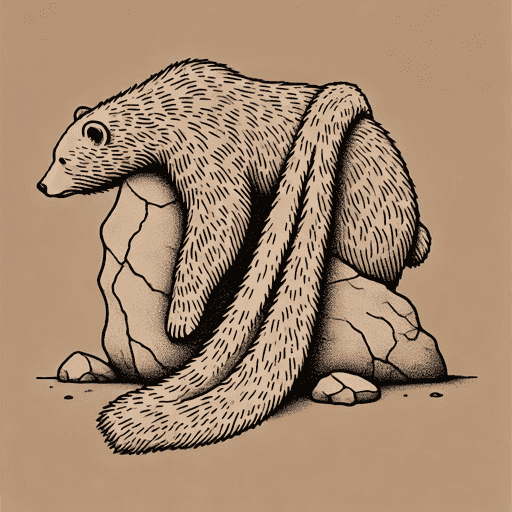
Bears symbolize primal, instinctual desires, reinforcing the struggle for survival in an unforgiving, wild landscape and how nature defines and destroys. The bear is a creature that can stand upright like a human yet remains undeniably wild and dangerous. Grizzly bears are described as nearly human in intelligence and behavior, creating a sense of kinship between people and these creatures. Syd explains to Birdie that the grizzly bear holds deep significance in Alaskan culture: “They prop up the bear’s disembodied head. They offer him food and drink and honor. It’s about fear. Reverence. Awe. But maybe shame too. Hell of a beautiful mess” (81). Indigenous Alaskan traditions often view the grizzly as a spiritual being, sometimes as an ancestor or a figure of transformation. Many Indigenous stories feature bears as shape-shifters or creatures with near-human intelligence, reflecting a belief in the fluid boundary between the animal and human worlds. Through this motif, Ivey employs the folk trope of the animal bridegroom as a psychological interrogation of hidden monstrousness, the inherent danger in certain behaviors, and the unseen forces that drive individuals toward destruction.
Arthur symbolizes the unsettling closeness between humans and animals and embodies this tension as he moves between human and beastlike existence. His movements from human society into a primal, instinct-driven state echo how bears move between civilization and the wild. Arthur symbolizes people’s hidden selves who resist domestication and are drawn toward something more elemental and dangerous. Arthur’s shifting nature recalls stories where a suitor’s true, often terrifying identity is gradually revealed. Unlike fairy tales where love or redemption can reverse the transformation, Ivey’s story presents a more unsettling reality. Birdie must confront Arthur’s hidden self and the extent to which she may have misjudged him from the start.
Arthur’s total transformation into a bear is a literal and metaphorical warning of predatory behavior and the way natural instincts can override moral consciousness. Arthur’s fate is inevitable, highlighting the dangers of allowing primal urges to dictate one’s choices. Arthur represents the allure of abandoning humanity to live alone by instinct as he gorges on food, roams the land, and becomes fully bear. Ivey reinforces this when Warren remarks that Arthur may have always been a bear at heart, highlighting that some people are naturally drawn toward the wild, no matter how much they try to remain tethered to society.
Light and Shadow
Ivey’s use of light and shadow reflects the novel’s exploration of truth, perception, and the boundary between the known and the mysterious. Light brings clarity, revelation, and moments of understanding, particularly in the wilderness. Birdie and Emaleen’s experiences in the wild are punctuated by the presence or absence of light, underscoring their dependence on nature’s rhythms and their shifting awareness of themselves in their new surroundings. After moving to the cabin, Birdie brings light by removing the window boards, exposing “clumps of fur and a stiff piece of animal hide with a soft, reddish-brown fur” (111), her first clue to Arthur’s truth. The solstice celebration intersects light and shadow, emphasizing the cyclical nature of time and transformation. As the longest day of the year, it represents endurance and the potential for clarity, yet it also acknowledges the inevitable return of darkness, much like human nature.
To young Emaleen, the shadowy dark represents a demarcation between safety and danger and the potential for adventure. She stands at the edge of the forest and considers “the thrill of stepping across a threshold, of trespassing into a shadowy place you’re not sure you belong” (102). Shadows represent uncertainty, hidden monstrosity, and danger. A shadow often suggests the presence of something beyond comprehension, whether it be the physical presence of a bear, the looming threat of violence, or the emotional weight of an unresolved past. Shadows become a manifestation of Emaleen’s trauma after her mother dies, and she’s convinced that the bear is after her. The interplay of shadow and light also mirrors the novel’s thematic exploration of The Line Between Reality and Fantasy, with the wilderness acting as a liminal space where figures like Arthur can exist between humans and animals, the real and the imagined.
Metamorphosis
The motif of metamorphosis reflects changes in form, identity, and self-perception. Through characters, setting, and mythic allusions, Ivey uses metamorphosis to explore the instability of identity, the primal instincts within human nature, and the inevitable forces of change in life and landscape. Throughout the story, the seasons shift from summer, to fall, to winter, and Emaleen transitions from being a child to a young adult. Being with Arthur causes Birdie to “become wild and powerful, soaring naked through the trees, a woman who ha[s] truly broken free” (70). On the eve of her departure for what she hopes is a new life, Birdie celebrates the solstice with her community, symbolizing being on the precipice of change. The summer solstice is associated with transitions and renewal in many cultures. By choosing this moment to leave, Birdie’s departure signifies a crossing of physical and psychological thresholds as she moves from the known world of human civilization into the wilderness.
Her journey mirrors ancient rites of passage in which individuals step away from society to undergo profound change. As the sun reaches its highest point, Birdie is on the cusp of transformation, preparing for an experience that will test and redefine her. Despite some physical changes like forgoing regular shaving and bathing, Birdie transforms mainly through heightened self-awareness and identity rather than form. Seeing that “[m]otherhood ha[s] failed to transform her” (43), Birdie seeks a reinvention of herself through leaving society. She initially sees herself as defined by the endless demands of work and motherhood, but living in the wild allows her to shed these limiting perceptions. Her journey mirrors a metamorphic process, akin to the shedding of an old skin, revealing a new understanding of herself.
Arthur sheds his skin physically, yet, unlike the rebirth that most animals experience when doing so, his rebirth is a painful confirmation of his inability to reconcile his bear nature with his desire to live in the human world. Instead of regaining his place among people, he remains an outsider, more lost than before. Arthur’s metamorphosis is tragic instead of redemptive. While surrendering to her innate nature makes Birdie more physically strong and mentally free, Arthur’s transformation into a man weakens him to the point of illness and depression. Through Arthur’s character, Ivey reveals that transformation is not always a choice but sometimes an inevitability. The novel’s exploration of mutation and transfiguration underscores the idea that identity is never fixed but constantly evolving. Metamorphosis can cause both self-discovery and self-destruction. Whether through Arthur’s descent into animalism, Birdie’s evolving sense of self, or the mutable landscape of Alaska, the novel demonstrates that change is both a force of renewal and a potential means of loss.

Unlock the meaning behind every key symbol & motif
See how recurring imagery, objects, and ideas shape the narrative.
- Explore how the author builds meaning through symbolism
- Understand what symbols & motifs represent in the text
- Connect recurring ideas to themes, characters, and events