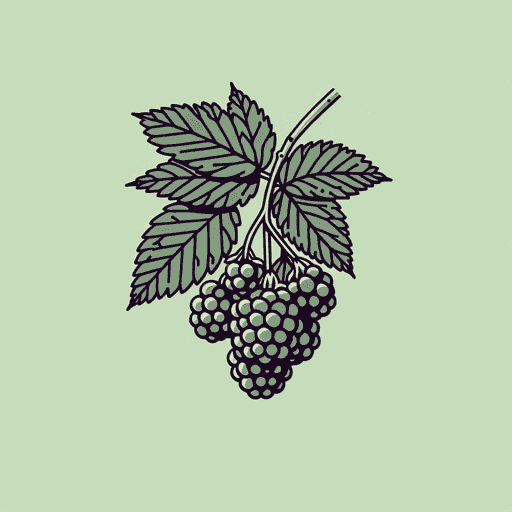
Blackberry Eating
Blackberry Eating
A modern alternative to SparkNotes and CliffsNotes, SuperSummary offers high-quality Study Guides with detailed chapter summaries and analysis of major themes, characters, and more.
Symbols & Motifs
Blackberries
Blackberries were a popular symbol in mid-century poetry. They are a fruit that grow in large parts of North America and Europe throughout late summer and early autumn. As such, blackberries can be foraged in urban, suburban, and rural areas. Blackberries are an excellent gateway into foraging your own food; eating them directly off the branch helps connect even the most adamant city-dweller with nature. Some notable poems about blackberries include Seamus Heaney’s “Blackberry-Picking” (1966), Sylvia Plath’s “Blackberrying” (1971), and Mary Oliver’s “August” (1983).
Kinnell likely chose blackberries as a metaphor for speaking and writing poetry because of their easy association. Many readers in North America and Europe might recognize blackberries and/or recognize the process of blackberry picking. Likewise, the sensation of eating a blackberry resonates with these readers in a tactile way.
Autumn
Early autumn can be a placid time of year in some parts of the US and abroad. Some places then receive severe frost that takes hold and help cause leaves to fall from trees. In the northeastern United States, autumn usually begins in late September, so summer berries are at the end of their fruiting. Kinnell likely chose this season as the poem’s setting because, for him, it is a peaceful space between the heat of summer and the freeze of deep autumn.
In poetry, autumn is also associated with maturity. In this case, Kinnell uses early autumn as a metaphor for the maturity of his verse. The poem’s speaker could forage blackberries in other seasons, but there might be more difficulties in place: the berries may not be ripe, he may encounter more dangerous animals like a bear, or the thorns may be thicker compared to the size of the berries. Because the speaker is an expert at his work, he knows to go out at exactly this time of year to gather blackberries with the least hassle. This maturity of knowledge correlates to the poet’s expertise with choosing the correct words when crafting a poem.
Eating
Eating is a sensuous motif in poetry. Any time food imagery is brought into a poem, the poet invites the reader to taste and experience delight, disgust, or mundane ordinariness of the food described. A poet can convey an entire range of emotions with just one piece of fruit, like in William Carlos Williams’s “This Is Just to Say” (1938).
Kinnell uses eating in this poem as a joyful celebration of how sounds form into words, then into sentences, and finally into a full poem. The poem’s speaker turns the “ripest,” juiciest berries (Line 7) on the stalk around on his tongue and they become the “certain peculiar words” (Line 9). By reading the poem aloud, the reader shares in this joy and feels the sensation of these peculiar words on their tongue.

Unlock the meaning behind every key symbol & motif
See how recurring imagery, objects, and ideas shape the narrative.
- Explore how the author builds meaning through symbolism
- Understand what symbols & motifs represent in the text
- Connect recurring ideas to themes, characters, and events