Blackbird House
60 pages • 2-hour read
Alice HoffmanBlackbird House
A modern alternative to SparkNotes and CliffsNotes, SuperSummary offers high-quality Study Guides with detailed chapter summaries and analysis of major themes, characters, and more.
Symbols & Motifs
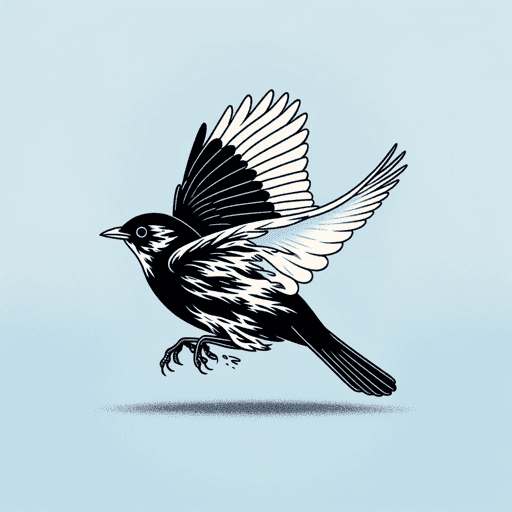
The Blackbird
In literature, blackbirds or crows often represent death or sorrow, and this is true in Blackbird House. In “The Edge of the World,” Coral Hadley holds out hope that her husband and sons are alive; however, when Isaac’s blackbird returns, now white, she knows that they’re dead. Only upon the creature’s arrival does she begin to mourn. The blackbird as a harbinger of sorrow is a pattern throughout the novel. For example, in “Lionheart,” when Violet’s son Lion leaves for Harvard and she acknowledges that he may never return, she spots a snow-colored blackbird overhead. The timing of this sighting correlates with Violet’s realization that she made a mistake and pushed her son away. In another instance, in “The Pear Tree,” when Billy Griffon feels uneasy upon hearing Meg Stanley cry, he “looked up and saw a big white bird in the old oak tree” (182), adding to the ominous feeling he already has. The moment foreshadows Dean’s death by suicide, and when Billy discovers the boy’s body, bird feathers litter the ground. These are only a few of examples of the white blackbird as a motif portending sorrow.
However, the novel expands on this by also tying the bird’s presence to the theme of Resilience Resulting From Adversity: The blackbird represents not only sorrow but also strength and hope. After losing her parents to smallpox and her home to a fire, Ruth Declan walks into town, and when “people looked out their windows […] a blackbird seemed to sweep by, followed by a herd of skinny milk-cows that had all turned to pitch in the fire” (25). The blackbird preceding Ruth does signal her sorrow, but because it leads her, the bird also acts as a beacon through tragedy. Despite suffering tremendous loss, Ruth survives and eventually finds love. Furthermore, the bird’s white hue connotes a more nuanced representation. Literally, the color indicates that it’s a ghost, especially given that Isaac Hadley’s bird couldn’t have lived for 200 years; however, the snowy color also suggests peace and hope. Most of the novel’s characters find a way out of their sorrow, but it takes time. The white blackbird’s relentless presence underscores that recovering from trauma isn’t a quick process but one that requires patience and resilience.
Colors: Red and Black
Red is a paradoxical symbol in Blackbird House, representing both fear and love. As established in “The Witch of Truro,” the townsfolk view red as a sign of witchcraft, hence their fear of Ruth’s red boots. Also, Ruth’s eldest daughter, Garnet, worries, “I had red hair, like my sister, and so I was called Garnet […] Now I wondered if people whispered things about me when I walked into town; I wondered what they said when my back was turned” (42). Garnet’s fear of being “whispered about,” or rumored to be a witch, stems from her ginger hair and her name. In the eyes of the town, red aligns with witchcraft and thus represents fear. However, from another perspective, the hue symbolizes love. For example, when Lysander looks at Ruth’s boots, “[h]e thought about the color of fire. He thought about flames. He thought he would never be hot enough to get the chill out of his body or the water out of his soul” (31). To him, red represents warmth, something he’s missing in his life. Since his fishing accident, he can’t shake the cold from his bones, and he lives a lonely existence. To him, Ruth’s red boots symbolize a warmth that eventually turns into love. She reciprocates this love after his death when, in her grief, she dyes everything red and cooks only red food. Her tears are crimson, and she kills a cardinal to watch what happens to its heartbroken mate. Although red is infused in her grief, Ruth’s mourning stems from her love for Lysander, demonstrating that perspective determines what this hue represents.
Likewise, although black typically symbolizes evil or deception, in this novel it symbolizes love. In the opening chapter, Isaac’s adoration for his blackbird is the first sign of this representation. “Black is the Color of My True Love’s Hair” is the next indication that black equates with love. While Violet doesn’t mention the hair color of either man (Ewan or George), she does say that when she first sees the professor, “[h]er straw hat made everything seem yellow” (78). This hints that he’s not her true love: She views him through the tint of her hat. When George brings her the singed bluefish scales, Violet realizes that George truly loves her and is willing to sacrifice his chances with her to bring her happiness. Ultimately, Violet recognizes that what she shares with Ewan is lust, not love; therefore, George is implicitly the one with black hair. While black often symbolizes evil or deception, in this case, it represents love.
Sweet Peas
The symbol of sweet peas represents love and nostalgia. Like Isaac’s blackbird, the flowering plant appears when the house is first built. After the storm, Coral sows the first crops: “She sprinkled the seedpods of pink sweet peas, feed for the cows they would someday have, and for remembrance as well. John had favored sweet peas and had brought her armfuls of the flowers when he was courting her” (13). Despite Coral’s intent to feed the flowers to the cows, she plants them as a loving gesture. At the beginning of their romance, her husband first brought her flowers, and now she returns the favor in the fields, a nostalgic nod to her love for John. Many years later, when Lion West falls in love, his thoughts return home: “Nothing in the world of mathematics had prepared Lion for love. Nothing about it added up. He would think about the sweet peas back home at the moment when he met Helen” (105). Consumed by his career teaching math, Lion is caught off guard by his feelings for Helen, so when his first thought is of the field of sweet peas, he makes an instinctual connection between the flowers and love. Additionally, he never wanted to leave the beauty of the Cape behind, so he associates the tenderness he feels for Helen with fond memories of the outdoors near Blackbird House. For both Coral and Lion, sweet peas symbolize love and nostalgia.

Unlock the meaning behind every key symbol & motif
See how recurring imagery, objects, and ideas shape the narrative.
- Explore how the author builds meaning through symbolism
- Understand what symbols & motifs represent in the text
- Connect recurring ideas to themes, characters, and events