Blackthorn
60 pages • 2-hour read
J. T. GeissingerBlackthorn
A modern alternative to SparkNotes and CliffsNotes, SuperSummary offers high-quality Study Guides with detailed chapter summaries and analysis of major themes, characters, and more.
Part 3-EpilogueChapter Summaries & Analyses
Content Warning: This section of the guide contains depictions of graphic violence, sexual violence, rape, sexual content, cursing, child abuse, child death, bullying, and illness or death.
Part 3: “Requiem”
Part 3, Chapter 39 Summary: “Maven”
Maven runs back to Blackthorn Manor and begins packing to leave. When she tells Bea they are departing, Bea angrily reveals that Maven promised they would not go back to Manhattan and sent a letter to the principal saying she would be homeschooling her in Solstice. Maven has no memory of this. Bea accuses Maven of never caring about her wishes and calls her a “stupid bitch” before fleeing. Maven finishes packing both their bags, then looks for Bea, finding the house empty.
Outside, Maven follows the fox into the forest. After calling for Bea with no response, she realizes that night has fallen unnaturally quickly. An enormous, winged creature with obsidian skin, glowing red veins, and blue eyes appears, grabs Maven, and flies her to a mountain cave. Despite her terror, the creature performs oral sex on her, and she becomes aroused. They have sex, and the creature bites her neck, drinking her blood as she climaxes.
Maven wakes in her bed, still climaxing from what appears to have been a dream.
Part 3, Chapter 40 Summary: “Maven”
Maven discovers that it is Tuesday afternoon; it has been two days since she went to church. Her belongings are neatly stored. She calls Luce at the museum, who insists that she does not know Maven. No record of Ezra exists, either. Maven panics, wondering if she worked at the museum at all.
Ronan calls, and Maven confesses that she has always loved him. He reciprocates, but she hangs up when she hears Bea crying somewhere in the house. A serpentine shadow with a forked tongue slithers across her bedroom walls but disappears after Maven closes her eyes. In the mirror, Maven sees that her hair has returned to its natural red, and she discovers two puncture wounds on her neck. She is wearing the rosary that Father O’Brian gave her.
Maven follows Bea’s cries deeper to the cellar doors, feeing warm air emanating from them. When she opens them, she is kicked from behind and tumbles into darkness. After she is carried and chained down, she finds herself in a massive underground cave with a bonfire. A naked Ezra is chained to a bloodstained altar. The cave floor is carpeted with enormous snakeskins, and Maven suspects that the tiny skulls must have belonged to infant, male Blackthorns. A robed figure approaches with a knife and reveals herself as Davina.
Part 3, Chapter 41 Summary: “Maven”
Davina explains that Maven should have been initiated into the Blackthorn coven at age 18. (Maven cannot move or speak now because she has been trapped by an immobility spell.) Davina cuts her palm and marks Maven’s face with blood, then slices off the rosary. She reveals that Bea is safe but is drugged with tea; she also admits to knowing that Bea is 11, not nine, and that Ronan is her father. Davina explains that Maven and Ronan’s union has produced a witch-demon hybrid of incredible power.
Davina explains that their ancestor, Megaera, cursed the Croft men to transform into monsters for seven nights each month. Davina killed Elspeth for trying to break the curse. She explains further that dark magic demands a price, which is why all the Blackthorn women die in accidents. After death, coven members reincarnate as animals in seven days, waiting for their master to rise. Davina declares that Bea is destined to become this master’s queen.
Drums beat while Davina has sex with Ezra. Then a robed figure slits Ezra’s throat, catching his blood in a bowl. His corpse is discarded, and after Davina is chained to the altar, Q has sex with her. Esme then takes Davina’s place and has sex with Q. Maven understands that she is next. Suddenly, Ronan arrives in his demonic form, breaks Maven’s chains, and flies her to safety. She loses consciousness.
Part 3, Chapter 42 Summary: “Ronan”
Ronan sits at Bea’s hospital bedside. When she wakes up, she asks if he is her father. He says that he would like to be. She agrees and falls back asleep. Silas Hawthorne, a former Croft groundskeeper, asks to see Maven and reveals that he is Maven’s biological father. He was in love with Elspeth, and on the night she died, he was running late. Elspeth, who was waiting for him on the roof, slipped and fell. Only Elijah Croft knew about their relationship. Ronan realizes that Elijah never actually admitted to being Maven’s father; all he did was furiously refuse to discuss it. He demands Silas take a DNA test to prove his claim, and Silas agrees.
Ronan visits Maven’s room. She is awake and asks about Bea. He assures her Bea is fine, then kisses her and declares his love. He vows that nothing will ever separate them again and that anyone who harms her or Bea will answer to him. He plans to marry Maven and move her and Bea into his house. Maven calls him “unhinged,” but he promises to always be beside her.
Epilogue Summary: “Cole Walker”
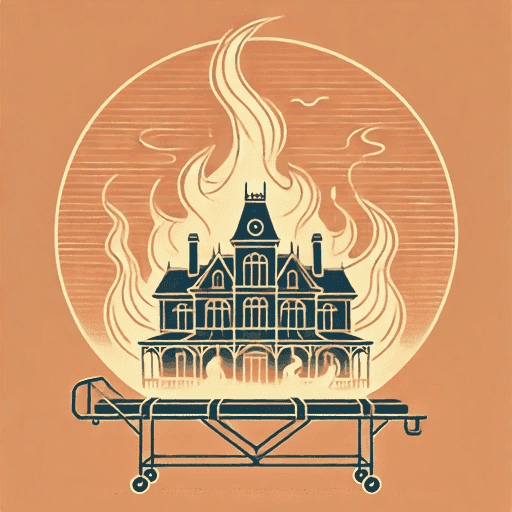
Cole Walker sees news coverage of a massive fire at Blackthorn Manor and drives from Burlington to Solstice. At the scene, he learns from investigators that an adult woman and a child were taken away by ambulance, and several, severely burned bodies remain inside. The official theory is that the fire was caused by a buildup of carbon monoxide and possibly methane from the soil. First responders confirmed that Maven experienced severe carbon monoxide poisoning, which her doctor had misdiagnosed as the flu. The cop notes that carbon monoxide poisoning causes hallucinations.
Cole connects this information to Maven’s frantic behavior, realizing that her wild claims could be explained as symptoms of poisoning. As he prepares to leave, he glimpses a huge, monstrous form flying overhead, but it vanishes when he blinks. A red fox watches him from an iron bench as he leaves.
Part 3-Epilogue Analysis
Elements of Gothic horror abound in the novel’s climax as Davina’s revelations portray the Blackthorn coven as a complex embodiment of Matriarchal Power as a Form of Resistance. However, this moment takes on an ominous tone as Maven is made to understand that the Blackthorn women’s power is a dark, cyclical, and violent force born from an ancestral wrong. Davina’s monologue reveals that the lineage has been sustained for centuries through ritual sacrifice, manipulation, and a curse that functions as perpetual biological warfare against the Croft patriarchy. The system that she describes—including reincarnation as a reward for loyalty to their “master”—is insular and self-perpetuating, and her murder of Elspeth for attempting to break the cycle proves that Davina’s loyalty to the idea of the coven supersedes any loyalty to its members. In the same way, the ritual sacrifice of Ezra is depicted as part of a cold, calculated tradition that reinforces the age-old misogynistic stereotypes of witches as subservient to the devil. In this traditionalist vision, even the devil functions as an evil form of masculinity, and the novel as a whole maintains a gendered hierarchy.
In this light, Maven’s encounters with Ronan’s demonic form engage with The Inextricable Link Between Desire and Past Trauma because Maven’s abduction and subsequent sexual encounter in the mountain cave blur the lines between assault and fated communion. The issue of consent is prominent in this scene as her terror coexists with intense arousal; likewise, her climax is triggered by the simultaneous pain and intimacy of Ronan biting her neck and drinking her blood. This act symbolizes the complete merging of their identities: a violent consumption that is both an attack and a consummation. Davina later provides a thematic justification, explaining that “the mating of a witch and a demon produces a child of incredible power” (336). Her comment is meant to frame the pair’s traumatic bond as an essential element of a magical destiny. Their connection is thus portrayed as one in which trauma is the fundamental expression of desire, for in this pivotal scene, both characters can express themselves without fear of rejection.
Maven’s character arc crystallizes in her opposition to Davina, who represents the destructive absolutism of Blackthorn tradition. Davina’s logic is rooted entirely in the preservation of the coven’s power, justifying human sacrifice, even of family members, as necessary acts. Whereas Davina embodies the coven’s cold cruelty and commitment to its feud, Maven represents a potential break in this cycle. Her horror at the rituals, her grief over Ezra’s murder, and her instinct to flee her initiation signify her moral divergence from her ancestors. Unlike Davina, Maven has undertaken a journey for truth and agency, and she finds both in her complex partnership with Ronan, the representative of her family’s sworn enemies. Ronan’s final vow to protect their new family is laced with all the suppressed violence of his alternate for, for he promises that if anyone harms Maven or Bea, he will “tear them limb from limb and pile their bodies at [Maven’s] feet” (349). This violent, protective dynamic stands in direct opposition to the coven’s bloody-minded matriarchy, and Maven’s survival and union with Ronan signify their joint rejection of inherited hatred in favor of a new, integrated lineage.
Notably, this rejection of inherited tradition occurs within a narrative that deconstructs the nature of reality itself. The cavern beneath Blackthorn Manor, with its floor of bones and giant molted snakeskins, represents a hidden, corporeal history that exists beneath regular society. The bones are physical evidence of the coven’s long reign, while the snakeskins symbolize the cyclical nature of their power through reincarnation. This physical history conflicts with the magical erasure of Maven and Ezra from institutional memory, creating a narrative space in which reality itself is subjective. Ronan’s transformation into a demonic creature further destabilizes the concept of a fixed human form, suggesting ways of living and understanding that defy normative conventions.
The narrative’s climax and resolution mark a decisive shift in genre from Gothic mystery to overt supernatural horror, only for the author to destabilize this vision with a deliberately ambiguous Epilogue. While most of the novel hints at the possibility of paranormal elements, the final chapters confirm them as fact through Davina’s dramatic exposition. This scene recontextualizes the entire preceding narrative, combining the many subtle clues with Maven’s psychological distress to create a manifestation of an ancient magical conflict. However, the Epilogue’s structural function is to destabilize this certainty. By introducing the possibility of severe carbon monoxide poisoning as a scientifically plausible explanation, the text retroactively offers a rational lens through which to view Maven’s experiences. When a police officer notes that CO poisoning can cause hallucinations of “angels and demons and monsters crawling up the walls” (353), this comment wars with the final image of Cole Walker witnessing a monstrous winged form and a smiling fox. With these elements of ambiguity, the author deliberately leaves the novel’s conclusion suspended between worlds, and The Unreliability of Memory and History thus becomes the novel’s central focus.

Unlock all 60 pages of this Study Guide
Get in-depth, chapter-by-chapter summaries and analysis from our literary experts.
- Grasp challenging concepts with clear, comprehensive explanations
- Revisit key plot points and ideas without rereading the book
- Share impressive insights in classes and book clubs