Blackthorn
60 pages • 2-hour read
J. T. GeissingerBlackthorn
A modern alternative to SparkNotes and CliffsNotes, SuperSummary offers high-quality Study Guides with detailed chapter summaries and analysis of major themes, characters, and more.
Prologue-Part 1, Chapter 8Chapter Summaries & Analyses
Content Warning: This section of the guide contains depictions of graphic violence, sexual content, cursing, bullying, and illness or death.
Part 1: “Home Sweet Home”
Prologue Summary
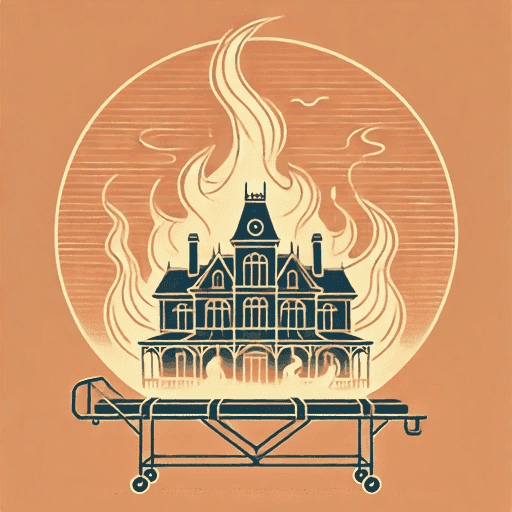
In a flash-forward, Maven Blackthorn is rolled away on a stretcher with an oxygen mask as Blackthorn Manor burns behind her. The narrative relates that she was born, fell in love, and nearly died in this ancient house. Massive flames paint the surrounding trees red. She is finally free of the house, except in her dreams.
Part 1, Chapter 1 Summary: “Maven”
The narrative shifts back in time to when Maven Blackthorn and her daughter, Beatrix, arrive in Solstice, Vermont, 12 years after Maven fled following her mother’s death, which was potentially a murder. Accustomed to Manhattan, Bea is frightened by the old-fashioned, fog-shrouded town, which makes her think of true-crime documentaries. Maven reflects that the Blackthorn women go feral if left in nature too long.
Quentin, the ancient caretaker, picks them up in a black Cadillac. Tall, stooped, and corpselike in appearance with pale skin and wispy white hair, “Q” is nonspeaking but conveys through eye contact that the powerful Croft family already knows about Maven’s return. As they drive to Blackthorn Manor through the rusty iron gates, Maven’s anxiety increases. The brooding stone house is a mix of architectural styles constructed over hundreds of years. Bea remarks that it looks haunted. Maven thinks of the “hungry goblins” of her past and touches the pistol in her coat pocket.
Part 1, Chapter 2 Summary: “Maven”
Maven and Bea enter the house, which smells of Maven’s childhood: old books, herbs, and decay. Maven’s aunts, Esme and Davina, both tall and youthful, are dressed in identical black gowns. They have the pomegranate-red hair that all the Blackthorn women share, though Maven has dyed hers black for years, ignoring her mother’s encouragement to embrace what makes her different. Esme takes Bea to the kitchen while Davina questions Maven, who has not told Bea anything about their family. The house is filled with books and features a labyrinth of corridors and staircases.
While Bea is asleep, Maven drinks wine with her aunts, who joke about their reputation as outcasts in town. They are proud to be different and judge Maven for dyeing her hair. They all miss Elspeth, Maven’s mother. When asked about Bea’s father, Maven says they had different ideas about fatherhood. A cold wind rattles the windows, and the aunts say that someone, or something, has arrived. Maven rushes upstairs and sees a tall figure in black outside the gate: Ronan Croft, her first love and worst nightmare. He disappears in the darkness.
Part 1, Chapter 3 Summary: “Maven”
Maven lies awake all night, thinking of her past relationship with Ronan. At dawn, she checks on the sleeping Bea and worries about her daughter’s approaching adolescence, remembering her own traumatic experiences. In the kitchen, Esme serves an herbal tea and reveals that she had nightmares about dark snakes trying to enter the house. When Bea joins them for pancakes, she notes that Maven never cooks. Maven looks forward to going back to New York. Davina announces that they must leave at 10 o’clock for the viewing for Lorinda, Maven’s grandmother, at the funeral home.
At Anderson’s Funeral Home, Esme mentions Ronan’s father, Elijah Croft, was recently attacked by ravens. Mr. Anderson nervously greets them, bringing them to a red-and-black, garishly decorated viewing room. At the casket, they find a glossy black bird feather beside Lorinda’s body. Davina gives Bea a pearl-handled knife and silver coins to place in the casket, explaining that Lorinda will need them to battle underworld figures and pay the ferryman for passage across the River Styx. Maven, worrying that the aunts are traumatizing Bea, drinks whiskey from Esme’s flask.
Part 1, Chapter 4 Summary: “Maven”
The viewing begins. Respectful Germans Ingrid and Helmut Schneider, who run the local bakery, arrive first. Becca Campbell, Maven’s childhood bully, who once spat on Maven in front of everyone, shrieks and lunges at Maven but trips, landing on her face. Esme stops Helmut from helping Becca, and Davina whispers something that makes the woman scream and flee. Elijah Croft (the patriarch of the Croft family and Ronan’s father, as well as and the former head of Croft Pharmaceuticals) arrives in a wheelchair, sporting a bandaged eye. The Blackthorns and Crofts have an ancient feud dating back to the time when Magistrate Levi Croft sentenced Megaera Blackthorn to death for witchcraft. Esme tells Elijah that he is not welcome, and he demands that they stop sending birds to attack him. Outside, a flock of ravens gathers in a maple tree, staring through the window at Maven. Sirens wail, and Maven senses distant fire.
On the drive home, Bea asks if they’re in the Mafia. Though Maven says they are not, she cannot claim that they have a “normal” family. Davina and Esme claim that Maven could have beaten Becca in a fight, recounting how Maven chopped down a maple tree outside Blackthorn Manor’s gate as a teenager. Vandals would hang hateful messages calling the Blackthorn women “witches” and “whores,” and Maven had to see the message from her window every morning. Driving through town, they pass Becca Campbell’s house, which is engulfed in flames. Davina gazes out with a secretive smile.
Part 1, Chapter 5 Summary: “Maven”
Unable to sleep, Maven wanders the house at midnight. After checking on the sleeping Bea, she sees light from under Lorinda’s bedroom door. Inside the empty room, the mounted owl, Quill, seems to watch her. She examines a photograph of seven Blackthorn women: her great-grandmother, Cleda; Cleda’s three daughters, Tisi, Perse, and Lorinda; and Lorinda’s daughters, Esma, Davina, and Elspeth. Maven recalls her mother explaining the lack of men in the family photo by saying that the Blackthorn women are too smart to fall for marriage’s trap. When she sees that Lorinda’s leather journal that has fallen from a shelf, Maven hears laughter echoing through the house. She then sees Ronan outside the gate, smoking.
She goes out barefoot and threatens to shoot Ronan. He calls her “Bugs,” which irritates her. Maven never told her aunts about their relationship. Now, she orders Ronan to prevent his father from attending Lorinda’s funeral. She notes that Ronan has grown taller and broader, and she is attracted to his voice and confidence. Maven accepts a drag from Ronan’s cigarette, and as Ronan walks away without looking back, Maven wishes that he would turn back and look at her.
Part 1, Chapter 6 Summary: “Ronan”
Ronan reflects on Maven’s return after 12 years of no contact. He finds her as alluring as ever, now a woman with dangerous curves and sharpened claws. A twisted part of him wants to punish her for leaving, and he fantasizes about breaking into Blackthorn Manor. He masturbates while thinking of Maven and their past intimacy.
Part 1, Chapter 7 Summary: “Maven”
Maven wakes with a nosebleed, feeling dread about Ronan. In the kitchen, Davina and Bea are baking biscuits, which reminds Maven of cooking with her mother; Maven has not cooked since Elspeth’s death. Bea mentions a white cat, which Davina identifies as Luna, Elspeth’s pet, now 25 years old. The healthy-looking Luna enters and rubs against Maven. Esme reports another nightmare about snakes invading the house. Quentin brings a brilliant blue morpho butterfly into the kitchen, a species that is not native to the area. As he brings it to Maven’s finger, she recites facts about it, including that it was once thought to be a witch’s spirit in shape-shifted form. Bea describes her dream of being a big black dog that barks at the moon. The aunts stare at Maven, knowing that black dogs are bad omens for their family, but Maven insists that dreams do not have any meaning. The phone rings. After a tense conversation, Davina announces that Mr. Anderson has lost Lorinda’s body.
Part 1, Chapter 8 Summary: “Maven”
The family is stunned. Based on the true-crime documentaries she has seen, Bea theorizes about a black market for body parts. Davina explains that Mr. Anderson conducted an exhaustive search and reviewed security footage, which showed no one entering or exiting the building. The casket was undisturbed, but the body vanished. Maven decides to investigate the matter herself and leaves Bea with her aunts. The phone rings again, and Maven answers. It is Ronan offering to help, but Maven pretends he has the wrong number and hangs up.
At the funeral home, Maven sees Ronan’s car and tells Q to call the police if she does not come back in 15 minutes. She finds Ronan smoking in the lobby, and he details all eight times they had sex. Maven pretends not to remember, but she privately recalls enjoying sex with Ronan. She calls him the Latin name for a parasitic isopod. He laughs, and when Maven searches the funeral home, she finds nothing. However, she notes that the door to the parlor where the viewing was held is now locked. When she returns, Ronan asks Maven if “our daughter” knows who her real father is.
Prologue-Part 1, Chapter 8 Analysis
The novel’s opening chapters use a Gothic framework to establish Blackthorn Manor as an antagonist in the novel. The narrative structure, beginning with a flash-forward Prologue depicting the manor’s destruction by fire, frames the entire story as a retrospective leading to a violent liberation. This technique positions the house as a physical manifestation of oppressive history and generational trauma. The description of the manor as an “architectural Frankenstein’s monster” with a “chaotic, unsettled appearance” (8) mirrors the fragmented nature of the Blackthorn family history. The intricate interior, which is composed of numerous stairways and misleading passages, invokes the imposing architecture characteristic of the Gothic genre and simultaneously serves as a metaphor for Maven’s psychological disorientation as she finds herself trapped in her past. In essence, the house is a prison of history, and its foreshadowed destruction is therefore presented as the only possible path to freedom, setting the stage for a narrative in which the protagonist’s primary conflict is with her own lineage and the physical space that contains it.
As the author gradually delivers a collective impression of the Blackthorn women, these chapters establish the idea of Matriarchal Power as a Form of Resistance, for Maven’s eccentric aunts revel in wielding their supernatural influence against the hostile community that surrounds them. In the funeral home, for example, they manipulate the social dynamics to rebuke Maven’s childhood bully and reject the patriarch Elijah Croft’s pretensions of authority. However, the mood of the narrative deepens as the aunts’ social manipulations are punctuated by details that suggest the presence of a darker power, such as the flock of ravens that menaces Elijah and the fire that destroys Becca Campbell’s house shortly after her confrontation with the family. This matriarchy operates outside of traditional patriarchal structures, and their adamantly independent philosophy is further encapsulated in their collective rejection of marriage. As Maven recalls, her mother once explained that “[t]he Blackthorn women are far too smart to fall for that old trap” (35), and these words acknowledge that historically, marriage has often been used as a patriarchal tool to control and oppress women. By banding together and remaining single, the Blackthorn women perpetuate a form of inherited resistance, but the menacing application of this stance blurs the line between self-preservation and aggression—a dynamic that is illustrated when Maven expresses disappointment in her aunts’ flamboyant public antics.
The narrative establishes Maven’s core internal conflict through her attempts to reject her own identity, an effort symbolized by her physical appearance and professional life. By dyeing her distinct pomegranate-red hair black and keeping it in a tight plait, she consciously suppresses her lineage, and this attempt to erase her physical resemblance to the other Blackthorn women reflects a deeper psychological need to contain the “feral” nature that she associates with her family and the traumatic memories of her youth. Her adult identity as a scientist also introduces a central irony, for when she returns to the family manor, she is immediately confronted with phenomena that defy empirical logic: a cat that has lived an unnaturally long life, the sudden appearance of a tropical butterfly, and the physically impossible disappearance of Lorinda’s corpse. Collectively, these implicitly supernatural details foreshadow the fact that she will soon have to come to terms with the events of her past and reckon with the changes that the current family crisis will have upon her future.
Additional foreshadowing can be seen in the recurring motifs of different animals, which hint at hidden threats lurking in family history. Esme’s recurring nightmares of snakes invading the house function as a classic omen, signaling a coming violation or a hidden threat. Similarly, Bea’s dream of becoming a black dog connects to family lore that labels such an animal as a portent of disaster. However, the most direct foreshadowing comes with the appearance of the blue morpho butterfly, an insect whose presence in Vermont is biologically impossible. Maven’s comment that butterflies were “once thought to be the spirit of a witch in shape-shifted form” (49) provides an explicit clue to the family’s hidden nature. Together, these elements create a symbolic ecosystem that blends the human and animal worlds and suggests that the “feral” qualities of the Blackthorn women are not merely metaphorical.
Against this ominous backdrop, the dynamic between Maven and Ronan begins to accelerate, embodying The Inextricable Link Between Desire and Past Trauma. Their combative reunion is charged with aggression and unresolved pain, and beneath their dialogue lurks a wealth of subtext, for their sarcastic jabs carry the weight of their shared history and the jagged edges of their unresolved emotions. Within this context, Ronan’s taunts about her being a “little witch” (40) are both a loaded reference to her family’s reputation and a hint at the power she holds over him. In these early scenes, Maven and Ronan exemplify the enemies-to-lovers trope, for they both try to deny their attraction, acting as though they hate one another in an effort to protect themselves from feelings of vulnerability.

Unlock all 60 pages of this Study Guide
Get in-depth, chapter-by-chapter summaries and analysis from our literary experts.
- Grasp challenging concepts with clear, comprehensive explanations
- Revisit key plot points and ideas without rereading the book
- Share impressive insights in classes and book clubs