Blackthorn
60 pages • 2-hour read
J. T. GeissingerBlackthorn
A modern alternative to SparkNotes and CliffsNotes, SuperSummary offers high-quality Study Guides with detailed chapter summaries and analysis of major themes, characters, and more.
Symbols & Motifs
Content Warning: This section of the guide contains depictions of graphic violence, sexual violence, child abuse, bullying, and illness or death.
Blackthorn Manor
Blackthorn Manor functions as a symbol of the Blackthorn family’s legacy, embodying their insular nature, chaotic history, and the untamed power that they wield on a whim. The house is a brooding, labyrinthine structure that mirrors the family’s complex and dangerous identity; Maven describes it as an “architectural Frankenstein’s monster” (8), explaining, “Part Medieval fortress, part Gothic mansion, and part rustic ruin, it defies easy categorization, much like its generations of inhabitants” (8). This description establishes the manor as a self-contained world built to resist outside influence. Ironically, it is both a fortress that protects the family’s secrets and a prison that traps them within a cycle of trauma and violence. The manor’s oppressive atmosphere and hidden passages represent a domain in which the family’s dark power has festered for generations.
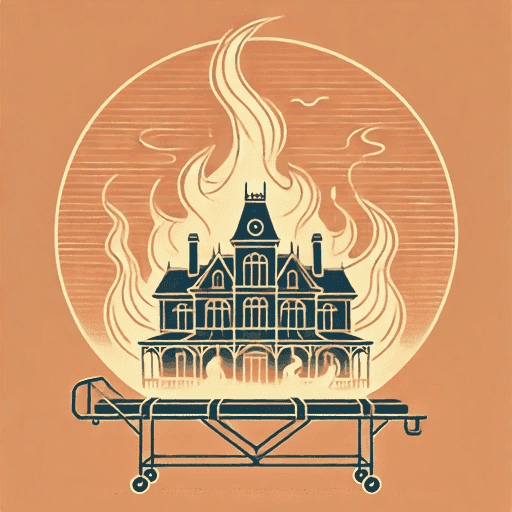
The manor is also central to The Inextricable Link Between Desire and Past Trauma and the tropes of Gothic literature. It is the site of Maven’s formative, traumatic relationship with Ronan Croft. Her return to the house therefore forces her to confront the “hungry goblins of [her] past” (8). The novel’s Prologue, which depicts the manor burning to the ground, frames the entire narrative as an escape from this source of pain. Watching the flames, Maven reflects, “I’m free of this place and the stranglehold it has always had over me” (1). This act of destruction symbolizes a violent but necessary severance from a legacy steeped in suffering. As it goes down in flames, the manor becomes a symbol of destruction as transformation, suggesting that freedom from the past can only be achieved by completely obliterating its physical and psychological foundations. The manor is almost a character of its own, and it “dies” as it burns, freeing Maven from yet another antagonist in her life.
The Red Fox
Throughout novel, Maven sees a red-and-black fox around Blackthorn Manor, and she is unnerved by its seeming intelligence. The fox appears to smile and watch Maven and Bea from a distance, though Bea is considerably more comfortable with the fox than Maven is. At one point, Bea sits with the fox while it sleeps next to her. The connection between the fox and Bea, contrasted with Maven’s discomfort, connects with Davina’s claim that the Blackthorn witches are reincarnated seven days after their deaths as animals. Lorinda, Maven’s grandmother, has recently died, and the fox appears just when the family realizes that her body is missing. Much like Davina and Esme, Lorinda was a proud member of the coven, meaning that she, too, would have predicted Bea’s ascendance as the “queen” for “the master.” As the narrative implies, the fox is Lorinda reincarnated, and her attachment to Bea reflects the family’s desire to indoctrinate both Bea and Maven into the coven, with special emphasis on Bea’s role in the upcoming “glory” of the coven.
In addition to being a literal manifestation of Lorinda’s spirit, the fox is a symbol for the enduring nature of magic and the legacy of the Blackthorn family. When Walker visits Blackthorn Manor after the fire, he notes the fox watching him with “preternatural golden eyes, canines flashing as it smiles” (354). Even though Esme, Davina, and Q are implied to be dead at the end of the novel, Lorinda remains at the shell of the Blackthorn home, smiling. The narrative thus implies that the fox will continue living, and that Esme and Davina may even join Lorinda as animals in the near future, guaranteeing the endurance of the Blackthorn coven until a new member can rekindle their power from the ashes of the manor.
Ravens and Feathers
The recurring motif of ravens and black feathers represents the wild, supernatural essence of the Blackthorn women and serves as an expression of their matriarchal power. Appearing frequently throughout the novel, ravens function as omens, messengers, and instruments of the family’s will, signifying their deep, primal connection to a form of nature that operates beyond patriarchal laws and logic. The birds are active agents in the narrative, embodying the family’s capacity for both protection and retribution. Their presence reinforces the idea that Blackthorn power is an innate, untamable, intelligent force. This constant visual thread solidifies the family’s identity as “other,” aligning them with ancient, formidable forces that the modern world of Solstice fears and rejects.
The motif is explicitly tied to the theme of Matriarchal Power as a Form of Resistance. After the family patriarch Elijah Croft confronts the aunts at Lorinda’s viewing, Maven learns that he was attacked by ravens that “nearly pecked the old man’s eyes right out of his skull” (21). This detail suggests that the birds are instruments of Blackthorn justice. Her follow-up comment that the ravens “know evil when they see it” (21) reinforces the idea that this power operates on a moral, albeit ruthless, framework, punishing those who have wronged the family. This act is a clear form of resistance, demonstrating the Blackthorns’ ability to strike back against the patriarchal Croft lineage that has persecuted them for centuries. The motif illustrates that their power is a living, breathing force capable of defending its own.

Unlock the meaning behind every key symbol & motif
See how recurring imagery, objects, and ideas shape the narrative.
- Explore how the author builds meaning through symbolism
- Understand what symbols & motifs represent in the text
- Connect recurring ideas to themes, characters, and events