Blood Over Bright Haven
52 pages • 1-hour read
M. L. WangBlood Over Bright Haven
A modern alternative to SparkNotes and CliffsNotes, SuperSummary offers high-quality Study Guides with detailed chapter summaries and analysis of major themes, characters, and more.
Chapters 19-23Chapter Summaries & Analyses
Content Warning: This section of the guide includes discussion of graphic violence, racism, gender discrimination, animal death, and death.
Chapter 19 Summary: “Mage’s Mirror”
The epigraph is a note explaining the rejection of a woman applying to the Magistry. In it, the Archmage comments that women are too emotional to be mages, since logic is required for magical work.
In Leon’s Hall, as proposals of the barrier expansion are about to be presented, Sciona notices that the portrait of Archmage Stravos destroyed during her exam has been replaced; the new painting erases Stravos’s Kwen features in favor of a more Tiranish appearance. Sciona must sit next to Renthorn. Renthorn presents his work, which is merely serviceable. When it is Sciona’s turn, the Archmages assume she has nothing, but she proves them wrong by presenting a clear spellograph map—not her completely visible window, but a version startlingly clearer than anything seen before. They declare that the border expansion can start immediately with her work.
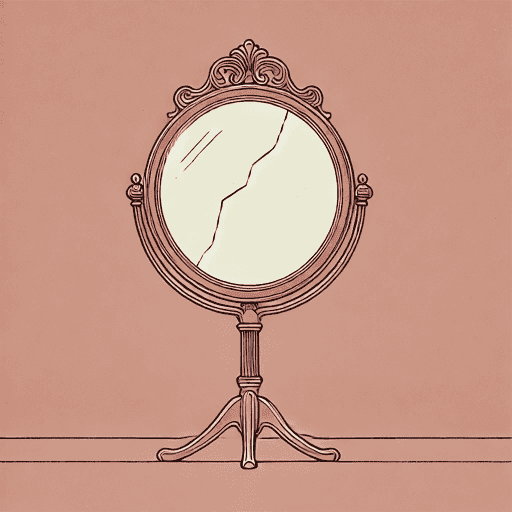
Just then, Sciona activates her Freynan Mirror, revealing the truth of the Otherrealm and exposing that the Archmages knew about siphoning all along. The Archmage Supreme soothes the audience by reminding them that God ordained the source of magical energy. She asks why hide it if it is good and warns them that she has taken matters into her own hands. At noon, the room goes dark.
As Sciona’s spells activate, Freynan Mirrors open citywide over every single device using magic, showing the exact creature being siphoned that allows the magic to happen. People scream from seeing the gore of the Blight. Sciona savagely reminds the mages that God commands them to pursue truth. The Archmage Supreme calls for her arrest; guards drag her out of the room as she yells that she did the right thing.
Chapter 20 Summary: “Made Monstrous”
The epigraph is a verse from the Tirasid that commands all ranked mages to have a military-grade spell conduit like a staff on their person at all times; they must train regularly to defend the city from violence.
Sciona watches her Mirrors blink in and out across the city, including over the barrier, which siphons massive amounts of life. Sciona is pushed into a police vehicle, where a Mirror above the engine horrifies the driver. Sciona watches as Reserve zones are revealed to be places where people and animals have no choice but to go, such as rivers or traps in the terrain. She watches as animals are devoured alive by the Blight. When the car’s engine consumes a human being, the shocked driver crashes into a newsstand. Sciona wakes up in jail. To her surprise, the chaos in the streets outside has not stopped.
Alba appears, furious: She no longer has a job because Kwen people in Tiran are rioting and destroying every Tiranish house and workplace they can. Alba has worked hard for everything she has, and it isn’t fair for Sciona to take it all away just because she’s decided to finally care about something other than herself. Sciona feels guilty when Alba accuses her of doing it all for ego. Sciona begs for her to take it back, but Alba slaps her, disowns her, and leaves.
Sciona cries that the city will tear itself apart in violence rather than coming to an understanding. When the prison is at capacity from arrested Kwen rioters, Bringham takes Sciona away to house arrest at his mansion. On the way, violent Kwen rebels see their white mage robes and try to kill them. Bringham uses his staff to kill and his armored car to ram into them, calmly explaining that the city has declared martial law. As they drive through the poorer parts of the city, Sciona sees that nobody is defending anyone there. Sciona wonders how long Tiran will stand.
Chapter 21 Summary: “Damsel and Demon”
The epigraph is a verse from the Tirasid advising men to protect their children, as children mirror who men are before God.
Bringham’s mansion is lonely; Bringham is unmarried and devoted to his work, which Sciona once thought was a sign of strength, but now sees as a sign of his empty inhumanity. Sciona contemplates that she must be the closest thing he has to a daughter. He chides her gently for ruining the reputation of women for centuries to come and laments that she has given up on her own potential. The Council will bury her truth in lies and convince the public that she showed them horrific illusions for self-glorification.
Sciona confronts him about poisoning Kwen women in his factories, but he argues that his factories help overpopulation. She realizes that she is his penance—a woman he put in a position of power to counterbalance hurting so many other women. He begs her to recant at her trial the next day. He doesn’t want her to die. He suggests she write a last letter to her family.
In the letter, Sciona apologizes to Winny, but stands by all of her choices. Bringham concludes that her lack of a father figure has made her lash out, which makes Sciona furious. He begs her to acknowledge the value of magical innovation, and she realizes that he wants her admiration, just like a father would. Although it hurts them both, she insists that Tiran is built on lies and blood.
The gate outside the mansion collapses. As Bringham forces Sciona to safety, she suddenly sees that the patriarchal system she lives in is only set up to gain more power. She attacks him and tries to wrestle his staff away, which finally breaks his fatherly façade snap; he throws her to the ground and attacks the Kwen insurgents.
The next day is Sciona’s trial at the Magistry. The city is calmer, but Sciona knows that violence will return soon enough. She will be a scapegoat for the Magistry to maintain control. The mages try to take her white robe, but Bringham refuses, insisting that they see her as a monster of their own creation, like Sabernyn.
Sciona greets the Archmages and the Council, calling Perramis “father” to humiliate him. Renthorn and Mordra are absent, and their fathers vote in their stead. The mages unanimously vote to sentence her to death. They place before her a vial of poison that kills painlessly, and she drinks it immediately. They ask her for her final words, but Sciona just laughs as a massive spell explodes—the final act of her and Thomil’s work.
Chapter 22 Summary: “Hope in Hellfire”
The novel flashes back several days.
Thomil is reluctant about Sciona’s final spell. He is determined not to be a murderer like the mages, but Sciona argues that it is an act of survival. Thomil doesn’t want to be complicit in killing Sciona or to put Carra at risk. Sciona leaves him the spellograph and assures him that any choice he makes is the right one.
Sciona asks to spend her last night with someone who appreciates her, but Thomil refuses to talk more about spells and violence. He grabs her hand and pulls her into a kiss, which she eagerly returns. She kisses him again. He is determined to remember her like this.
Later, Thomil asks Carra what she wants her future to look like. She wants the mages to die, and reassures him that Sciona wants that, too. He goes up to the roof where he can see the Magicentre and activates the spellograph. The Magicentre explodes as the barrier expands, consuming everyone within.
Inside the Magicentre, Sciona calmly watches mages scramble and die brutally in the Blight. She is content to die with them. When the Blight consumes her, she doesn’t feel pain because the poison has made her numb. Her last thought is a loving prayer that Thomil did this for himself, not for her.
The chapter ends with an excerpt from Bringham’s letter of recommendation for Sciona. He describes he as the “greatest mage of her generation” (399) and promises that she heralds a new age.
Chapter 23 Summary: “Out of Oblivion”
Carra and Thomil weep as they watch the Blight shred the Magicentre, knowing Sciona died in the chaos. Thomil loved her, and it is Kwen destiny to lose what you love.
As he and Carra flee, they run into two highmages—Mordra and Renthorn. Carra takes the spellograph and hides. Renthorn gloats that Sciona’s actions have positioned them to be the only sources of magic left in the city. Renthorn knew that Sciona would kill everyone; he spared Mordra as a harmless lackey. Renthorn demands the spellograph and Sciona’s exact coordinates. Thomil pleads ignorance. As Renthorn prepares to use his staff to torture Thomil, Carra drops down from a nearby building, slamming the heavy spellograph into Renthorn’s skull and killing him.
Carra immediately turns and runs for Mordra with a knife, but Thomil intervenes. Mordra begs for mercy and claims to have not known anything. Thomil decides to not kill Mordra, who has a chance to use his conscience to lead Tiran to a better place. He and Carra pray over Mordra and leave.
Three border guards accost them. Thomil blows one of them up with a conduit and punches another unconscious. The third is hit over the head by a strong Kwen man Thomil doesn’t recognize, part of a Kwen group of Endrastae escaping the city. They run toward the border, helping each other as Tiranish soldiers shoot at them. Soon enough, the guns stop working, revealing that everyone in the Magicentre is dead. As Thomil runs, he realizes that he is empowered by everyone who has sacrificed to keep him alive, Sciona included. At the border, they are hit by brutal cold, but Thomil quietly raises a fist to Sciona and to hope.
Chapters 19-23 Analysis
The end of the novel interrogates how the moral limits of pursuing justice. Sciona’s death for her beliefs prompts comparisons and critiques from surprising quarters. The usually supportive Alba finds Sciona’s actions untenable: She disowns Sciona and rebukes her for causing mass harm, creating chaos that she did not foresee, and acting selfishly. Alba prizes comfort and stability above the uncertainty of freedom. Alba loves Sciona, but her rejection shows that she is unwilling to follow Sciona into a dangerous new world of upheaval.
To some degree, Sciona’s choices align her with the executed Highmage Sabernyn, the heretic who similarly siphoned from the Forbidden Coordinates and struck at Tiran. Since both killed other mages to prove a point about their beliefs, the novel asks readers to consider what makes them morally different. The mages claim that Sabernyn acted to kill his rivals, but the emphasis on official concealment and propaganda makes it unclear whether this is true. Could Sabernyn’s mass murder have been an attempt at rebellion? If another authoritarian government arises in Tiran, it is highly likely that Sciona will also be portrayed as a mass murderer. In the end, the main difference between Sciona and Sabernyn may be competence: Only Sciona had the ambition and ability to kill everyone, while Sabernyn could only target a few.
Even Sciona’s death penalty highlights The Inevitability of Prejudice in Authoritarianism. Although Sciona has committed a wildly destructive crime, the mages still view her as deserving some measure of respect. At her trial, at Bringham’s urging, she retains the white robe of her office; the method of execution is a painless poison that kills comfortably. In contrast, Bringham treat Kwen people without regard or humane treatment; he considers inflicting infertility on Kwen women a form of pest control, has little guilt about powering his magic through genocide, and doesn’t hesitate to get his own hands bloody when making his way through the city. This highlights the racism at the heart of Tiranish society.
The ending is ambiguous about whether Sciona succeeded in changing Tiran. The power vacuum she created will most likely be filled by Mordra the Tenth, a man characterized by his incompetence and the nepotism that earned him a place as a highmage. It is unclear whether this is a positive transition. On the one hand, Mordra does not display the power hunger and will to dominance of the other mages. He apologizes to Sciona for his peer-pressured misogyny and claims that he wants to be a good person. Mordra’s lack of magical skill, social adroitness, and political savvy marks him as easy prey for someone of more powerful ambition; as Renthorn points out, Mordra would make for a perfect yes-man. Moreover, as the Tenth, Mordra comes from a long line of mages complicit in the abuses of the Kwen lands—entrenched in Tiranish propaganda and culture. This shows that Tiran will retain aspects of the old world; questions remain about whether Mordra the Tenth can guide it to building a new one.

Unlock all 52 pages of this Study Guide
Get in-depth, chapter-by-chapter summaries and analysis from our literary experts.
- Grasp challenging concepts with clear, comprehensive explanations
- Revisit key plot points and ideas without rereading the book
- Share impressive insights in classes and book clubs