Bridge of Sighs
63 pages • 2-hour read
Richard RussoBridge of Sighs
A modern alternative to SparkNotes and CliffsNotes, SuperSummary offers high-quality Study Guides with detailed chapter summaries and analysis of major themes, characters, and more.
Chapters 11-15Chapter Summaries & Analyses
Content Warning: This section of the guide includes depictions of bullying, racism, emotional and physical abuse, substance use, death by suicide, and cursing.
Chapter 11 Summary: “Ghost Ikey’s”
In present-day Thomaston, Lucy stands in Ikey’s market, staring at a decades-old drawing Sarah made. Owen startles him, asking if he’s having a “spell.” Lucy denies it. Owen reassures him that Sarah, who recently had cancer surgery, is recovering well. Tomorrow they meet with the oncologist to confirm that she is cancer-free before their planned trip to Italy.
Lou’s melancholy stems not from worry about Sarah but from a powerful sense that an alternate, truer version of his life exists—one where his late father still lives and Bobby Marconi never left Thomaston. He tried explaining this to Sarah, who responded with logic, reminding him of how his mother used to dismiss his father’s similar musings.
After Owen leaves, Lucy visits the elder Gabriel Mock, who is now the caretaker at their apartment building. Gabriel has been in recovery from alcohol use disorder but recently had a relapse, from which he is now recovering. Lucy inspects the property, noting that the old footbridge and railroad trestle are gone, and reflects that his memoir project is an attempt to restore what has been lost.
Driving away with soaked shoes after slipping into the Cayoga Stream, Lucy sees his daughter-in-law, Brindy, emerging from a duplex with an unidentified man. When Brindy notices Lucy watching, her radiant expression vanishes.
Chapter 12 Summary: “Homecoming”
Robert Noonan (known in Thomaston as Bobby Marconi) returns to Thomaston from military academy after his mother has fled to Jacksonville, Florida. Through nested flashbacks, the narrative reveals his mother’s history of failed escapes from her controlling, abusive husband. When Robert was six, his father caught her fleeing, smashed her suitcase, and threw her clothes into the street. Young Robert gathered them. Later attempts were similarly thwarted by his father’s surveillance network and financial control.
A pivotal escape occurred when Robert was in sixth grade. Using his paper route savings, he helped fund her bus trip to Montreal, but she was stopped at the border and had a medical crisis. At the academy, Robert experienced an epiphany: His father, despite his threats, had never actually struck anyone—he was a cowardly bully. He also realized his mother’s cruel nickname, D.C., stood for “Dumb Cunt.”
Back home, Robert picks up his mother from the train station after secretly cleaning the house in defiance of his father. His mother has negotiated a promise from his father to let her get her tubes tied after this baby. At home, she immediately goes into labor. After the baby is born, Robert threatens his father: If he ever impregnates his mother again or uses that nickname, Robert will kill him.
Lucy calls, inviting Robert to Ikey Lubin’s to meet his girlfriend, Sarah Berg, who drew a picture including Robert years ago. At the market, Sarah greets him warmly, showing him her drawing of the store with Robert depicted on the threshold. Driving Robert home, Tessa asks him about his mother, warning him that he won’t be able to protect her from his father for long, since he’ll be graduating and moving away soon. She also predicts he’ll become interested in Sarah. Over the summer, Robert becomes a fixture at Ikey’s. When Sarah returns from Long Island in September, he’s struck by her transformation and confused by his attraction to his friend’s girlfriend.
Chapter 13 Summary: “A Dream of Fish”
On the first day of senior year, Robert learns he’s been moved into Mr. Berg’s honors English class. He assumes Sarah arranged it as a romantic signal, then discovers that she’s in the class he was removed from—she moved him away from their only shared class.
Mr. Berg arrives gaunt and disheveled, accompanied by Three Mock, who has ongoing brain injury from being beaten by Perry Kozlowski years earlier. Berg’s iconoclastic teaching begins: He writes Langston Hughes’s poem “Hope” on the board and leads the class in a close reading, noting that Three, the only Black student, is the only one who knows what the “dream book” in the poem refers to. He admonishes the white students that, so long as they remain invested in a system of racial injustice designed to remain invisible to them, they will never understand this poem. He smokes in class, offering Robert a cigarette, and relentlessly questions students about their parents and their assumptions. When Perry Kozlowski protests the cigarettes, Berg creates a trap of complicity. He goads Perry about race and class, probes Nan Beverly about her rich father, and gets Robert to identify Lucy as caught between his believing father and doubting mother. Lucy has a “spell,” feels faint, and must see the nurse.
That evening at Ikey’s, Robert and Lucy remain giddy from the strange class. Tessa speculates that Berg is trying to get fired. That night, Robert’s drunk father appears in his doorway, saying Robert has the wrong answers because he has not asked the right questions—words eerily similar to Berg’s teaching. Robert realizes Lucy never mentioned his supposed best friend David Entleman, whose death by suicide Berg referenced in class. He has an unwelcome thought about stealing Sarah from Lou, then resolves to keep Berg at arm’s length despite the exhilarating classes.
Chapter 14 Summary: “The Bridge of Sighs”
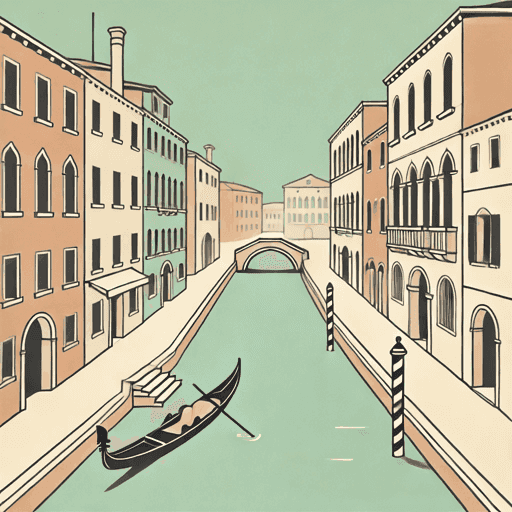
In the present, Lucy arrives at the junior high art room to view his wife Sarah’s new painting. The custodian, Tom Shipley, unlocks the door for him. Lucy sees the painting and is immediately moved, recalling his feelings upon seeing Sarah’s first drawing as a child. It depicts Venice’s Bridge of Sighs, a stone passage connecting the Doge’s Palace to the prison, where convicts’ despairing sighs are said to have across the canal.
His thoughts drift to Gabriel Mock and the night Whitcombe Hall burned down, which coincided with Perry Kozlowski’s return to Thomaston to give the high school commencement address. Gabriel had disrupted Perry’s speech to remind everyone that Perry beat Three into a coma when they were children, leaving him with lifelong brain damage. Three had since died in Vietnam, leaving Gabriel feeling doubly vengeful. He was arrested for the fire, and Tessa insisted they post his bail.
Staring at the painting, Lucy finally succumbs to one of his “spells,” which he’s been flirting with all day. He feels himself enter the painting’s world, stepping onto the Bridge of Sighs. Sarah’s voice calls him back, but he’s ashamed of something he hid in his desk drawer and wants to stay. On the bridge, he encounters his dead father, Big Lou, who reminds him of a childhood promise never to drift away. Lucy protests that he’d rather stay with his father.
Sarah’s voice grows closer. Lucy opens his eyes to find her kneeling beside him, holding his hand, having brought him out of the “spell.”
Chapter 15 Summary: “All and Sundry”
Sarah Berg reflects on her divided life between her separated parents. Her father is an ascetic whose Thomaston household runs on rigid schedules. Her mother lives chaotically at the Sundry Arms, a Long Island apartment complex for divorced men run by Harold Sundry. Her mother has become voluble since the separation, expounding cynical philosophies about marriage and freely entertaining male visitors. Sarah sometimes overhears late-night conversations and finds martini glasses on the doorstep.
Her father remains unaware of her mother’s lifestyle, wrongly assuming she struggles financially. Sarah suspects her father has a secret drug dependency.
Sarah is a popular babysitter on Long Island. One summer, her favorite family offers her their garage apartment as a live-in arrangement with a studio. Though tempted, she lies to her mother, saying she declined, not wanting to hurt her feelings. That marriage soon collapses anyway.
By the summer before senior year, Sarah harbors a secret of her own: inexplicable, powerful feelings for Bobby Marconi, whom she has met only once. When she mentions him to her mother, she receives harsh warnings about the Marconi family genetics.
Sarah realizes drawing is her way to understand confusing emotions. She decides to compromise—she’ll draw Bobby again, but not until summer’s end, hoping the spell will break itself.
Chapters 11-15 Analysis
These chapters juxtapose two divergent responses to the past through the foils of Lucy Lynch and Robert Noonan. Lucy’s engagement with history is an act of sentimental restoration. His fantasy of a “Ghost Ikey’s” is not merely nostalgia but a belief in an alternate, “truer” reality where loss has been nullified. This impulse directly fuels his memoir, which he acknowledges is a “poor attempt to restore what was and is no more” (319). He seeks to inhabit the past, preserving it as a refuge from the present reality. Robert, by contrast, confronts his history to liberate himself from it. His return to Thomaston is predicated on a transformative revelation that his father’s tyranny is a performance of cowardly bullying, not genuine strength. This epiphany empowers Robert to dismantle the patriarchal power structure that has defined his family, allowing him to rewrite its narrative. While both men are consumed by their personal histories, Lucy’s approach is one of passive immersion, whereas Robert’s is an active, calculated rebellion. This dichotomy establishes the central theme of The Inescapable Influence of the Past on Identity, framing it not as a uniform force but as a catalyst for fundamentally divergent psychological journeys.
While the previous section showed Big Lou and Mr. Marconi as fundamentally different kinds of parental figures, this section focuses on how the two younger men make sense of their relationships with those fathers in adulthood. Mr. Marconi’s abusive control forges in Robert a reactive identity rooted in opposition and a desire for escape. Conversely, Big Lou’s gentle, if naive, optimism fosters a son who seeks comfort and continuity. The text subverts a simple good-father/bad-father binary through the critical reinterpretations offered by female characters. Sarah’s mother reframes Big Lou’s vigil on the footbridge not as paternal intuition but as helpless incompetence, while Tessa Lynch’s pragmatic realism constantly undercuts—but also complements—her husband’s sentimental worldview. Mr. Berg’s provocative and even uncomfortable questioning of his students articulates the intractable mystery parents’ ongoing influence in their grown children’s lives, suggesting that one’s identity is inextricably, and often mysteriously, tied to parental legacy. Berg’s disruptive method is thematically echoed by Robert’s abusive father, who tells his son, “[y]ou think you’ve got all the answers, but you haven’t even bothered to ask the questions” (382). This parallel suggests a link between domestic tyranny and intellectual interrogation, framing both as forms of psychological warfare aimed at dismantling an individual’s sense of certainty. The sons, Lucy and Robert, must navigate these legacies—one by embracing an idealized version, the other by violently rejecting a traumatic one.
The characters’ struggles with their pasts are complicated by the fallibility of perception and memory. The narrative structure, with its nested flashbacks and shifting points of view, mirrors this uncertainty. Robert’s understanding of his past evolves, culminating in a reassessment of his entire childhood after his epiphany about his father’s character. Sarah, caught between her father’s asceticism and her mother’s chaotic hedonism, consciously uses her art as a tool to process conflicting realities. Tessa Lynch serves as the narrative’s primary voice of skepticism, challenging the romantic interpretations held by her husband and son. Her declaration that “people don’t change. You do know that, right?” (342) questions the very possibility of the self-transformation that characters like Robert seek. The novel suggests that memory is not a reliable record but a continuous act of interpretation, shaped by need, fear, and desire.
Amid this landscape of unreliable memory and contested identity, art emerges as a means of accessing and mediating truth. Sarah’s drawings allow her not only to represent the world as she sees it, but also to create the future as she imagines it. Her initial sketch of Ikey’s, which places Bobby on the threshold years before his return, functions as both prophecy and invitation, prefiguring his entry into the Lynch world and granting her a form of authorial control over her life’s narrative. Years later, her painting of Venice’s Bridge of Sighs transcends its symbolic function as an image of despair. For Lucy, it becomes a literal portal into his subconscious, the setting for a “spell” where he confronts his dead father and his own shame. Art, in these instances, reshapes reality, allowing characters to either manifest a desired future or retreat into a psychologically resonant past. Sarah’s decision to draw Bobby is a conscious attempt to use this power to understand and contain an inexplicable emotional force that threatens her constructed world.

Unlock all 63 pages of this Study Guide
Get in-depth, chapter-by-chapter summaries and analysis from our literary experts.
- Grasp challenging concepts with clear, comprehensive explanations
- Revisit key plot points and ideas without rereading the book
- Share impressive insights in classes and book clubs