Brigands & Breadknives
62 pages • 2-hour read
Travis BaldreeBrigands & Breadknives
A modern alternative to SparkNotes and CliffsNotes, SuperSummary offers high-quality Study Guides with detailed chapter summaries and analysis of major themes, characters, and more.
Character Analysis
Content Warning: This section of the guide includes depictions of cursing.
Fern Teverlin
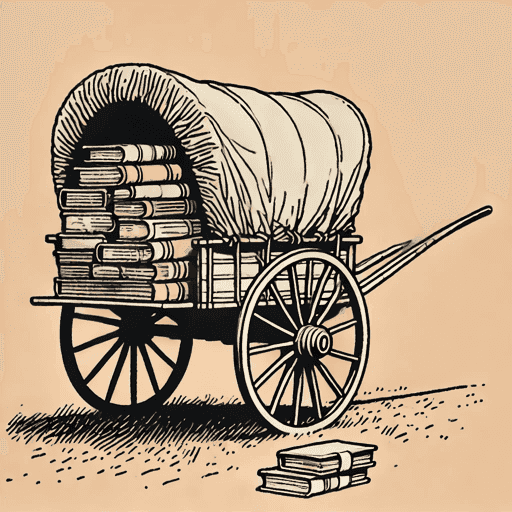
As the protagonist of the novel, Fern Teverlin is a dynamic and round character whose journey is defined by a deep-seated existential crisis. When the story begins, she is grappling with a sense of dissatisfaction, a “hollowed-out feeling” (26) that her career as a bookseller can no longer fill. Believing a change of scenery will solve her internal turmoil, she moves to Thune to open a new shop, an endeavor that represents The Illusion of the “Fresh Start.” The failure of this planned reinvention, culminating in her desperate sob, “I fucking hate it!” (26), serves as the inciting incident for her true, chaotic journey. Her drunken, accidental departure from Thune aboard Astryx’s cart is not a choice but a surrender to the unpredictable, marking the actual beginning of her transformation from someone seeking a comfortable destination to a traveler embracing an uncertain path. Throughout this journey, her unsent letters to Viv act as a recurring motif, symbolizing her attempts to process her experiences and articulate her evolving self-awareness.
Fern’s identity is initially intertwined with her vocation, and her inability to find happiness in her new, successful bookshop forces her to confront the idea that her self-worth must exist outside of her professional role. This struggle aligns with the theme of Redefining the Self Beyond Vocation. Her travels with Astryx and Zyll strip away her title of “bookseller,” forcing her to become a companion, a survivor, and, in Astryx’s eyes, a “little squire.” Quillin’s philosophy that work is merely “the stuff that holds the rest of it together” further challenges her to see herself as more than her job (139). Her final refusal of Astryx’s offer of squireship and her decision to become a writer, chronicling her travels, represents the culmination of her growth. She reframes her relationship with books from a static profession to an active, creative pursuit of meaning, demonstrating that she has embraced a fluid, self-determined identity.
Despite her constant self-deprecation and feelings of inadequacy, Fern possesses a deep well of resourcefulness and courage that reveals itself under pressure. While she sees herself as a burden or an accident, her actions prove otherwise. She uses her knowledge of Astryx’s legend to secure a fair price for her book in Bycross, and her quick thinking is instrumental in the fight against the verdigaunt, where she uses an oil lantern as a weapon. Her most significant moment of courage comes during the confrontation with Tullah. Fern points out the hidden weapon to Astryx to help her fell Tullah, who would’ve otherwise killed her, thus demonstrating decisive, heroic action. Her journey runs parallel to that of Breadlee, a symbol of diminished purpose who is ultimately proven to be a weapon. Like the breadknife, Fern discovers her strength in an unexpected form, transitioning from a person fleeing her life to one capable of shaping her own story.
Astryx One-Ear
Astryx One-Ear is introduced as a figure of legend but is characterized by a weariness that complicates her heroic archetype. A dynamic and round character, she has spent a millennium as an adventurer, and the weight of this long life has forged her into a stoic and pragmatic individual. Initially, she subverts the epic image Fern has of her from history books. She is more concerned with practicalities than glory, famously declaring that after 10 centuries, the only thing that remains exciting are dry socks. Her life’s work is not a grand calling but a familiar occupation; she tells Fern, “This life is like a sword. It’s the tool I know how to use” (150). This detachment is evident in her initial interactions with her stowaway, Fern, whom she treats as a simple inconvenience to be dispatched with a piece of cheese and directions home. Her emotional distance is a shield built over centuries of loss and repetition, making her initial persona that of a legend hollowed out by time.
The unexpected companionship of Fern and Zyll gradually erodes Astryx’s stoic facade, forcing her to confront the loneliness she has long accepted as an inevitability of her long life. Her relationship with Fern, in particular, marks a significant emotional evolution. While she begins the journey with dismissive pragmatism, she slowly develops a protective and then affectionate bond with the rattkin. She shows concern for Fern’s safety in the mountains and grows to value her perspective, eventually admitting that it has been a long time since she had a friendship that “mattered.” This thawing culminates in two pivotal moments: her formal, heartfelt apology to Fern after an argument and her subsequent offer of companionship, where she asks Fern to be her “squire and friend” (306). These acts reveal a vulnerability and a desire for connection that she has suppressed for hundreds of years, showing her capacity for change.
Astryx’s central conflict is the tension between her rigid adherence to principle and the messy, unpredictable nature of human connection. She governs her life by the metaphor of walking a “straight road when night falls” (210), believing this unwavering commitment to her code is what provides stability. This principle is tested by Zyll’s bounty. While she is bound by her covenant to deliver the goblin, her growing fondness for her companions complicates this duty. Her ultimate decision to release Zyll before delivering her to the bounty office is a rejection of her long-held code. In this moment, she chooses the person over the principle, demonstrating that she’s learned how a meaningful life is not a straight road but a path that must sometimes curve to accommodate others.
Zyll
Zyll functions as the novel’s trickster archetype, an agent of chaos whose actions are unpredictable and often logic-defying. While she is a static character in her essential nature, she is also round, as her seemingly random behavior is gradually revealed to be driven by a unique form of perception and loyalty. Introduced as a bound captive, Zyll is a constant source of disruption, from escaping her bonds to befriending a venomous hazferou. Her most defining feature is her “Coat of Many Pockets,” which aligns with her narrative function. Like the coat, which produces stolen spoons, an Elder Blade, and a soup ladle at critical moments, Zyll is a source of both trouble and unforeseen solutions. She operates outside of conventional rules, consistently subverting expectations and pushing the plot in new directions, reinforcing the novel’s embrace of the unpredictable.
Beneath her chaotic exterior, Zyll possesses a sharp intelligence and a form of loyalty that is as unconventional as she is. Though she communicates in broken Territories speech and goblin curses, her perception is keen. It is Zyll who first intuits the truth about the Four Fingers in Bycross, identifying them as “foxies in the chicken house” (94). She also demonstrates a protective instinct toward her companions, offering Fern a healing salve and, most significantly, saving the entire group by single-handedly destroying the Tarimite Bridge to stop Tullah’s pursuit. Her decision to place a bounty on herself in order to secure the protection of a formidable warrior like Astryx reveals a cunning survival instinct. Her repeated choice to remain with Fern and Astryx, even after being set free, cements her role within their unlikely trio and reinforces the theme of The Unpredictable Nature of Found Family and Friendship.
Viv
Viv serves as the catalyst for the novel’s plot and a thematic anchor for Fern’s journey. Although she is physically absent for most of the narrative, her presence is foundational to Fern’s initial motivations and ongoing internal conflict. As a friend who has successfully transitioned from a life of adventure to one of peaceful domesticity, Viv represents the ideal of the illusion of the “fresh start” that Fern is desperately chasing. Fern’s decision to move to Thune is predicated on reconnecting with Viv and emulating her success. The failure of this plan, when Fern cannot find happiness in the life Viv helps build for her, triggers the story’s central crisis.
Throughout Fern’s travels, Viv functions as a silent confessor. Fern’s unsent letters, which are all addressed to Viv, become the primary vehicle for her self-reflection and character development. In this way, Viv is the repository for Fern’s guilt, her fears, and her gradual transformation. The massive stack of papers she finally hands Viv is a physical representation of her messy, nonlinear journey of self-discovery. Viv’s eventual forgiveness, despite her initial anger and hurt, validates the strength of their friendship and underscores the idea that true connection can withstand distance and misunderstanding.
Quillin
Quillin is a supporting character who functions as a temptation and a thematic counterpoint for Fern. As a charming, well-traveled rattkin, he represents an alternative, more accessible path of adventure compared to the legendary and intimidating world Astryx inhabits. He is emotionally open and articulate where Astryx is stoic and reticent. His philosophy on work, which he describes as merely “the stuff that holds the rest of it together” like nails in a house (139), speaks directly to Fern’s central crisis and offers her a framework for redefining herself outside her vocation. He presents the possibility of a romantic and adventurous life that seems more attainable for Fern.
However, his connection to the bounty on Zyll, even as an unwilling informant for Tullah, reveals the complexities and dangers that lie beneath his charming facade. Fern’s ultimate decision to side with Astryx rather than pursue a future with Quillin marks a key turning point, signifying her commitment to her own difficult and unpredictable journey over an easier, more conventional escape. When Fern reconnects with him in the epilogue of the novel, this represents how she has accepted her path in life, for the time being, and is willing to travel with him on her own terms rather than as a means of escaping a more tumultuous past.
Breadlee (Bradelys Tertius)
Breadlee is an Elder Blade who has been reforged into a common breadknife, making him a symbol of diminished purpose, indignity, and the potential for reinvention. His character arc runs parallel to Fern’s. Initially discovered in one of Zyll’s pockets, he is comically self-important yet deeply insecure about his current form, lamenting his “diminishment” from a greatsword to mere “tableware.” He yearns for a return to glory and a wielder worthy of his Elder steel lineage.
Throughout the journey, however, Breadlee proves his worth in a series of unconventional but crucial acts. He is used to cut Bucket free from the falling wagon, to create sparks for a life-saving fire, to fight Staysha when she kidnaps Zyll, and, most significantly, as the hidden weapon that delivers the fatal blow to the antagonist, Tullah. His journey from a seemingly useless object to the heroically monikered “Bridgewrecker” and “Bardsbane” mirrors Fern’s own transformation from a woman who feels useless to a resourceful and courageous individual, reinforcing the novel’s theme that strength can be found in the most unexpected forms.
Nigel (Nigellus Primus)
Nigel is Astryx’s Elder Blade and serves as a foil to Breadlee. Pompous, fussy, and long-winded, Nigel represents the established, traditional form of legendary power. He is acutely aware of his own and Astryx’s reputations, often delivering unsolicited historical anecdotes or lectures on propriety. His personality reflects the rigid, principle-bound life that Astryx has led for centuries. Where Breadlee is an underdog who must prove his worth in a new form, Nigel is the establishment, confident in his status and disdainful of anything he deems undignified, such as being polished by a goblin or challenged by a mere breadknife. His constant, formal interjections provide comic relief while also highlighting the stuffy, legend-bound world that Astryx is slowly learning to move beyond.

Unlock analysis of every major character
Get a detailed breakdown of each character’s role, motivations, and development.
- Explore in-depth profiles for every important character
- Trace character arcs, turning points, and relationships
- Connect characters to key themes and plot points