Brigands & Breadknives
62 pages • 2-hour read
Travis BaldreeBrigands & Breadknives
A modern alternative to SparkNotes and CliffsNotes, SuperSummary offers high-quality Study Guides with detailed chapter summaries and analysis of major themes, characters, and more.
Prologue-Chapter 8Chapter Summaries & Analyses
Content Warning: This section of the guide features depictions of cursing, alcohol use, graphic violence, and illness or death.
Prologue Summary
Fern, a rodent-humanoid called a rattkin, is traveling by carriage with her elderly gryphet, Potroast, when they are attacked by pescadines—clawed, fish-like creatures. As one forces its way through the breaking door, an unseen rescuer kills the attackers. A pompous voice lectures on pescadine anatomy before a second, practical voice asks Fern to unlatch the door. Astryx One-Ear appears: an ancient elf with cropped silver hair, one scarred ear, and glacial blue eyes. The legendary Blademistress returns the horses’ reins and departs without ceremony.
Days later, after a cautious journey, Fern reads correspondence from Viv, an orc who runs a coffee shop in Thune. Fern has sold Thistlebrun, her bookshop of 25 years in Murk, to start fresh in Thune as well. She carries her belongings, Potroast, and a satchel once belonging to an absent companion named Satchel. She rereads a philosophical letter from her old friend, Zelia Greatstrider, about life being a “glorious tangle.”
Chapter 1 Summary
Fern stands paralyzed outside Legends & Lattes, terrified to reunite with Viv after decades apart. Only the need to care for Potroast gets her moving. Viv opens the door, and they have an emotional reunion.
Inside, Fern tries coffee and politely lies about enjoying it, disappointing Viv. Overwhelmed, Fern changes the subject by asking if Viv got married, breaking the tension. She meets Viv’s wife, Tandri, a succubus; plus Cal, a taciturn hobgoblin carpenter; and Thimble, a shy, gray rattkin baker.
Cal and Viv show Fern the derelict building next door that will become her bookshop. Despite vacant windows and peeling paint, they reassure her it has good bones. Inside, Tandri reveals a cozy furnished bedroom they prepared, complete with a basket bed for Potroast. Overwhelmed, Fern bursts into tears.
Later, Fern recounts being rescued from pescadines by Astryx One-Ear. Viv expresses awe at the legendary Blademistress, while Tandri has never heard of her. Thimble quietly leaves cookies. Fern attributes her emotional state to the near-death experience.
Chapter 2 Summary
Over the following weeks, Fern renovates the bookshop alongside Cal, finding the work therapeutic. They develop a comfortable, mostly wordless partnership. Cal gently probes her emotional state, correctly inferring she’s still worried about her choices.
Thimble delivers lunch daily but remains too shy to speak. Fern suspects Viv and Tandri are matchmaking and complains to Cal, who suggests they simply hope that people they care about find happiness. Cal teases her affectionately.
One evening, Fern and Viv unpack book crates, discovering old seagull-shaped bookends and a copy of Ten Links in the Chain, the first book Fern sold Viv decades ago. Viv grows serious, saying Fern saved her life by setting her on a new path, and she can now return the favor.
Fern names the shop Thistleburr Booksellers, a variation on the name of her old shop, Thistlebrun, which her father originally built. Opening day is an overwhelming success with many memorable customers.
Chapter 3 Summary
One week after the successful opening, Fern sobs in the alley. Despite everything working perfectly, the hollow dissatisfaction within her has grown worse. Cal finds her and offers his flask. After drinking, Fern confesses her emptiness, and she fears she cannot continue or admit this to Viv. Cal points out their friendship survived decades of silence and urges her to talk to Viv tomorrow. Fern agrees, drunkenly calling him uncle.
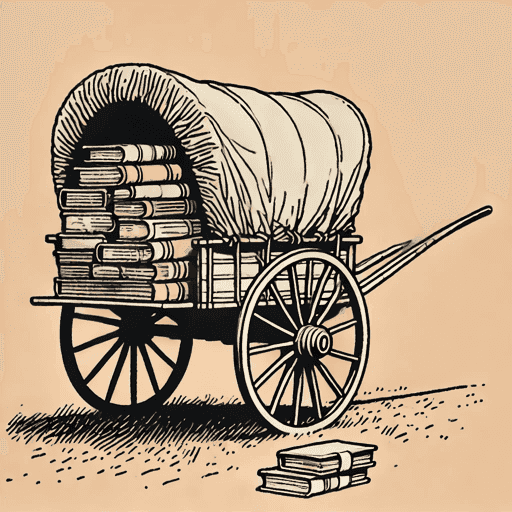
Later that night, drunk and restless, Fern leaves her unlocked shop with her satchel and Ten Links in the Chain as a peace offering. She sees lights on at Legends & Lattes but decides to walk around the block first. Slightly lost, she spots Astryx securing a tarpaulin on a two-wheeled cart.
Imagining the painful conversation ahead, Fern panics. On drunken impulse, she climbs into the cart and hides under the tarpaulin. She berates herself but doesn’t leave. As Astryx returns and tends the cart, Fern falls asleep.
Chapter 4 Summary
Fern wakes hungover in the moving cart, face-to-face with a grinning, bound goblin. She screams and tumbles out onto a country road. Astryx recognizes her from the pescadine attack.
Astryx explains the goblin is a bounty and they are a day and a half from Thune. She offers cheese and bread, then prepares to send Fern walking back to a village. Fern realizes with horror she has no money. Astryx makes clear she will not turn back.
The goblin curses in its own language. Seeing an opportunity, Fern implies she understands Goblin when Astryx asks. She proposes translating in exchange for passage to the next town. Astryx accepts despite skepticism about how a penniless bookseller will afford the return trip.
Chapter 5 Summary
As they travel, Fern struggles to write an apology to Viv, feeling immense guilt for abandoning her shop and especially Potroast. The goblin, named Zyll, watches with interest. Astryx jogs tirelessly alongside. Fern speaks nonsensical Goblin to keep up her ruse with Astryx; Zyll is surprised but does not respond.
That evening, Fern asks about Zyll’s crimes. Astryx recounts that Zyll allegedly disrupted the supply chain of the Seventy Saint army in the North Territory. She explains bounties are contractual deliveries, not moral judgments—after centuries, good and evil blur. Zyll studies Astryx’s sheathed sword, murmuring in Goblin.
Fern challenges Astryx’s indifference, comparing her attitude to her legendary status. Astryx expresses weariness with expectations of excitement, saying that after 10 centuries, dry socks are what she finds exciting.
Fern dreams of her empty bookshop, where dream-Viv and Tandri discuss selling it while Potroast pines. In the dream, Viv says Fern is gone, waking her.
Chapter 6 Summary
Astryx wakes Fern to report that Zyll has escaped. During a fruitless search through the woods that leaves Fern scratched by brambles, Astryx carries her part of the way. Astryx gives up, apathetic about what may have happened to Zyll, and Fern rebukes her indifferent attitude. Astryx says getting upset over plans gone awry isn’t worth it, and they return to camp to find the goblin calmly waiting with a captured hazferou, a venomous chicken-like creature.
Chapter 7 Summary
Astryx attempts to separate Zyll from the hazferou, but both resist. She offers a bargain: rebind Zyll less severely and spare the bird if Zyll cooperates. Zyll agrees. The hazferou reappears on the buckboard two leagues later. Astryx reaches for her sword, but Zyll waves her bound hands significantly. At Zyll’s hissed command, the bird hops into the cart and roosts. Astryx relents.
As the journey continues, Fern’s fur is grimy and scratched. Zyll produces moldy-looking herbs from one of her many pockets, which numb and soothe the scratches. Later, Astryx questions why Fern fled her life as a bookseller. Fern vents that bookselling is stressful and unpredictable, but she does it because she loved it and believed it important. Astryx notes Fern used past tense. Fern deflects, asking if Astryx always felt good about her work. Astryx replies nothing feels good all the time and reminds Fern that Bycross is a day away, ending the conversation.
Chapter 8 Summary
Fern rehearses her apology aloud, using Zyll as audience. She tries various approaches, imagining Viv’s responses. When she voices a hypothetical dismissal, she despairs at how ridiculous her situation is.
Astryx jogs backward beside the cart and advises simplicity, noting that the guilty dog barks loudest and a quick cut is best. Fern objects that she wants to apologize, not stab Viv. Astryx says it seems wasteful to agonize over something Fern already ran from.
Fern points ahead where someone waits. Astryx’s hand goes to her sword. A snakelike man called a tapenti blocks a footbridge. He wears two magestones on his belt, meaning he uses magic. Holding a slim dagger, he demands Zyll for safe passage, momentarily confused by the hazferou.
Astryx declines and draws her blade. The sword—an Elder Blade named Nigel—speaks pompously, identifying the tapenti’s magestones as common hedge-wizard fare. Astryx cuts him off.
The tapenti identifies himself as Chak the Pathless. He recognizes Astryx and claims to be her greatest student. Fern warns he faces a legend, but Chak says he came prepared. He formally challenges Astryx for custody of Zyll, to disarm rather than death. Astryx agrees.
Prologue-Chapter 8 Analysis
The narrative establishes and then deconstructs The Illusion of the “Fresh Start.” Fern’s move to Thune is a flight from an internal crisis that external changes cannot resolve, playing on the archetypal “midlife crisis” plotline wherein a character second guesses the life choices they made in their youth. The successful opening of Thistleburr Booksellers, a moment that should signify triumph, is immediately followed by her emotional breakdown in the alley. The venture’s success exacerbates her misery, proving that the “hollowed-out feeling of dissatisfaction” is an internal state (26), not a product of her circumstances. This is reinforced by the shop’s name, Thistleburr, a slight variation on her old shop, Thistlebrun, signaling a superficial change that fails to address a core problem. Her impulsive decision to hide in Astryx’s cart is the ultimate rejection of the new life she supposedly chose, a physical manifestation of her psychological inability to inhabit the fresh start she has constructed. By grounding the narrative in this internal conflict, the story prioritizes a journey of self-discovery over external adventure.
Fern’s emotional turmoil is juxtaposed with Astryx One-Ear’s pragmatic detachment, creating a comparative study of vocational dissatisfaction. While Fern feels overwhelmed by her identity as a bookseller, she passionately defends the profession as important. In contrast, Astryx, a legendary warrior, displays weariness with her own vocation, reducing heroic deeds by claiming the simple pleasure of dry socks would be more exciting. Fern is in crisis, unable to reconcile her sense of self with her unhappiness, while Astryx represents a potential future where survival necessitates emotional numbness. Her detachment is a coping mechanism developed over centuries, a recognition that such a “[depth] of feeling […] can’t survive the numbers” (53). This comparison deepens the theme of Redefining the Self Beyond Vocation, suggesting that neither clinging to a failing identity nor becoming emotionally numb to a long-held one offers a path to fulfillment.
Structural techniques externalize Fern’s internal state, most notably in the Chapter 5 dream sequence. From a limited third-person perspective, Fern’s anxieties are presented as objective reality. In the dream, Viv and Tandri discuss selling the bookshop and pragmatically accept that Fern is “gone,” mirroring her deepest fears of being a burden and easily discarded. Fern’s dream-self is a “powerless, floating perspective” (45), forced to witness a scene that confirms her self-loathing. By staging her fears as an event she observes but cannot alter, the narrative conveys the depth of her alienation and the lack of agency she feels in her quest to find satisfaction. The dream is not a reflection of Viv’s character but a manifestation of what Fern believes she deserves, solidifying her conviction that she has irrevocably damaged her most important friendships.
The recurring motif of books, particularly Ten Links in the Chain, symbolizes the complexities of connection and miscommunication. The book initially represents the foundation of Fern and Viv’s friendship, the object Viv credits with saving her life. Fern’s choice to bring it as a “peace offering” is an attempt to leverage that shared history. However, her flight transforms the book into an artifact of a conversation that never happened. This highlights a central irony: Fern’s profession is dedicated to facilitating understanding through stories, yet she is incapable of articulating her own. Her subsequent lie about speaking Goblin further underscores this breakdown in authentic communication, which is the root of her isolation. The motif thus evolves from an emblem of her trade into a commentary on the gap between professional storytelling and personal truth. This extends to Astryx’s character, as Fern believes she knows everything about Astryx; however, the many books have failed to convey how the elf actually feels about her life and her profession, something Fern can only learn through her conversations with the bounty hunter.
The introductions of Astryx and Zyll subvert traditional fantasy archetypes, shifting the focus from epic conflict to interpersonal dynamics. Astryx, the legendary Blademistress, is defined by weary practicality rather than heroic bombast. The reveal of her talking Elder Blade, Nigel, as a pompous academic further deflates the epic tone. Conversely, Zyll, presented as a bound goblin bounty, exhibits significant agency. She escapes her bonds, tames a hazferou, and demonstrates that her helplessness is a performance. This destabilization of expected power dynamics forces Fern out of her passive state and into a situation that demands active participation. By deconstructing these archetypes, the narrative signals that its primary conflicts are internal and relational, centered on motivation, agency, and the performance of identity.

Unlock all 62 pages of this Study Guide
Get in-depth, chapter-by-chapter summaries and analysis from our literary experts.
- Grasp challenging concepts with clear, comprehensive explanations
- Revisit key plot points and ideas without rereading the book
- Share impressive insights in classes and book clubs