Broken Country
71 pages • 2-hour read
Clare Leslie HallBroken Country
A modern alternative to SparkNotes and CliffsNotes, SuperSummary offers high-quality Study Guides with detailed chapter summaries and analysis of major themes, characters, and more.
Background
Social Context: Class Division in Rural England
Clare Leslie Hall positions the Meadowlands estate and Blakely Farm on opposite sides of a deep rural class divide that defined much of mid-20th-century England. Meadowlands, the big house with a private lake, servants, and a wine cellar, embodies the landed gentry whose fortunes survived both World Wars. Gabriel is reared to expect Oxford, country-house weekends, and London literary parties, and his mother, Tessa, casually writes a four-figure check to quiet Beth’s pregnancy, illustrating disposable wealth that can literally erase “inconveniences.” In contrast, Blakely Farm is a smallholding that lives from season to season, where Frank, Jimmy, and Beth measure prosperity in lamb yields and milk quotas. Jimmy’s resentment bursts out whenever Meadowlands infringes on farm life: He calls Gabriel a “posh nob” and accuses him of ruining honest people’s livelihoods.
The division is not simply economic; it shapes language, manners, and opportunity. Beth notices it at 16 when Gabriel’s “curt, cut glass accent” rebukes her for trespassing and again in 1968 when journalists refer to her as a “lowly ‘farmer’s wife’” (8, 237). Frank’s refusal to retaliate against Gabriel after the affair shows a deference that often accompanied perceived lower-class status, while Jimmy’s violent anger channels postwar working-class frustration at estates that still dominated thousands of acres yet employed few locals.
Hall also shows that upward mobility is limited: Beth’s scholarship hopes at St Anne’s are derailed by pregnancy, and Jimmy’s single shot at respectability is Nina’s pub job, not university. The fatal collision of the brothers’ worlds literalizes the tension: An aristocratic lurcher kills Blakely lambs, and a wealthy boy’s shotgun kills a farmer. Hall’s plot thus re-enacts the class antagonisms of Dorset villages where, even in the 1960s, manor walls and tenant hedgerows still marked whose stories mattered and whose could be bought off with silence.
Geographical Context: The Dorset Landscape
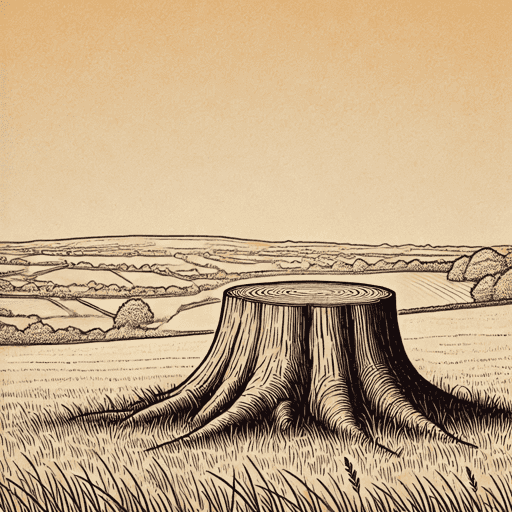
North Dorset is more than a setting in Broken Country; it is the novel’s emotional compass. Hall uses recognizable features of the Blackmore Vale and Cranborne Chase—rolling chalk downs, ancient hedgerows, and oak-lined meadows—to mirror her characters’ inner landscapes. The “long, sloping field” crowned by the Kennedy/Johnson oak evokes the isolated, self-contained farms that pepper real parishes such as Child Okeford or Shillingstone (289), where livestock outnumber neighbors and a tractor is the fastest way to the local pub. Seasonal farm routines in the novel follow the actual agricultural calendar: lambing in March, haymaking in July, and stubble burning after harvest. When Beth describes “burn[ing] the stubble to a crisp” (217), she echoes a practice that was common in Dorset until it was restricted in the late 1990s.
Rural remoteness also shapes plot mechanics. The telegraph pole felled by the storm that strands Beth in labor reflects how, before widespread mobile coverage or all-weather roads, villages like Hemston could be cut off overnight. Similarly, Frank’s fatal drive to find Jimmy takes place on single-track lanes where a wrong turn leads only to hedges and slurry pits. Hall’s birds—kestrels, skylarks, and nightingales—are species genuinely protected on Dorset Sites of Special Scientific Interest such as Fontmell Down, and Bobby’s notebook of calls captures the region’s status as an ornithologist’s haven. Even social rituals are place specific: The Compasses Inn, with its thatched roof and rusted scythe décor, resembles real ale pubs along the Stour Valley. By anchoring every major event—the illicit swims, the oak felling, the shotgun accident—to precise rural coordinates, Hall shows how landscape shapes destiny: Dorset’s beauty nurtures romantic idealism, but its isolation intensifies secrets, class resentments, and ultimately tragedy.
Socio-Historical Context: Postwar Britain and Shifting Social Mores
The narrative’s setting, spanning 1955 to 1969, coincides with seismic changes in British society, and Hall threads these together through character choices and village gossip. Postwar education reforms, like the 1944 Butler Act that established free, compulsory education, finally opened grammar-school doors for rural girls like Beth: Her Oxford offer from newly chartered St Anne’s signals widened female opportunity. Yet the convent head’s expulsion of pregnant Beth shows lingering pre-war moral codes. The 1961 introduction of the birth control pill in England and the 1967 Abortion Act hover in the background; Tessa’s offer of a “clinic abroad” reflects upper-class use of pre-1967 private abortions, while Beth’s refusal aligns her with a generation beginning to claim bodily autonomy.
Marriage patterns shift, too. Nina’s proposal to Jimmy lampoons 1960s commentary on women proposing marriage. Gabriel’s divorce and high-profile custody battle embody the era’s climbing divorce rate, which nearly doubled between 1958 and 1969 (“Divorces in England and Wales: 2022.” Office for National Statistics, 22 Feb. 2024). Popular culture also intrudes: Bobby’s Elvis obsession and Nina’s Carnaby-Street dresses place Hemston within the “Swinging Sixties,” even as many rural residents lag behind the trends.
Legally, Frank’s trial reveals a justice system before the 1984 Police and Criminal Evidence Act, which established a legal framework for policework, that relies on character, not forensic rigor. Courtroom theater outweighs hard evidence, letting bias about class and adultery shape the manslaughter verdict. In addition, by contrasting Meadowlands’s champagne weddings with Blakely’s shotgun funerals, Hall shows how the permissive decade liberated some while entrenching double standards for others. The timeline ends just shy of the 1970 Equal Pay Act—suggesting that, for Beth and Grace, the fight for modernity is only beginning.

Unlock all 71 pages of this Study Guide
Get in-depth, chapter-by-chapter summaries and analysis from our literary experts.
- Grasp challenging concepts with clear, comprehensive explanations
- Revisit key plot points and ideas without rereading the book
- Share impressive insights in classes and book clubs