Broken Country
71 pages • 2-hour read
Clare Leslie HallBroken Country
A modern alternative to SparkNotes and CliffsNotes, SuperSummary offers high-quality Study Guides with detailed chapter summaries and analysis of major themes, characters, and more.
Symbols & Motifs
The Lake at Meadowlands
Content Warning: This section of the guide includes discussion of child death and animal death.
The lake at Meadowlands functions as a powerful symbol throughout the novel, marking the evolution of Beth and Gabriel’s relationship across time. When they first meet as teenagers, the lake represents the beginning of their love and the promise of youth. Gabriel has “set himself up with a rug, a picnic hamper, and a folding canvas chair, a pair of fishing rods propped up against it” (17). This idyllic setting becomes the backdrop for their blossoming romance, and the lake’s over-the-top beauty reflects the intensity of their connection: “The glittering water and overhanging trees, their fronts reflected in a mirror image of feathery gold. The irregular stipple of white and pink” (18). The lake is a private paradise, separate from the social divisions that would ordinarily keep them apart.
Years later, when Gabriel returns to Meadowlands with his son, Leo, the lake becomes a site of reconnection for him and Beth. When they return to the lake during their affair, it evokes nostalgia but also highlights the painful reality of their choices. The lake represents not just the beauty of their past but also the sorrow of what might have been. During the affair, they spread “the old blue picnic rug, the same one from the day [Beth] met Gabriel” (209), explicitly connecting past and present, but Beth’s characterization of it strips it of the romance of their earlier connection, representing it instead as a worn, commonplace household item.
As the novel progresses, the lake’s symbolic meaning transforms from representing innocent love to embodying bittersweet memories, regret, and the passing of time. When Beth revisits Meadowlands at the novel’s conclusion, she observes, “There’s a spot in the road where you can see through the trees and have an almost perfect view of the lake. I stand there for a moment remembering the girl and boy who once fell so passionately in love. They don’t feel like Gabriel and me anymore” (300). Instead of being near the lake, Beth can only see a portion of it from a distance away, highlighting the metaphorical distance between her present and her past. The lake ultimately symbolizes how the past simultaneously haunts and nurtures the present, highlighting the theme of The Unrelenting Grip of the Past.
The lake also serves as a space of revelation and truth. It’s where Beth and Gabriel first share intimate details about their dreams and aspirations. Later, it becomes a place for family bonding when Leo joins them for a picnic, creating a painful simulacrum of the family they might have been. This symbolic function connects to the theme of truth and secrecy running throughout the novel. The lake, with its reflective surface showing both what is above and what lies beneath, mirrors how the characters present themselves to the world while hiding deeper truths.
Animals
The recurring presence of animals throughout Broken Country provides a consistent motif that illuminates the novel’s themes of life, death, nurturing, and the innate instincts that drive human behavior. Farm animals, particularly sheep and lambs, form the backdrop of rural life but also function as catalysts for crucial plot developments and character revelations.
The novel opens with a violent animal encounter when a lurcher attacks the lambs at Blakely Farm. This attack initiates the reconnection between Beth and Gabriel when he and Leo come to apologize, setting the entire plot in motion. The violence of this scene foreshadows the human violence to come: “A flick-switch change in the dog. Eyes black, teeth bared, body rigid with adrenaline” (12). The description mirrors how Jimmy will later transform when drunk and violent, suggesting the thin line between human and animal instinct.
Throughout the narrative, the birthing and nurturing of lambs connects to themes of parenthood and care. Beth’s son, Bobby, had a special affinity for them: “Bobby was mad for our lambs. He fed the waifs year after year with a bottle, that was his job, he wouldn’t let anyone else touch it” (11). Later, his half-sister, Grace, shows the same connection: “Grace is weaving down Top Field with two ewes and a cluster of newborn lambs” (295). The parallels between human children and animal offspring recur throughout the novel, suggesting a natural inheritance beyond blood relation.
Most significantly, animals represent the cyclical nature of farm life and the continuity that persists through tragedy. After Bobby’s death, Beth observes, “For Frank and me everything changed when Bobby died but the farm stayed the same, season by season” (218). The relentless cycle of animal birth, care, and death provides structure and meaning when human relationships fracture. At the novel’s end, Grace helps birth a lamb herself, symbolizing renewal and the continuation of life: “One of these lambs is more special to Grace than the others because yesterday she birthed it by herself” (295). Through this motif, Hall demonstrates how animals connect humans to both the inevitability of death and the persistence of life.
Secrets and Lies
The motif of secrets and lies forms the novel’s structural backbone, driving the plot and revealing character motivations. Virtually every significant relationship in Broken Country is built on or damaged by concealed truths, creating a complex web of deception that ultimately leads to tragedy.
The central secret—that Bobby was Gabriel’s biological son, not Frank’s—structures the entire narrative. This secret shapes Beth’s life choices and her relationship with Frank, with whom she shares the secret. Even when she considers telling Gabriel about her pregnancy, Tessa intervenes, telling her, “Promise you won’t tell Gabriel about the pregnancy. His life at Oxford is just beginning, I couldn’t bear for this to ruin his prospects” (285). This deception creates ripples of guilt and unresolved emotion that influence Beth’s actions decades later, demonstrating how secrets can distort lives across generations.
The affair between Beth and Gabriel represents another layer of secrecy. Their clandestine meetings are fraught with fear of discovery: “I pick up the phone and call Gabriel, dialing his number with shaking hands. There is nothing risky about this, the farmhouse is empty, but I still find myself whispering guiltily into the phone” (215). Beth becomes “a practiced, efficient liar” (213), illustrating how deception becomes habitual and transforms identity. The novel suggests that secrets, once created, develop their own momentum and demand ever more elaborate deceptions to maintain.
Hall employs this motif to explore how truth and authenticity are essential for genuine human connection. When Gabriel finally learns that Bobby was his son, his reaction—“You stole him. You and Frank” (278)—reveals how destructive concealment can be, even when motivated by protection. However, through the trial and Frank’s protection of his son, Gabriel comes to terms with the truth by telling Leo the truth about his half-brother and reconnecting with Beth to learn more about Bobby. Only through painful revelation can any healing begin, suggesting that knowing the truth, however difficult it may be, is necessary for reconciliation.
The Oak Tree
The oak tree appears as a potent symbol throughout Broken Country, representing life and death, as well as permanence and fragility. The massive oak that kills Bobby had once been a symbol of enduring love and commitment; Beth notes, “The oak tree has more meaning for us than any other on the farm. It is where Frank asked me to marry him” (159). This transformation from symbol of life to agent of death encapsulates the novel’s exploration of how joy and tragedy are inextricably linked.
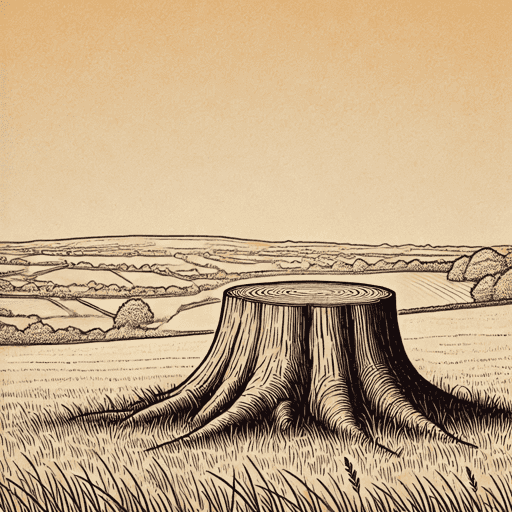
When the oak falls and kills Bobby, it becomes the central trauma around which the characters’ lives revolve. The remaining stump serves as a physical reminder of their loss: “And through all of it, through snow, through rain and scorching sun, the stump remained to remind us” (218). Frank’s attempt to burn the stump years later represents his desperate need to destroy this reminder: “Bobby’s tree is burning. I know it before I see it, before I stand at the edge of the field and watch flames curling up its stump and a line of fire streaking across the grass toward the trees” (217). This symbolic act of destruction reveals Frank’s inner turmoil and his struggle to process his grief and guilt.
The author deliberately positions the oak as a symbol that evolves throughout the narrative. Initially, it represents stability and tradition as the centuries-old cornerstone of the farm. Bobby and Beth would spend hours beneath its sprawling branches. After Bobby’s death, it becomes a tormenting memorial, with Frank observing that “it’s over”—the tree, Bobby, and their marriage—directly connecting the tree to their fractured relationship.
Trees also appear elsewhere in the novel as symbols of shelter, family lineage, and the passage of time. The willow trees surrounding the lake at Meadowlands create a secluded paradise for Beth and Gabriel. Leo’s tree house offers him sanctuary during difficult times: “Inside, the tree house is a revelation. It’s a fairly big space, tall enough to stand up in, around eight feet wide, with a big open window looking out over the grounds” (53). The “family tree” becomes significant when the truth about Bobby’s parentage is revealed.

Unlock the meaning behind every key symbol & motif
See how recurring imagery, objects, and ideas shape the narrative.
- Explore how the author builds meaning through symbolism
- Understand what symbols & motifs represent in the text
- Connect recurring ideas to themes, characters, and events