Broken Country
71 pages • 2-hour read
Clare Leslie HallBroken Country
A modern alternative to SparkNotes and CliffsNotes, SuperSummary offers high-quality Study Guides with detailed chapter summaries and analysis of major themes, characters, and more.
Themes
The Unrelenting Grip of the Past
Content Warning: This section of the guide includes discussion of death, child death, suicidal ideation, and addiction.
Broken Country portrays past events as persistent forces that continuously shape characters’ present realities. The novel’s structure itself reinforces this concept through alternating chapters set in different time periods, creating a narrative where memories and past relationships intrude upon current experiences. This approach suggests time as cyclical rather than linear, with past and present existing in constant interplay.
The relationship between Beth and Gabriel vividly illustrates how the past refuses to fade, continuing to affect every aspect of Beth’s life after Gabriel returns. Beth’s teenage romance with Gabriel, cut short by misunderstanding, continues to influence her life decades later. When Gabriel returns to Hemston with his son, Leo, unresolved feelings resurface for both of them. On seeing Gabriel again, Beth reflects, “There have been too many thresholds like this one, chances missed, turns not taken, and always the question burning between us, me and Gabriel, Gabriel and me, the life we might have had” (171). For Beth, the past exists alongside the present, coloring every interaction and even affecting her life with Frank.
Bobby’s death, which happens before the present timeline in the novel, continues to affect every aspect of Beth’s and Frank’s lives. Frank, who failed to watch over Bobby as promised, carries this guilt into every subsequent action. His acceptance of Beth’s affair with Gabriel stems from his belief that he deserves punishment for what happened to Bobby. During his trial, Frank explains, “I felt I’d ruined her life. I’d taken away the one person she loved more than anyone else” (254). This enduring guilt later drives him to take responsibility for Jimmy’s death to protect Leo, as if he is atoning for what he perceives as his earlier failure.
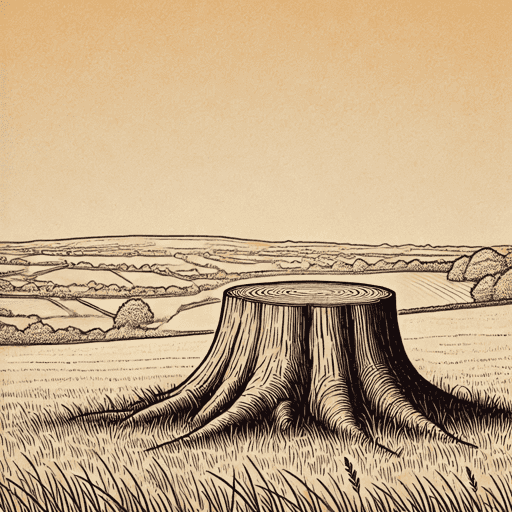
Even the landscape functions as a repository of memory. The oak tree stump where Bobby dies remains a haunting presence that alternately comforts and upsets the Johnsons. Beth observes,
So much has changed since that fateful day. We have passed through autumn, once, twice, and now almost three times. […] For Frank and me everything changed when Bobby died but the farm stayed the same, season by season. And through all of it, through snow, through rain and scorching sun, the stump remained to remind us (217-18).
The physical environment itself refuses to let them forget, and in frustration, Frank eventually attempts to burn it as a way of gaining closure.
In addition, events in the novel follow cyclical patterns that emphasize the past’s inescapable influence. Bobby’s accidental death involving the oak tree finds an echo when Jimmy dies from Leo’s gunshot. In both tragedies, Frank assumes responsibility—first emotional, then legal. These parallel events trap characters in cycles that they struggle to break. Only when Frank finally tells Beth on the phone, “I’m ready to let him go” (299), does he take the first step toward liberation from the past’s grip.
Hall ultimately suggests that while the past cannot be erased, it can be integrated into one’s life in ways that permit growth rather than stagnation. The novel concludes with Frank returning home after his prison sentence, reuniting with Beth, and meeting his daughter, Grace, for the first time. This moment represents the possibility of moving forward while acknowledging what came before. The past has shaped them indelibly but does not need to dictate their future.
Navigating Class Conflict and Social Division
Class conflicts and social hierarchies permeate Broken Country, creating tensions that drive the plot development and character relationships. Hall portrays a rural English village where strict social stratification persists throughout the 1950s and 1960s. These divisions manifest most clearly in the relationship between Beth, who is from a modest teaching family, and Gabriel, who is heir to the grand Meadowlands estate.
Social differences color Beth and Gabriel’s relationship from their first encounter. Beth immediately perceives Gabriel, dressed in his father’s old tweed, as “a brainless, upper-class twit. A Bertie Wooster” (9). This judgment reflects the inherent suspicion between different social strata in the village. Though their attraction transcends these boundaries initially, social pressures ultimately prove insurmountable, particularly through Gabriel’s mother Tessa’s interference.
Tessa embodies class prejudice at its most insidious. During Beth’s first dinner at Meadowlands, Tessa deliberately undermines her through subtle social cues, remarking when Beth tries to help clear the table, “We don’t stack here, we leave that to the school dinner ladies” (69). This seemingly casual comment establishes Beth’s inferior position by implying that she is closer in status to being one of the “help.” Later in the novel, when Beth becomes pregnant with Gabriel’s child, Tessa offers money for her to disappear, stating, “Boys like Gabriel don’t tend to end up with girls like you” (82). Her dismissal of Beth reveals how the British upper class at that time viewed cross-class relationships as temporary diversions rather than legitimate connections.
The village itself functions as a microcosm of broader social stratifications, illustrated by the tension that erupts upon Gabriel’s return to Hemston as a successful novelist. Jimmy’s hostility stems partly from class resentment, which is evident when he confronts Gabriel at the pub: “Why don’t you go back to London or wherever you came from? No one wants you here. Get lost” (116). In addition, village gossip about the “playboy” author and the “farmer’s wife” reveals how social divisions persist through collective surveillance and judgment.
The gap between Beth and Gabriel’s educational opportunities further highlights the class divide. Gabriel attends boarding school and Oxford University as a birthright, while Beth surrenders her hard-won Oxford place after becoming pregnant. When discussing Oxford with Gabriel, Beth reflects on this inequality: “It’s so easy for someone like Gabriel, with his future mapped out from birth” (31). In the time and place of the novel, social class determines not just material wealth but access to knowledge and opportunity. Gabriel’s literary career flourishes through his connections and Oxford education, while Beth’s poetic talents remain largely undeveloped due to her circumstances.
Class also significantly influences how characters’ transgressions are judged. When village mother Alison testifies against Frank, her testimony carries class prejudice: “The Johnsons don’t live by a normal code of conduct. They’re a bit feral” (163). The choice of the word “feral” equates the Johnsons with animals or people of a “lower order.” Meanwhile, the media portrays Gabriel sympathetically as the “playboy author” while disparaging Beth as a “lowly ‘farmer’s wife’” (237), demonstrating how moral narratives are shaped by class assumptions.
Throughout the novel, Hall illustrates how social divisions function as active forces that determine relationships and life trajectories. While characters like Tessa actively enforce these boundaries, others like Beth and Frank create meaning despite them. The novel suggests that although class hierarchies persist stubbornly, individual resilience and authentic connection can carve spaces where such divisions hold less power.
The Cycle of Love, Betrayal, and Reckoning
Broken Country examines the intricate patterns of love, betrayal, and reckoning that can characterize romantic relationships. Hall portrays passionate connections that inevitably lead to betrayal, compelling characters to face the consequences of their choices. This pattern repeats throughout the novel, suggesting that these emotional sequences constitute an inescapable aspect of human experience.
Beth and Gabriel’s relationship exemplifies this dynamic. Their teenage romance begins intensely but collapses when Beth misinterprets his diary entries about Louisa. Years later, she discovers the truth when Gabe tells her, “You were wrong all those years ago about me and Louisa. […] I didn’t sleep with Louisa while you and I were together” (169-70). This revelation shows how misunderstandings can create decades of separation. When their affair reignites, Gabriel tells Beth, “These last days with you have made me realize what a fool I was to let you go last time. I always knew that, but now I really know. We were meant to be together” (216). This language of destiny obscures the reality that their renewed love betrays Frank, initiating another sequence of pain. However, in the end, Beth and Gabriel are forced to reckon with the devastating results of their affair and face the consequences of their actions.
Beth’s marriage to Frank presents a different variation on this theme. Frank accepts Beth while knowing that she carries another man’s child, demonstrating a selfless love that contrasts with Gabriel’s absence. Yet Beth ultimately betrays Frank’s devotion through her affair with Gabriel. When confronted, Beth admits, “I still love you,” to which Frank responds, “And him. Do you love him?” (219). Her telling hesitation confirms her divided heart. Frank’s reply—“Then you can have this. I won’t stand in your way” (219)—reveals his understanding of Beth’s emotional conflict, stemming not from weakness but from recognition of his role in their marital struggles after Bobby’s death. However, Frank’s willingness to step aside has consequences as well, as it disrupts the fabric of their family and sets Jimmy on a fatal path.
Gabriel’s marriage to Louisa represents another variation of this pattern: Despite appearances, their relationship was built on compromise rather than genuine passion. Louisa confesses to Beth, “I loved him, absolutely I did. And Gabe tried to love me back. But we were kidding ourselves” (146). Social expectations and Gabriel’s lingering feelings for Beth doomed the marriage from its beginning. Louisa eventually betrayed Gabriel by falling for another man, and she admits, “I’m not making excuses, really, I’m not. I will always feel guilty about falling in love with someone else while I was married” (147). This confession highlights how betrayal often stems not from malice but from emotional currents beyond control. The consequences of Louisa’s actions play out in her distance from Leo and his perception that she prioritizes her new family.
The most profound reckoning follows Jimmy’s death, when the consequences of Beth and Gabriel’s affair become catastrophic. The pattern completes itself when Beth finally reveals that Bobby was Gabriel’s biological son—information that she had withheld. When Gabriel discovers this secret, he confronts her about her betrayal of his trust: “You cheated [Leo] out of a brother. And me out of a son. You stole him” (278). This revelation forces Beth to confront her betrayal of Gabriel years earlier as past and present deceptions collide.
Frank’s decision to take the blame for Jimmy’s death represents a transcendent reckoning—a sacrificial act that breaks the cycle. By protecting Leo, Gabriel’s son, Frank demonstrates compassion beyond jealousy or resentment. This choice suggests that while patterns of love and betrayal may be inevitable, our response to their consequences remains within our control. Frank chooses forgiveness over vengeance, displaying moral courage that rises above predictable patterns of hurt. When the novel concludes as Frank returns home to Beth and Grace after serving his prison sentence, it suggests that while these emotional patterns shape our lives, they need not define us completely. As Frank lifts his daughter and declares, “I AM HOME” (302), Hall intimates that honest confrontation with past betrayals can eventually lead to healing, though scars from these cycles remain permanently etched in characters’ lives.
Enduring the Weight of Grief and Loss
Broken Country portrays grief not simply as an emotion but as a transformative force that reconstructs identities and relationships. Through the characters’ varied responses to loss, particularly following Bobby’s death, Hall illustrates how grief isolates individuals even as they share identical tragedies. Bobby’s death functions as the narrative’s emotional core, affecting every character’s trajectory. The novel portrays grief not as a temporary state to overcome but as a permanent condition to incorporate into one’s existence.
For Beth, grief manifests as an omnipresent companion that infiltrates all aspects of life. She constantly carries Bobby’s photograph, maintaining a tangible connection that Leo notices: “I’ve seen your face when you look at the photo of him in your bag” (85). This observation reveals how her sorrow remains visible, even to strangers. Beth relies on constant activity rather than contemplation: “Busyness is the only thing that helps. People spoke to me of meditation after Bobby died, I was lent library books on Buddhism and the ancient art of yoga. And I thought, Really, you think a few minutes of intense breathing will modify my pain?” (61). This rejection of conventional consolation illustrates how profound grief defies simple remedies, requiring instead, for Beth, the numbing distraction of perpetual motion.
Frank processes sorrow through silence and guilt. Unlike Beth, who yearns to discuss Bobby, Frank internalizes his pain, unable to articulate it. Beth observes, “Frank can’t often bear it because he’s so steeped in guilt he manages to carry on only by acting as if Bobby never existed” (133). This avoidance creates distance between them even immediately after Bobby’s death: “[W]e are apart when David drives the tractor forward, winching its colossal load, the dead tree rising inch by painful inch” (175). This physical separation symbolizes their emotional divergence, each unable to reach across the chasm of individual suffering. Frank copes with his grief through physical exertion: “His way of coping is to work himself into the ground so that he falls into an exhausted sleep each night, ready to start over again at sunrise” (133). Although Frank’s grief manifests differently, like Beth, he uses activity to escape it.
Jimmy exhibits yet another grief response and develops an alcohol addiction, becoming more volatile. Frank notes, “It all goes back to Bobby. Jimmy’s never been right since he died” (157). During his stag night, Jimmy confesses to Frank that “he d[oes]n’t think he [i]s any good at living. Sometimes he th[inks] [they]’d be better off without him” (157). This admission reveals how unacknowledged grief can transform into self-destruction. Jimmy’s way of coping, in which he acts out his grief, contrasts with Frank’s stoic endurance, demonstrating varied manifestations of unresolved loss.
Hall suggests that grief does not diminish but instead becomes integrated into one’s identity. Beth states plainly, “You can never change back once you’ve had a child, even if that child no longer exists” (25). This observation captures how loss fundamentally alters one’s sense of self, creating a permanent division in life. When Gabriel offers Beth opportunities to discuss Bobby, she experiences momentary relief: “Slowly, at first, so that I hardly register it. The early evening wine drinking. An hour when I talk about my dead son and Gabriel listens as if I am telling him a story, night after night, while I draw Bobby’s character from scratch” (135). This relief comes not from diminished grief but from its acknowledgment, supporting Hall’s message that grief is not something to overcome but an ongoing state to incorporate into one’s life. The novel concludes with Frank’s reunion with Beth and their daughter, Grace, but Bobby’s absence remains, acknowledged rather than forgotten. This depiction suggests that enduring grief requires accepting its permanent weight while finding ways to continue living, embodying resilience without demanding resolution.

Unlock every key theme and why it matters
Get in-depth breakdowns of the book’s main ideas and how they connect and evolve.
- Explore how themes develop throughout the text
- Connect themes to characters, events, and symbols
- Support essays and discussions with thematic evidence