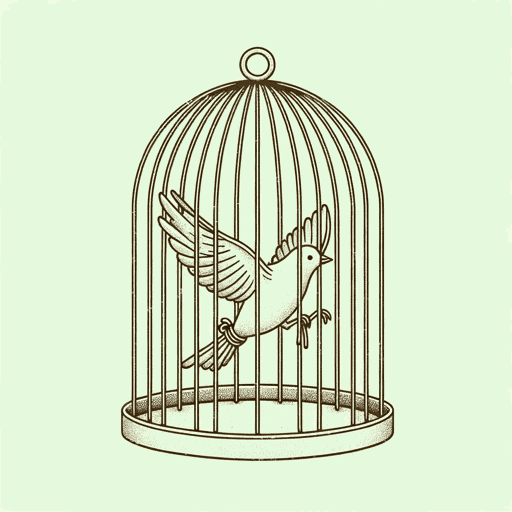
Caged Bird
34 pages • 1-hour read
Maya AngelouCaged Bird
A modern alternative to SparkNotes and CliffsNotes, SuperSummary offers high-quality Study Guides with detailed chapter summaries and analysis of major themes, characters, and more. For select classroom titles, we also provide Teaching Guides with discussion and quiz questions to prompt student engagement.
Book Club Questions
General Impressions
Content Warning: This section of the guide contains discussion of racism.
Gather initial thoughts and broad opinions about the book.
1. How does the contrast between the images of the free bird and the caged bird affect your emotional response to the poem? Which visual created the strongest impression, and why?
2. Angelou’s “Caged Bird” serves as a companion piece to her autobiography I Know Why the Caged Bird Sings. How does the poem’s extended metaphor illuminate aspects of her personal journey that resonated with you? For those who have read both works, how does the autobiography enhance your understanding of this poem?
3. What effect did the repetition of the stanza about the caged bird singing of freedom have on your reading experience? How did this structural choice influence your understanding of the poem’s message?
Personal Reflection and Connection
Encourage readers to connect the book’s themes and characters with their personal experiences.
1. The caged bird sings “with a fearful trill / of things unknown / but longed for still” (Lines 16-18). What aspirations or experiences have you yearned for without having directly experienced them? How has that yearning influenced your choices or outlook?
2. Angelou writes that “a caged bird stands on the grave of dreams” (Line 27). When have you felt your dreams were restricted by external circumstances? How did you respond to those limitations?
3. The two birds are a contrast of power and powerlessness. Reflect on a time when you felt either particularly empowered or disempowered. What circumstances contributed to that feeling, and how did you navigate that experience?
4. The free bird’s ability to ignore the caged bird’s song by thinking “of another breeze” (Line 23) raises questions about privilege and complicity. How does this dynamic compare to similar relationships in To Kill a Mockingbird, where Harper Lee also uses bird imagery to explore inequality? How have you witnessed such dynamics in your own life?
5. Voice and expression are central to this poem. How have you used your own voice—whether through speech, writing, art, or another medium—to express your desires or process difficult experiences? Which medium do you feel most comfortable using?
Societal and Cultural Context
Examine the book’s relevance to societal issues, historical events, or cultural themes.
1. Angelou was heavily involved in the civil rights movement, working with figures like Martin Luther King, Jr., and Malcolm X. How does this poem reflect the ideologies and strategies of that movement, particularly in relation to finding one’s voice amid oppression?
2. The guide mentions that while most critics view the poem as a comment on the Black American experience, it can represent any group of people who feel trapped. Beyond racial inequality, what other forms of societal oppression might this poem speak to?
3. The metaphor of the caged bird draws from Paul Laurence Dunbar’s poem “Sympathy” (1899), written a few years after the US Civil War. How has the significance of this metaphor evolved from Dunbar’s time, to Angelou’s publication in 1983, to our present day? Is it as effective now as it was then?
Literary Analysis
Dive into the book’s structure, characters, themes, and symbolism.
1. How does Angelou use contrasting natural imagery to establish the difference between the free bird and the caged bird? What specific language choices highlight this contrast most effectively?
2. The poem contains various forms of rhyme, including end rhymes, internal rhymes, perfect rhymes, and slant rhymes. How do these different rhyming patterns contribute to the musicality and meaning of the poem?
3. The poem describes the free bird as one who “dares to claim the sky” (Line 7) and later “names the sky his own” (Line 26). What might these acts of claiming and naming symbolize in the context of power dynamics within society?
4. What is the significance of the line “his shadow shouts on a nightmare scream” (Line 28)? How does this complex image contribute to our understanding of the caged bird’s emotional state?
5. The act of singing functions as both resistance and hope in “Caged Bird.” How does Angelou develop this dual symbolism throughout the poem, and what specific language choices emphasize this dual function?
6. How do the alternating descriptions of the free and caged birds contribute to the poem’s overall impact? What would be lost if Angelou had focused exclusively on the caged bird?
Creative Engagement
Encourage imaginative and creative connections to the book.
1. How would you make the poem into a powerful visual art piece? What colors, textures, and compositions would you use to capture its contrasting imagery and emotional impact?
2. What music would you choose as a soundtrack to accompany a reading of “Caged Bird”? How would your selection enhance specific moments or overall themes in the poem?
3. Your book club has been asked to create a community project based on “Caged Bird.” What kind of project would you propose, and how would it honor both the letter and spirit of Angelou’s work?

Unlock all 34 pages of this Study Guide
Get in-depth, chapter-by-chapter summaries and analysis from our literary experts.
- Grasp challenging concepts with clear, comprehensive explanations
- Revisit key plot points and ideas without rereading the book
- Share impressive insights in classes and book clubs