Contact: A Novel
54 pages • 1-hour read
Carl SaganContact: A Novel
A modern alternative to SparkNotes and CliffsNotes, SuperSummary offers high-quality Study Guides with detailed chapter summaries and analysis of major themes, characters, and more.
Part 3Chapter Summaries & Analyses
Content Warning: This section of the guide contains discussions of illness or death.
Part 3: “The Galaxy”
Part 3, Chapter 19 Summary: “Naked Singularity”
In the opening quotes, Ralph Waldo Emerson comments on “paradise,” and Samuel Taylor Coleridge muses on the vastness of the universe.
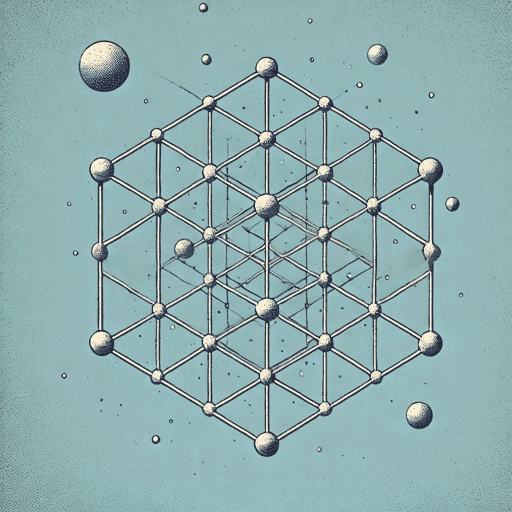
After the Machine is activated, the travelers fall through a vast tunnel. They emerge near Vega, where Xi Qiaomu identifies a massive polyhedral structure as a radio telescope array. Ellie feels slightly let down to realize that the aliens’ array bears many similarities to the ones on Earth. Eda suggests that they are on the rustic outskirts of a galactic transport network. Ellie records everything as Eda and Vaygay debate the black hole-related physics that makes their passage possible. As the pod makes several jumps through uninhabited star systems, Ellie reflects that the aliens are “boasting” about their achievements, and she believes that this might reflect a flaw in their character. The vehicle finally emerges at the center of the galaxy, which features two supermassive black holes. They approach an immense station with thousands of docking ports of various sizes, and their pod automatically docks with a matching port.
Part 3, Chapter 20 Summary: “Grand Central Station”
Opening quotes from Thomas Browne, Thomas Aquinas, and William Shakespeare variously comment on the nature of God, angels, and the Devil.
The Five step out onto a simulated beach inside the station, and their pod vanishes behind them. They explore their surroundings, and as Ellie carries her Earth palm frond forward, she laughs to behold the palm trees on this alien beach. That night, they all experience the same dream of swimming and breathing underwater. Ellie awakes with a headache, and soon, a freestanding door appears on the sand. After some brief discussion, Eda, Xi, Vaygay, and Devi walk through it and disappear, but Ellie hesitates. She remains on the beach, swimming in the water and sitting on the shore, reluctant to enter the mysterious door and morbidly imagining a scene in which her colleagues have been captured in a zoo. Finally, a figure resembling her deceased father approaches. The being, which has taken the form of a “simulacrum” created from her memories, explains that it is one of many Caretakers who maintain a vast transport network that was built by an ancient civilization. This civilization has since disappeared, and the Caretakers do not know where or why.
The Caretaker states that the early transmissions from Earth made them aware that humanity was teetering between opposite futures of evolution or self-destruction, so they sent the message to nudge humanity in the right direction. The Caretaker reveals that there are much greater mysteries that they are still studying, such as the fact that a message is embedded deep within Pi (π). The other travelers return to the beach, each accompanied by a simulacrum of a loved one. The Caretakers say that time is short, and as the pod reappears, they declare that this journey cannot be repeated. The Five are escorted to the pod so that they can return home.
Part 3, Chapter 21 Summary: “Causality”
A quote from Shakespeare’s King Lear (1606) states, “As flies to wanton boys are we to gods—/ They kill us for their sport” (322).
The Five return to Hokkaido in high spirits to find that only 20 minutes have passed on Earth, though they experienced 18 hours. Disbelieving authorities refuse to accept the veracity of their story and decide to debrief them separately. As Secretary of Defense Michael Kitz contemptuously interrogates Ellie, he reveals that all their video and instrument records are blank, and he accuses the entire group of perpetrating an elaborate hoax. When Kitz accuses Ellie of setting Drumlin up and declares that she never liked her former mentor, Ellie notes that “Der Heer slumped still further down in his chair” (331), and she intuits that he may have “regal[ed] Kitz with secondhand pillow talk,” but “[s]he couldn’t be sure” (331). Kitz cites the fact that the Vega transmission ceased at the precise moment when the Machine was activated—a causal impossibility. He believes this fact is proof of a conspiracy involving S. R. Hadden, who would have had the means and the mischievous motivation to help fake a signal from Vega.
Kitz dismisses a recent report that the pod shows signs of physical stress consistent with the rigors of the pan-galactic journey that they describe. He then offers them a deal; the government will claim to the world that the Machine has failed. If the Five remain silent, they will be allowed to return to their lives unbothered, but if they decide to speak out about their experiences, dossiers are already being created as a contingency plan to publicly discredit them. Kitz also tells Ellie that Hadden reportedly died in space around the same time that the Machine was activated.
Part 3, Chapter 22 Summary: “Gilgamesh”
A poem by Emily Dickinson states, “That it will never come again/ Is what makes life so sweet” (339).
The narrative reveals that S. R. Hadden has faked his own death. Now, having resolved to learn nothing more of the Five after the activation of the Machine, he departs his orbital home on a private spacecraft called Gilgamesh and sets a trajectory for interstellar space. He has always been chasing dreams of immortality in one form or another, and now he plans to tour the outer reaches of the solar system before entering cryogenic sleep. He hopes that in some unguessed future moment, he may find a form of immortality upon being discovered and revived by an alien civilization. He cuts all contact with Earth, satisfied with his decision.
Part 3, Chapter 23 Summary: “Reprogramming”
A biblical quote from II Peter 1:16 states, “We have not followed cunningly devised fables… but were eyewitnesses” (345). Another quote by Karl Jay Shapiro urges people to immerse themselves in the world in order to make contact with the divine.
The government releases its official account that the Machine failed. The president honors Ellie publicly for her courage, and Ellie is unable to ascertain just how much the president knows about the Five’s descriptions of their journey. In exchange for her silence, Ellie receives lifelong tenure at Argus and quietly begins a new search for evidence that will exonerate her. She works with Vaygay to reprogram the Argus supercomputer so that it will continuously search for patterns deep within Pi (π) and other transcendental numbers.
When Palmer Joss visits, Ellie tells him the full story and entrusts him with a manuscript of her account of the journey. They discuss what the Caretaker said and agree that the real search for the creator of the universe might best be taken by searching the world of mathematics for a “signature.” Joss affirms his belief in her and insists that people will believe her story without proof. Ellie agrees to consider going public in a few months, even if she still lacks empirical evidence.
Part 3, Chapter 24 Summary: “The Artist’s Signature”
A quote from I Corinthians 15:51 states, “Behold, I shall tell you a mystery; we shall not all sleep, but we shall all be changed” (365). In the second quote, Nichomachus of Gerasa muses on the idea that numbers played a role in the creation of the universe.
Months pass, and one day, Ellie is informed that her mother has died. When Ellie arrives grief-stricken at the nursing home, John Staughton urges her not to look at her mother’s body, as her mother would not want to be seen that way. He gives Ellie a sealed letter from her mother and asks her to read it later that night.
Back in her hotel room, a distraught Ellie ignores a notification from the Argus computer, which is reporting a discovery. Instead, she reads her mother’s letter, which was written many years ago, when Ellie was only a teenager. In the letter, her mother reveals that John Staughton, not Theodore Arroway, is Ellie’s biological father. As Ellie processes the news and feels a deep shock at this upending of her own personal origin story, she philosophically recognizes the importance of love in the middle of exploring the cosmos.
In italics, an objective third-person narrator reveals that the Argus computer has discovered a nonrandom sequence of zeros and ones deep within the digits of Pi (π), calculated in base 11. Arranged as a grid, the sequence forms a perfect circle and is the long-sought “artist’s signature” embedded in the fabric of the universe.
Part 3 Analysis
In this climactic section, the narrative refines its exploration of The Search for Meaningful Contact, revealing that true connection is predicated on shared frames of reference. The extraterrestrial Caretakers do not appear in their own form; instead, they manifest as simulacra of the travelers’ loved ones. This act acknowledges that contact must be mediated through personal memory and emotion in order to be comprehensible. Ellie’s encounter with the being who assumes her father’s form is the most significant cosmic contact she experiences, yet the physical form that she sees is built entirely from her own consciousness. This experience foreshadows her eventual realization that the search for cosmic connection and the capacity for human love are intrinsically linked. As the narrative later states, “For small creatures such as we the vastness is bearable only through love” (371). This synthesis resolves Ellie’s character arc, transforming her from a seeker of abstract signals into a person who understands the universal meanings to be found in personal relationships.
On a structural level, the more mundane aspects of the novel’s final chapters also contain a sharp pivot from cosmic exploration to the constrained environment of Earth-bound politics as skeptical bureaucrats deride and dismiss the personal revelations that the Five have experienced. This deliberate movement from the macrocosm of the galactic transport network to the microcosm of an interrogation room illustrates the flaws and limitations that humanity as a species has yet to overcome. The journey through wormholes and the arrival at the galactic hub fulfill the wildest promises of the science fiction genre by presenting humanity with evidence of a universe that is far older and more organized than people have ever imagined.
However, the chapters detailing the world’s response to the Five systematically dismantle this framework of empirical certainty, as is evidenced by Kitz’s cynical reinterpretation of the events as he sees them. Thus, Kitz’s skepticism becomes the primary antagonist of these final chapters, and although his logic is internally consistent, his provincial viewpoint limits his understanding and compels him to callously reinterpret every extraordinary event as part of a hoax. His condemnation illustrates the importance of the scientists’ collective efforts at Overcoming Human Provincialism, and in this endeavor, Ellie finds an unlikely ally in Palmer Joss, who accepts her account as an expression of a spiritual archetype. He specifically recasts the Five’s journey in theological terms, quoting Genesis: “He dreamed, and behold a ladder set up on the earth, and the top of it reached to heaven…This is none other but the House of God, and this is the gate of heaven” (363).
In this way, Ellie and her colleagues experience an ironic reversal, having flipped from skeptical observers to fervent believers who now profess a broader vision of the universe. In a deliberate echo of Jesus’s disciples, they stand desperately before the tribunal of human doubt, begging their fellows to have faith in their account of what they have seen firsthand. The fact that these chapters are preceded by Bible verses attributed to the first devout followers of Jesus further blurs the boundaries between faith and science, implying that Sagan himself may hold a more measured view that allows for the empirical and the divine to exist together.
Faced with humanity’s incredulity, Ellie is forced to redirect her focus inward in her ongoing quest of Reconciling Faith and Reason. The narrative therefore culminates in her private discovery of a groundbreaking mathematical pattern that suggests the existence of a conscious “author” of the cosmos. With this revelation as a conclusion, Sagan expresses a supremely optimistic vision of the universe and implies that even in the face of a crushing public rejection, the quiet work of scientific inquiry and spiritual reverence for the “numinous” will continue indefinitely, marching toward an ever-broader and more enlightened view of reality itself.

Unlock all 54 pages of this Study Guide
Get in-depth, chapter-by-chapter summaries and analysis from our literary experts.
- Grasp challenging concepts with clear, comprehensive explanations
- Revisit key plot points and ideas without rereading the book
- Share impressive insights in classes and book clubs