Crusoe in England
Crusoe in England
A modern alternative to SparkNotes and CliffsNotes, SuperSummary offers high-quality Study Guides with detailed chapter summaries and analysis of major themes, characters, and more.
Poem Analysis
Analysis: “Crusoe in England”
Elizabeth Bishop’s “Crusoe in England” is based on Daniel Defoe’s 1719 The Life and Adventures of Robinson Crusoe. Defoe’s novel depicts the misfortunes and tenacity of its main character, Robinson Crusoe, as he survives as a castaway on an unknown Caribbean island. Bishop adopts Crusoe as her speaker and imagines his life and recollections after returning to England at the end of Defoe’s novel. Bishop takes poetic liberties with the events of Defoe’s narrative, particularly regarding Friday and his death “of measles” (Line 181) at the poem’s end. In Defoe’s account, Friday is a former cannibal, presumably from a local tribe, rescued by Crusoe. Crusoe converts Friday to Christianity and befriends him, and Friday leaves the island to live with Crusoe upon their rescue. Their loyalty toward one another is eternalized in the expression “my man Friday,” which suggests someone loyal and trustworthy, a so-called right-hand man. Despite Bishop’s liberties with Friday, she stays true to the novel’s setting and themes of continual solitude.
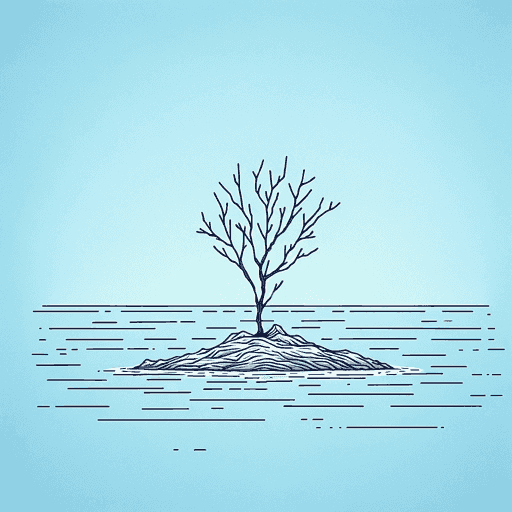
Bishop’s poem relies on the distinctions its speaker, Robinson Crusoe, makes between England and his “poor old island” (Line 8). In doing so, Bishop sets England and Crusoe’s Caribbean island in constant juxtaposition. This means that Crusoe’s experiences in England and the Caribbean are always being compared. Crusoe thinks and operates in this way because he, when speaking the poem, exists between the two worlds. The split in Crusoe is clearest at the beginning of the poem, where he moves from the raw potential of “A new volcano” (Line 1) to a week-old newspaper report. One moment he embodies the disorienting potential of his old Caribbean home; one moment he inhabits the boring predictability of England. Crusoe struggles to adapt to the trappings and confinements of this outdated civilization after being at the cusp of a new, practical mode of life on his island. Stuck between these two ways of living, Crusoe finds himself further isolated.
Though Crusoe spends most of the poem describing his “poor old island” (Line 8) somewhere in the Caribbean, the poem states that he remembers the island after at least “seventeen years” (Line 182) of life in England. Crusoe also cannot help but view England as “another island” (Line 154), even if it “doesn’t seem like one” (Line 155). Crusoe’s dubbing England “another island” works to clarify his dichotomy between England and his own island by classifying them in the same way (See: Themes). England, and the “island being born” (Line 3) at the beginning of the poem, are easily named and identified. Crusoe takes pride in that his “poor old island’s still / un-rediscoverable, un-renamable” (Lines 8-9). These lines not only establish the tension between long-discovered England and the new island where Crusoe survived. The lines suggest that Crusoe’s island cannot be contained through the colonial project of discovery and naming. Crusoe makes this suggestion concrete when he states that “None of the books has ever got [his island] right” (Line 10). Crusoe’s island resists definition.
Crusoe’s island is difficult to define because it is a land of becoming. The “new volcano” (Line 1) that allows “an island [to be] born” (Line 3) is outnumbered “fifty-two” (Line 11) to one on Crusoe’s island. Though Crusoe calls these “miserable, small volcanoes” (Line 12) “dead as ash heaps” (Line 14), they hold powerful potential in shaping the island. These volcanoes create “folds of lava, running out to sea” (Line 40) that later “prove / to be more turtles” (Lines 41-42). Far from creating a single island, Crusoe’s volcanoes create life itself and change the island’s form. Crusoe’s description of the beaches best exemplifies the volcanoes’ creative range: “all lava, variegated, / black, red and white, and grey” (Lines 43-44). While not working with a full palette, the island is a “fine display” (Line 45) compared to the new island’s insignificant “black fleck” (Line 5). The volcanoes exemplify the disorienting potential of Crusoe’s island. They allow Crusoe to walk among them and think he “had / become a giant” (Lines 20-21). The island’s creative potential also extends to the snails that appear as “beds of irises” (Line 75) and the “home-made flute” (Line 82) that plays “the weirdest scale on earth” (Line 83). Crusoe’s island and its inhabitants constantly change form according to their potential. This potential infects Crusoe, as well. Like the volcano, Crusoe’s “brain / bred islands” (Lines 156-57).
Crusoe’s England, by contrast, is where this potential dies. Crusoe complains about his emotional state in England, saying his potential has “petered out. I’m old. / I’m bored, too, drinking my real tea” (Lines 158-59). Rather than drink whatever tea Crusoe was able to create while on the island, England’s “real tea” (Line 159) is a sign of boring predictability. Similarly, the tools that Crusoe used to ensure survival on his island, such as his knife, “reeked of meaning, like a crucifix” (Line 162). The reference to a crucifix, on which the Christian savior Christ was executed, highlights the importance of Crusoe’s knife in his own salvation. In England, however, the knife’s “living soul has dribbled away” (Line 169). Out of their practical context, Crusoe’s objects become sterile artifacts fit for the “local museum” (Line 171). Crusoe’s connection to poetry also fails upon his return to England. His failure to complete the line “which is the bliss …” (Line 97) while on the Caribbean island opens the remembered poem to the island’s potential, where it has a variety of possible endings. Upon his return to England, “One of the first things that [he] did” (Line 98) was look up the correct end of the line, thereby making the poem stable and predictable.
The poem Crusoe recites is “I Wandered Lonely as a Cloud” by William Wordsworth, and “solitude” (Line 22) is the word Crusoe struggles to remember. Crusoe’s inability to remember the word while on the island indicates that he did not think of his solitude there. Instead, he only comes to understand his stay on the island as solitary once he returns to England. Crusoe not only feels alone and out of place in England, then, but his return to England also allows him to realize how alone he was on the Caribbean island. Despite his attempts to resist such definitions, Crusoe’s return to England makes him identify his island (incorrectly) through the same books that never “got it right” (Line 10).

Get in-depth, chapter-by-chapter summaries and analysis from our literary experts.
- Grasp challenging concepts with clear, comprehensive explanations
- Revisit key plot points and ideas without rereading the book
- Share impressive insights in classes and book clubs