Crusoe in England
Crusoe in England
A modern alternative to SparkNotes and CliffsNotes, SuperSummary offers high-quality Study Guides with detailed chapter summaries and analysis of major themes, characters, and more.
Symbols & Motifs
The Museum
The “local museum” (Line 171) serves as a symbol of England’s colonial institutions. The museum’s request for Crusoe’s items signals their change from tools to artifacts worthy of study and display (See: Themes). The museum also encapsulates the end goal of discovery and exploration during Crusoe’s time, which was to bring valuable objects under the control of the British Empire. The fact that Crusoe’s museum is “local” (Line 171) does little to mitigate these impulses, but the fact does work to suggest that Crusoe’s tools hold little value as artifacts.
Crusoe’s relationship with the museum suggests that he no longer finds himself under the sway of the colonial narrative that originally drove him aboard a ship. Instead, he wonders “how […] anyone [can] want such things” (Line 180), due to their condition. Crusoe might be unable to see the aesthetic value in the tools he used to survive, but he maintains they “still will work” (Line 178), reiterating that his practical concerns trump the concerns of empire.
Crusoe’s Knife
Crusoe’s Knife acts as a mirror and provides one of the few suggestions of how deeply Crusoe felt during his time on his island. Crusoe still presents the knife “there on the shelf” (Line 161) as a memento of his time as a castaway, even though its “living soul has dribbled away” (Line 169). The relationship between the survivor and his tool was so close that he “knew each nick and scratch by heart” (Line 165). The knife’s state directly reflects Crusoe’s. As an object key to his survival, Crusoe understands that if the knife were to break, he would have been unable to survive. Crusoe’s imploring the knife “not to break” (Line 164) demonstrates his own desperation, but it also demonstrates the lucky circumstances that allowed him to live.
Crusoe understands that the knife is not a mere object like the “uninteresting lumber” (Line 160) framing it, but he struggles with the fact that it is no longer significant to him. Still, he states that the knife “lived” (Line 163) while they were on the island, suggesting that Crusoe also felt more alive there.
Islands
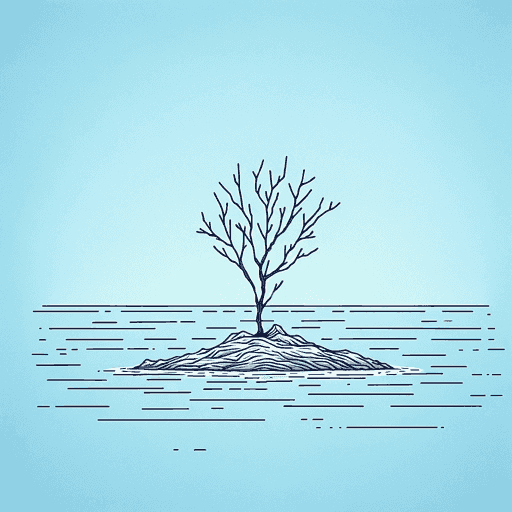
Being surrounded by ocean, and inaccessible except by long boat journeys, islands often act as symbols of isolation and insularity. In fact, the English word “insular” comes from the Latin insula, which literally translates to “island.” The constant presence of islands in Crusoe’s retelling, and particularly his insistence on calling England “another island” (Line 154), point toward his continual solitude. In actuality, England is one part of the island of Great Britain. Crusoe’s insistence on calling England an island showcases how he feels cut off from the rest of the world and isolated in his own cultural bubble.
The poem also suggests that one’s mind is a kind of island. Crusoe’s comment that “None of the books has ever got [his island] right” (Line 10) demonstrates the difficulty of communication between people. The books Crusoe read were “full of blanks” (Line 93) and useless to him on the island. The cultural institutions he grew up in, in other words, failed him. Instead, Crusoe builds relationships based on action and visibility. He says Friday was “[p]retty to watch” (Line 152) as he played with the goats. His knife, similarly, “won’t look at him at all” (Line 168) after their return to England, marking the end of their relationship. When Crusoe states that his “brain / bred islands” (Lines 156-57), he also suggests that the island informs all he sees and does. Unable to communicate with the average person, Crusoe becomes an island.

Unlock the meaning behind every key symbol & motif
See how recurring imagery, objects, and ideas shape the narrative.
- Explore how the author builds meaning through symbolism
- Understand what symbols & motifs represent in the text
- Connect recurring ideas to themes, characters, and events