52 pages • 1-hour read
Curse of the Starving Class
A modern alternative to SparkNotes and CliffsNotes, SuperSummary offers high-quality Study Guides with detailed chapter summaries and analysis of major themes, characters, and more.
Act IChapter Summaries & Analyses
Content Warning: This section of the guide contains references to substance use, mental illness (including one character referring to another as “insane”), domestic violence, emotional abuse, and sexual harassment.
Act I Summary
Lights come up on a plainly furnished kitchen with mismatched chairs and faded curtains. On the floor are fragments of a broken door (pieces of wood, a torn screen). Wesley, a young man in jeans and cowboy boots, diligently gathers the debris and puts it in a wheelbarrow. Ella, his mother, enters in a bathrobe, as if having just woken up. She tells him that his father broke the door the previous night in a drunken rage when he found it locked upon returning home from the bars. She admits that she locked the door and called the police when she heard it being broken down. She claims she didn’t know who was breaking in, but Wesley contradicts this, saying he could hear the two of them arguing. He says she shouldn’t have called the cops on his father because the presence of police in the house made him feel as if the family was in “trouble.”
As Ella cooks breakfast, Wesley delivers a long monologue, seemingly to himself, about the previous night: the nocturnal sounds and smells, and how he could feel “the presence” of all the people and animals outside, whether sleeping or awake. Soon, his thoughts become nervous and fearful, as if he were an “enemy” about to be invaded. He describes hearing his father drive up in his car, intoxicated, and start kicking wildly at the locked door of the house. In short, impressionistic sentence fragments—“Fist through door. Man screaming. Man insane” (138)—he describes the violent row that followed, ending with his father driving off into the night.
His soliloquy over, Wesley pushes the wheelbarrow offstage. Ella, still at the stove, offers rambling advice to her daughter, Emma, who enters from stage right, about the onset of menstruation. Ella’s prattle mixes tall tales (e.g., that swimming during your period can kill you by “drawing out” your blood) with her personal terror of germs. Searching the refrigerator, Emma discovers that her raw chicken is gone. Shouting that she raised (and killed) that chicken herself so that she could cut it up as part of a presentation for 4-H, Emma accuses her mother of eating it, calling her a “spoiled brat.” As Wesley looks on wearily, Ella and Emma scream at each other, Ella offering the excuse that she was “starving,” and Emma shouting, “WE DON’T BELONG TO THE STARVING CLASS!” (142). Ella counters that “hungry” is “starving enough” for her. Wesley, exasperated with Emma’s shouting, opens his fly and urinates all over his sister’s handmade 4-H diagram about how to cut up a frying chicken. Enraged, Emma storms off, vowing to leave for good. Wesley says her father “spoils” her and cites her desire to run away from home as proof that his peeing on her chart has improved her life.
As Wesley rifles through the refrigerator’s meager contents, Ella reassures him that the family is “not poor.” In fact, she adds, they’ll soon be rolling in money, enough to go to Europe. Wesley reminds her that “Dad” recently got fired, but she says, coyly, that this money has nothing to do with him. She adds, irrelevantly, that Wesley’s penis is “almost identical” to his grandfather’s, scandalizing him. Emma reenters, looking for her jodhpurs—since she intends to use the horse to run away—and then leaves again. Ella urges Wesley to stop her, saying the horse is “crazy” and Emma will likely be hit and killed on the “freeway.” Wesley scoffs at her worries and again asks about the “money” they’re coming into. Finally, Ella says she’s selling the house, the orchard, the stock, the tractor—“everything.” Shocked, Wesley reminds her that his dad co-owns the place and it’s still mortgaged, but Ella says she’s not telling him anything about it. Her “lawyer friend,” she says, is handling the sale in exchange for a “small percentage.”
Dumbfounded by the thought of losing his home, Wesley tells Ella that any money she gets for it won’t even pay her way to San Diego, let alone Europe. However, Ella says the land is what’s valuable: “Land will double its value in ten years. […] Land is going up every day.” (146). Wesley implies that she’s wrong, adding that he and his father put a lot of work into the place and don’t deserve to lose it. Ella jeers at him, claiming that when his father is home, he spends most of his time at home drinking to oblivion. Wesley storms off, saying his dad will “kill” her when he finds out what she’s doing.
Ella opens the refrigerator and stares into it, moaning, “Nothing.” Suddenly, Emma reenters, her white 4-H uniform stained with mud. The horse, she says, almost “killed” her, ruining her plans for escape. Ella blurts out that it doesn’t matter, because the whole family’s going to Europe—except the paterfamilias, probably. Emma says that sounds “awful” and will change nothing, since no matter where they go, they’ll still be the “same people.” Nevertheless, Emma says that being dragged through the mud by the horse made her into a different person; earlier, she’d planned to go to Baja California, learn Spanish, and pursue multiple trades: deep-sea fisher, auto mechanic, short-order cook, and novelist. Minutes later, all these dreams went up in smoke as the horse dragged her.
Telling Emma that she’s “too young” to leave the family, Ella exits stage left. Moments later, Taylor, Ella’s “lawyer friend,” enters from stage right and asks Emma if her mother is in. Emma stalls him, telling him he’s “creepy.” Seeing through his “business” with Ella, she sneers that her mother is a “sucker” who will fall for anything. When Taylor insists on sitting down to wait, Emma tries to scare him, saying her father, who has a “terrible temper,” will be coming home soon. She says he almost killed a man her mother was fooling around with; both her father and brother, she claims, have a “highly explosive” chemical (“nitroglycerin”) in their blood that makes them violent. Describing it as “hereditary,” she says it’s also what makes her father drink.
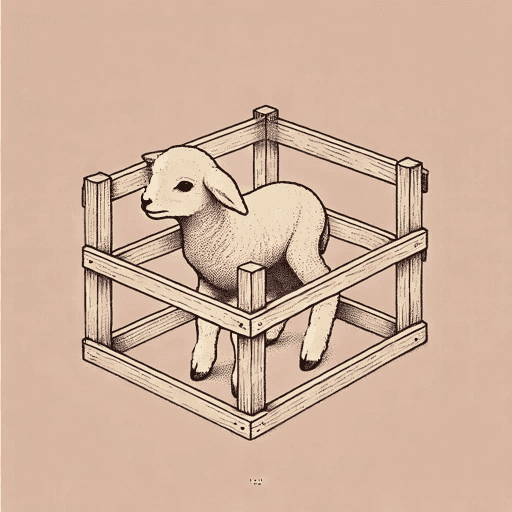
Undeterred by Emma’s hostility, Taylor continues to wait, albeit awkwardly, while Emma stares steadily at him. Nervously, he rambles to her about the fine setting of their property, how “it’s a shame to see agriculture being slowly pushed into the background in deference to low-cost housing, but that’s simply a product of the times we live in” (153). Soon, Wesley enters from stage right and sets up a small fence enclosure in the kitchen, as if for an animal. Hearing from Emma that Taylor is a lawyer, Wesley refuses to shake his hand. Wesley leaves and returns with a sick-looking lamb, which he places within the fence pen. He says he has brought it inside to keep it warm, since it’s infested with maggots, and Taylor opines that they shouldn’t keep it in the kitchen. Scoffing, “That’s nothing,” Emma points to her brother’s “piss,” still on the kitchen floor from when he urinated on her 4-H chart.
Aggressively, Wesley asks Taylor if he’s the lawyer who’s trying to sell their house, to which he freely admits. Shocked to hear this, Emma shouts for her mother. When Wesley tells the lawyer that their father would never sell the house, Taylor responds that the family may have to sell because the father is deep in debt. This surprises Wesley, who thought everything was “paid for.” Ella enters from stage left, wearing a formal dress and white gloves. Refusing to discuss her plans for the house, she orders Emma to change out of her muddy clothes. Stomping offstage, Emma tells her mother she’ll never “see” her again if she sells the house. As Ella and Taylor leave for their “business” lunch, she tells Wesley to keep an eye on Emma, since she has the “curse” (menstruation). Again surveying the empty refrigerator, Wesley tells the lamb how lucky it is to be living in a “civilized” household, rather than Korea, where someone who’s “starving” would probably butcher it for meat.
An offstage crash of metal heralds the arrival of Weston, the man of the house, who screams drunkenly about how someone left garbage cans in front of the door. Wesley avoids him by exiting stage left. Weston wears a rumpled overcoat, baggy pants, tennis shoes, and a baseball cap, and he carries bags of groceries as well as a big laundry bag. Perplexed at seeing a lamb in the kitchen, Weston ponders whether he’s “inside or outside” (156). Loading the groceries into the empty refrigerator, he rants loudly that his family left “everything” up to him again, always hoping for a “miracle.” Wesley comes back onstage, and Weston proudly shows him the groceries: a bunch of artichokes he bought in the desert for “half price.” He was in the desert, he says, to check up on a piece of land he bought from a smooth-talking salesman, who told him it was ideal for development—“golf courses, shopping centers, banks, sauna baths” (158). Not being “stupid,” he says, he didn’t pay the whole amount but put down a large deposit, which he borrowed. Unfortunately, the land is apparently worthless, just a strip of wasteland in the middle of nowhere, far from any water. Turning to leave, Weston orders his son to get Ella to do his dirty laundry, which he has piled on the kitchen table, and also to nurse the lamb back to health. He adds that he’s been thinking of selling the place and buying some land in Mexico. Wesley shows little reaction to the news but agrees not to tell his mother.
Act I Analysis
The stage lights rise on the Tate family’s ramshackle kitchen, illuminating the scattered remains of late-night debauchery: The door—the family’s main barrier against the threatening outside world—lies in fragments on the floor, metaphorizing the ailing family’s vulnerability to threats from both inside and out. This gaping fissure in their homelife symbolizes both the long-standing “curse” of the play’s title and its members’ failure to protect themselves from other curses: poverty, infidelity, drunkenness, and outside threats such as loan sharks, “speculators,” con men, and a corrupt culture. Though the door’s destruction is a recent event, it represents, in microcosm, the decades-long decay of the family itself and, as Wesley later tells his sister, of a “whole country.”
Against his mother’s wishes, Wesley volunteers to clear away the door that his father broke, which suggests that his role is one of restoring stability. His sturdy, workmanlike clothes (jeans, boots), in contrast to his father’s “baggy pants” and tennis shoes, reinforce this image. However, Shepard soon hints that a fall may be in store for Wesley; the play’s title, Curse of the Starving Class, borrows heavily from both Greek tragedy (e.g., the cursed households of Oedipus and Atreus) and modern case studies of intergenerational abuse and despair. Wesley’s poetic monologue, which he delivers to himself while clearing away the remnants of his father’s rage, hints at how that rage deeply affects him too.
Wesley’s soliloquy begins as a Whitmanesque ode to the scents and stirrings of the night: “I could smell the avocado blossoms. I could hear the coyotes” (137). However, it soon morphs into images of fear and alienation: “Me, the enemy […] Like any second something could invade me. Some foreigner” (137). His free association blends outdoor things (tractors, animals) with objects in his bedroom, such as model planes, suggesting the porous boundaries, in his fractured homelife, between cozy domesticity and the creatures of the night, implying that the broken door is just the latest symptom of lifelong insecurity. Even his childhood planes become sinister, “scouting” him, indicating that he, too, may be a menace, perhaps to his own family. His Messerschmitt and “Jap Zero” models, while evoking a more innocent age when the “enemy” was easier to define, allude to new “foreign” threats, such as outsiders who buy up California farms to build suburbs and freeways or literal foreigners (e.g., Middle Eastern cartels that impaired the US economy through oil embargoes in the 1970s, the time of the play’s writing).
Like an ultrasensitive antenna, Wesley picks up omens of a more primal invasion: his father returning from the bars, his “headlights closing in” (138) like fate itself. As Weston batters his way in, his son’s sentences become as fragmented as the broken door: “Man going insane. Feet and hands tearing. Head smashing” (138). Weston’s wife locked him out to protect the household: Long before the door was even smashed, then, the house was already invaded, from within, by the paterfamilias himself. If Wesley feels, in his darker moments, like an “enemy within,” his father is the original menace, the worm that rotted the apple from the inside. Despite Wesley’s diligent attempts to restore stability to the household, the fear never leaves him that he may someday follow in his father’s ruinous footsteps.
Wesley’s monologue already contains premonitions of this “curse.” Though he typically speaks (to others) in terse monosyllables, Wesley lavishes more words on this soliloquy than he uses in the rest of Act I combined. His long monologue, however, addresses no one but himself, introducing one of the play’s major themes: The Breakdown of Communication that is part of the family’s doom. In this sense, Wesley is already his father’s double: In Act III, Weston delivers a similarly long, poetic monologue, ostensibly to a lamb but really to himself. Wesley tries to listen in, which only annoys his father. Ironically, Wesley still hungers for his father’s affection, despite the fact that Weston has repeatedly betrayed his family’s trust and left them vulnerable to outside threats. Part of Weston’s “invasion” is that he has gotten so far under his son’s skin that Wesley can’t help but long for his attention, which leads him to resent his father’s “spoiling” Emma. This jealousy, also part of the “curse” he inherited from his father, leads to shocking cruelty.
Emma has just begun to menstruate, the first of several pivotal life changes that upend the characters’ homelife over the next couple of days. Her mother, however, offers no helpful advice, just a rehash of her own phobias and obsessions, namely infection and invasion, the primary concerns of Shepard’s play. Germs, Ella says, can spread everywhere—jumping from dirty coins to wrapped tampons—and swimming during your period can kill you by turning you inside out. This blending, or confusion, of inside/outside recurs frequently in Curse as barriers dissolve, characters expose their nakedness, and so-called friends or loved ones become enemies. Later in Act I, Ella refers to her daughter’s period as “the curse,” likening it to the violence of her husband’s hereditary “explosive” blood rather than to the miracle of childbirth. Emma’s maturation, to her, means only greater vulnerability for the family to new forms of invasion, infection, and volatility.
Emma’s preparation for a 4-H demonstration on how to cut up a chicken is the first of the play’s many references to food, or the family’s lack thereof. The four family members constantly open and close the refrigerator, one of the play’s central images, symbolizing the void at the center of the family and its members’ incessant hunger for emotional sustenance and stability. However, Emma realizes that her mother stole and ate her chicken, the latest of many breaches of trust in a family that, while not literally “starving,” is hungrily eating itself out from within. When Emma loudly protests, Wesley lashes out: In a bizarre act of emotional abuse and self-exposure, he pulls his “pecker” out in front of his mother and sister and urinates all over Emma’s 4-H diagram of the chicken. No longer the family’s stable defender, he shows his contempt for his sister (of whom he’s jealous) by defiling an image of food, the symbolic sustenance of family love. Later, Ella tells him that his genitals closely resemble those of her father: By exposing his “pecker,” Wesley also exposes his inborn “curse” of volatility and selfishness, which he gets from both parents. In addition, his bizarre action prompts an equally bizarre response from his mother: Instead of admonishing him for impropriety, she comments on the similarity between his and her father’s genitals, subtly raising the question of sexual impropriety in her past and in the family’s present.
In response to these betrayals by her closest family members, Emma announces that she’s running away from home, introducing another of the play’s themes escaping to chase The Illusion of the American Dream. Trapped in a “cursed,” emotionally starved household, each of the Tates harbors fantasies of having the means to run away: Weston to Mexico, Wesley to Alaska, Ella to Europe, and Emma to an exotic, rambling life in Baja California. These aspirations all misfire, and the dreamers are yanked back, excruciatingly, into the web of fate. The first is Emma, who’s thrown and dragged through mud by the horse and views herself, fatalistically, as “just a hunk of meat tied to a big animal. Being pulled” (148).
Ella, feeding her own delusions of retiring to Europe, entered a shady business deal with an outsider (her “lawyer friend” Taylor), with whom she is also having an affair. Having given up on her abusive husband, and fairly indifferent to her children, she plans to sell the house and farm, which will likely be replaced with suburbs (“zombie architecture,” in Wesley words). Taylor, one of several sinister outsiders who vie to exploit the Tate family, represents the corporate “speculators” who historically wooed postwar farming families with promises of wealth, turning much of southern California from bounteous farmland into suburban sprawl. The ultimate serpent in the Garden, Taylor is also the silver-tongued swindler who conned Weston into buying his worthless desert land.
While Taylor and Emma sound each other out in the kitchen, Wesley brings into the house another of the play’s blatant symbols: a lamb infested with maggots, which represents the Tate family itself, rotted from within and menaced from without. At this point, Wesley devotes himself tenderly to its care, just as he earlier gathered up the family’s broken door; however, as he falls deeper under the malign influence of his father later in the play, this changes. Another of the play’s themes, The Normalization of Violence in Domestic Spaces, emerges as Emma comments that both Wesley and his father have “nitroglycerin” in their blood, a family curse that leads to drunkenness and violence. Wesley shows no propensity for alcohol (yet), but his facade of rationality and familial devotion already shows signs of splintering, just like the family’s demolished door.

Unlock all 52 pages of this Study Guide
Get in-depth, chapter-by-chapter summaries and analysis from our literary experts.
- Grasp challenging concepts with clear, comprehensive explanations
- Revisit key plot points and ideas without rereading the book
- Share impressive insights in classes and book clubs