52 pages • 1-hour read
Curse of the Starving Class
A modern alternative to SparkNotes and CliffsNotes, SuperSummary offers high-quality Study Guides with detailed chapter summaries and analysis of major themes, characters, and more.
Important Quotes
Content Warning: This section of the guide contains references to substance use, mental illness, domestic violence, emotional abuse, and sexual harassment.
“[Stage direction]: In the down right corner is a pile of wooden debris, torn screen, etc., which are the remains of a broken door.”
(Act I, Page 135)
The first lines of Curse of the Starving Class—the stage direction describing the Tate family’s kitchen, the play’s sole setting—indicate a long history of volatility, vulnerability, and self-destructiveness in the form of a demolished door. It’s soon clear that it’s the door to the outside and was shattered by Weston, the family patriarch, in a drunken rage. The ruins of the door (the first objects that the stage lights reveal) illuminate Weston’s reckless, profligate behavior, which has long wreaked havoc on his family’s security and future, leaving them vulnerable to threats from outside. Throughout the first act, none of the characters make a move to repair the door, signifying their numbed acceptance of a family “curse.”
“WESLEY: […] I could feel myself in my bed in my room in this house in this town in this state in this country. I could feel this country close like it was part of my bones. I could feel the presence of all the people outside, at night, in the dark.”
(Act I, Page 137)
Weston’s son, Wesley, describing how he heard his father drunkenly vandalize the door, launches into a poetic vignette that serves almost no expository purpose. Wryly evocative of Walt Whitman’s “Song of Myself” and other Transcendental verse, Wesley’s reverie shows that he’s a dreamer. Dreamers are common in Sam Shepard’s plays: powerless people who seek transcendence via the magic of words rather than material actions or emotional connection with loved ones. Significantly, Wesley delivers his monologue to himself rather than to his mother, who completely ignores him, or even to the audience.
“ELLA: […] I want you to know all the facts before you go off and pick up a lot of lies. Now, the first thing is that you should never go swimming when that happens. It can cause you to bleed to death. The water draws it out of you.”
(Act I, Page 139)
Misinforming her daughter, Emma, with a macabre superstition about menstruation, Ella reveals that she, like her husband, is a failed parent. In Curse of the Starving Class, most of the family’s communication is fraught with cross-purposes (largely lies and emotional abuse), which weaken the rather than strengthen the family. Emma’s first period introduces the play’s overarching theme of change, which affects all the family members during the play’s brief action, whether dawning pubescence, the advent of adulthood, midlife crisis, or death.
“EMMA’S VOICE (off): SO NO ONE’S STARVING! WE DON’T BELONG TO THE STARVING CLASS!”
(Act I, Page 142)
In a line that echoes part of the play’s title, Emma, learning that her mother stole and ate the chicken she raised from an egg, furiously denies that her mother could have been “starving.” She insists that they don’t belong to that desperate niche of humanity. Her pride ignores the irony that her family is, indeed, desperate for other, basic forms of nourishment; e.g., mutual love, loyalty, wisdom, and emotional truth. Throughout the play, the family’s materialistic appetites—for food, money, power, revenge, escape, etc.—starve them of this essential, shared bounty. Meaningful exchanges escape them, highlighting The Breakdown of Communication as a theme.
“ELLA: […] You’re circumcised just like him. It’s almost identical in fact. […]
WESLEY: What’d you sneak into his room or something?
ELLA: We lived in a small house.”
(Act I, Page 144)
Shepard’s dialogue often flirts with the surreal, which has the effect of tragicomically defamiliarizing everyday surroundings (such as a family kitchen). Here, a mother tells her son that his penis is “almost identical” to her father’s. The implications of incest between father and daughter, and now between mother and son, underscore the theme of an intergenerational “curse” and allude to ancient myth, such as Oedipus.
“ELLA: […] Thousands and thousands are being spent every day by ordinary people just on this very thing. Banks are loaning money right and left. Small family loans.”
(Act I, Page 146)
Ella, seduced by the same con man who sold her husband a worthless tract of desert, parrots her lover’s sales spiel, claiming that land “double[s] its value in ten years” (146). She’s correct that “ordinary people” are borrowing thousands in bank loans to speculate on property but seems oblivious that this predatory lending and selling on credit destroyed her family’s fortunes. Her ominous spiel foreshadows Weston’s confession that he already put the family deep in debt with his profligate borrowing and buying. This passage thematically develops The Illusion of the American Dream.
“EMMA: […] Then I’d learn how to be a short-order cook and write novels on the side. […] Then I’d get published and disappear into the heart of Mexico. Just like that guy […] who wrote Treasure of the Sierra Madre.”
(Act I, Page 149)
Emma describes her broken dreams of just minutes earlier, when she imagined riding off to Baja California, where she would master Spanish as well as multiple trades: deep sea fishing, auto repair, cooking, novel-writing, etc. Her vague plans of escape, apparently picked up from films and magazines, are her quixotic reaction to the empty aridity of her home life: In fact, all members of the Tate family, at some point in the play, harbor dreams of running away from home. The vaporousness of Emma’s half-baked scheme is evident in her confusing German author B. Traven (who wrote The Treasure of the Sierra Madre) with American writer Ambrose Bierce.
“EMMA: I’m not dreaming now. I was dreaming then. Right up to the point when I got the halter on. Then as soon as he took off I stopped. I stopped dreaming and saw myself being dragged through the mud.”
(Act I, Page 149)
Emma’s grand escape ends humiliatingly when her volatile horse, whose temperament she shares, panics and throws her. Her short-lived dreams of riding off into the sunset, combined with her mother’s worry—“She’ll get killed on the freeway” (144)—encapsulate Shepard’s typical subversion of Western tropes. Moreover, Emma’s out-of-body vision of “being dragged through the mud” foreshadows her father’s epiphany about “wondering who this was walking around in the orchard at six-thirty in the morning” (185). In both cases, a transformation has occurred, and the changed looks back in confusion at their former self; the brevity of Emma’s ruptured dream hints that Weston’s epiphany will likewise fall by the wayside.
“EMMA: It’s chemical. It’s the same thing that makes him drink. Something in the blood. Hereditary. Highly explosive.”
(Act I, Page 152)
This quote thematically exemplifies The Normalization of Violence in Domestic Spaces. Describing to Taylor her father’s “short fuse,” which he inherited from his father (just as Wesley, according to his mother, inherited his grandfather’s penis), Emma traces the family’s woes to an “explosiveness” passed down through generations. Pinpointing this volatility as “nitroglycerin” in the blood, she claims that it’s solely a male trait, though her own behavior throughout the play belies this. Then, as if free-associating this with her recent period, Emma asks Taylor if her mother “bleeds,” hinting that the Tate men’s violence and instability are as inevitable as the “curse” of menstruation. The play’s overarching sense of fate (and its many references to a “curse”) mythically link the Tate family to cursed households of Greek tragedy, such as those of Oedipus and Atreus.
“TAYLOR: […] Of course it’s a shame to see agriculture being slowly pushed into the background in deference to low-cost housing, but that’s simply a product of the times we live in.”
(Act I, Page 153)
Thematically representing The Illusion of the American Dream, the con man/lawyer Taylor, who plans to fleece the family, sheds crocodile tears over the heartland’s agricultural decline, which has tempted many families to sell their farms to opportunists like himself. Smoothly, he suggests that the disintegration of a thriving farm community into a patchwork of “low-cost housing” is inevitable (“the times we live in”), mere workings of fate like the family “curse” that set the Tates against each other and destroyed their fortunes. Taylor is the first of several predators to enter the house through the broken kitchen door, like ravenous animals slithering through a breach in the wall.
“ELLA (noticing lamb): What’s that animal doing in here, Wesley?
WESLEY: It’s got maggots.”
(Act I, Page 155)
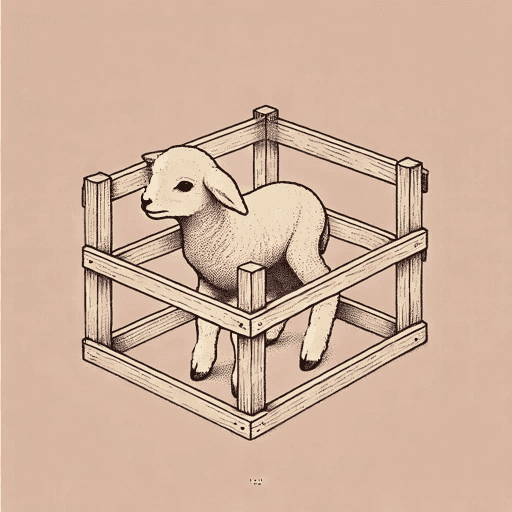
The nurturing side of Wesley moves him to bring an animal into the house, a lamb whose intestines are infested with maggots. Metaphorically, the diseased lamb represents his family’s rotted values, as well as their land, which is cursed, like the mythical kingdoms of Oedipus and the Fisher King, by the failings of its patriarch and other members. Wesley tries to save (and purify) this symbol of his family’s degraded hopes, but he fails.
“WESLEY: So it means more than losing a house. It means losing a country.”
(Act II, Page 163)
While Emma pictures ordinary people like themselves buying the family’s home, Wesley spells out for her the larger implications of their loss for the “country.” It’s not “Mr. and Mrs. America” (162) who will be buying their farm, he reminds her, but faceless corporations, which have been pillaging the American heartland and its failing family businesses for their own profit. This “zombie invasion,” he says, will be led not by family men but by soulless scavengers, devoid of any community bonds—predators like Taylor, who are busily razing the country’s generations-old houses and farms to make way for prefab “zombie architecture.”
“WESTON: […] THIS IS MY HOUSE! I BOUGHT THIS HOUSE! AND I’M SELLING THIS HOUSE! AND I’M TAKING ALL THE MONEY BECAUSE IT’S OWED ME!”
(Act II, Page 169)
The Tate patriarch and matriarch, in a race to swindle each other, have both arranged secretly to sell the farm to unscrupulous outsiders. Weston, hearing of his wife’s plans to sell to Taylor, accuses his whole family of plotting against him, and defiantly vows to sell the house from under them all, after he kills Ella and Taylor using his “captured” (i.e., Japanese) gun. As he tells Wesley, he must sell the house to settle his huge debts. His infantile rage, selfishness, and threats of violence exemplify the curse of “nitroglycerin” in his bloodline, which has torn the family apart and has now pushed him to a breaking point: Soon, after collapsing into sleep, he experiences an epiphany and feels “reborn.”
“MALCOLM: It seems she rode her horse through a bar downtown and shot the place full of holes with a rifle.”
(Act II, Page 179)
Emma escalates her subversion of Western myths by shooting up the bar of an enemy (Ellis) while on horseback. This melodramatic development, dropped casually into the play’s dialogue, highlights the absurdity of cowboy-style “justice” in the play’s modern setting, mocking the characters’ self-defeating sprints for freedom and vengeance. Like Weston’s destroying his own kitchen door or Ella’s clumsy double-dealing with Taylor, Emma’s shooting spree only places the family in greater danger—and puts herself in considerable legal jeopardy. By resorting to rash, solitary actions rather than building solidarity with loved ones, the Tates isolate and doom themselves, fulfilling the family “curse” of stagnation, rancor, and spiritual desolation.
“WESTON: […] Somethin’ brought me straight off the ground and I started yellin’ my head off. I don’t know why it was comin’ outa’ me but I was standing there with this icy feeling up my backbone and just yelling my fool head off. Cheerin’ for that eagle. I’d never felt like that since the first day I went up in a B-49.”
(Act III, Page 183)
Rhapsodizing to Wesley about his recent epiphany, which he thinks has finally restored his wisdom and responsibility, Weston revisits a long-ago memory of feeding the testes of castrated lambs to a rapacious eagle. A former Air Force pilot, Weston closely identified with the eagle, feeling a thrill of transcendence (“straight off the ground”) whenever the bird plunged, which he relates to the ecstasy of his “rebirth” as a devoted family man. However, this memory, like the epiphany itself, is delusional: Ella and Wesley later tell the full story, which ended in the eagle’s painful death.
“WESTON: […] And I felt like I knew every single one of you. Every one. Like I knew you through the flesh and blood. Like our bodies were connected and we could never escape that. But I didn’t feel like escaping. I felt like it was a good thing.”
(Act III, Page 186)
Weston, after his “rebirth,” still feels a flesh-and-blood connection to his children but no longer regards this as a curse he must escape. For the first time, it feels “natural” to him—as if a family is ultimately a single animal with one set of needs and aspirations. His dawning sense of oneness with, and responsibility to, his family gives him “hope.” However, these soaring words of fellow-feeling carry an eerie echo of his son’s Whitmanesque soliloquy in the play’s first act, which soon devolved into a haunted litany of his father’s repetitiously violent, squalid behavior.
“WESLEY: They fit me. […]
WESTON: I can’t fathom you, that’s for sure. What’d you do with that lamb? […]
WESLEY: Butchered it.”
(Act III, Page 191)
When Weston asks why Wesley dressed himself in his father’s cast-off clothes, Wesley replies that they “fit” him: Feeling, like his father, that blood is destiny, Wesley fatalistically steps into his father’s discarded roles of prodigal and wastrel. Moreover, just as his father destroyed the family’s hopes through fiscal irresponsibility and violence, Wesley butchers the sickly lamb, a symbol of his degraded family. His action introduces a religious parody: The death of the lamb, traditionally a symbol for the sacrifice of Jesus Christ, in this case suggests no salvation or redemption for the Tate family, whose circumstances only get increasingly worse.
“WESTON: […] I don’t have to pay for my past now! Not now! Not after this morning! All that’s behind me now! YOU UNDERSTAND ME? IT’S ALL OVER WITH BECAUSE I’VE BEEN REBORN! I’M A WHOLE NEW PERSON NOW! I’m a whole new person.”
(Act III, Page 192)
Believing that his revelation of family love has made him a “new person,” Weston argues that he shouldn’t have to answer for the deeds of his “old” self, such as borrowing heavily from loan sharks. His all-caps shouting, however, betrays his growing doubt, and harkens back to his previous, drunken outbursts, suggesting that he hasn’t changed much at all. When his diatribe loses its caps and ends on a dying note (“I’m a whole new person”), it becomes clear that his grand epiphany is already fading and perhaps was just another result of alcoholism.
“WESTON: […] Buy cars, houses, lots, invest. They wouldn’t be so generous if they didn’t figure you had it comin’ in. At some point it had to be comin’ in. So I went along with it. Why not borrow if you know it’s comin’ in.”
(Act III, Page 194)
As cold reality begins to sink in, Weston explains to his son how he got so far over his head in debt, thematically alluding to The Illusion of the American Dream. Demonstrating the magical thinking that seems to run in the family, he says the banks and other lenders convinced him, against his own judgment, that he had money “comin’ in”—otherwise they wouldn’t have given him the loans. This circular logic has bankrupted many families, but Weston, embracing his perceived role as an American father and consumer, kept “playing ball”—buying land, cars, and appliances, none of which he could afford—rather than providing his family with the love and stability they hungered for.
“WESTON: […] I kept looking for it out there somewhere. And all the time it was right inside this house.
WESLEY: They’ll be coming for you here. They know where you live now.”
(Act III, Page 194)
Weston struggles to explain to Wesley (and to himself) the meaning of his epiphany, which came much too late. For years he looked for “it”—presumably, success, belonging, fulfillment—and always failed because, he now realizes, this great bounty lay not “out there” but at home with his family. Now, however, the loan sharks are after him, and his home has become a death trap—just as he finally began to cherish it.
“WESLEY: I tried his remedy, but it didn’t work.”
(Act III, Page 195)
In the immediate aftermath of his father’s rhapsodic “rebirth,” Wesley tried to heal his inner emptiness by trying out his father’s “remedy.” As he tells his sister, he took a scorching hot bath followed by a cold one, and then walked around the house naked, just as his father did after his epiphany. These rituals, however, didn’t recreate in him his father’s transformation, short-lived though it was.
“WESLEY: I could feel myself retreating. I could feel him coming in and me going out. Just like the change of the guards.”
(Act III, Page 196)
Feeling cold from walking around naked, Wesley dons his father’s discarded clothes. However, the transformative effect of this action is opposite to the transcendence he originally hoped for. As he put on Weston’s filthy clothes, he could feel himself falling, zombielike, into his father’s doomed trajectory. Ironically, Wesley’s failed father replaces him, rather than the other way around, signifying Wesley’s sense of fate and his “cursed” inheritance, which takes rather than gives. Also ironic is the phrase “the change of the guards,” since his father guarded nothing; instead, he brought his family only poverty and dissolution.
“ELLA: I can’t let her go! I’m responsible!
(Huge explosion off stage. Flash of light, then silence. WESLEY and ELLA just stand there staring.)”
(Act III, Page 197)
While attempting to steal the family car so that she can launch a life of “crime” far away, Emma is killed by a car bomb planted by the loan sharks hunting her father. Her “innate criminal intelligence” (196) didn’t get her very far; like the “nitroglycerin” in the family’s male blood, it has only destroyed her and those close to her. Her mother’s claim that she’s “responsible” for Emma is true only in the sense that Ella bears partial responsibility for Emma’s death, having failed in all her parental duties.
“ELLA (staring at dead lamb): I must’ve slept right through the day. How long did I sleep?”
(Act III, Page 199)
In Curse, which unfolds over a momentous few days in the lives of the Tate family, Ella and Weston are asleep during much of their time onstage. This metaphorically represents how both parents have remained largely oblivious or indifferent to moments of great import for themselves and their family. Even after awaking, Ella shows no real awareness of what’s going on: Repeatedly, she mistakes her son for her husband (again hinting at possible incest) and fails to register the slaughtered lamb in front of her, which symbolizes the now-ruined family that she has long ignored, underscoring the thematic depth of The Breakdown of Communication.
“ELLA: […] They fight like crazy in the middle of the sky. That cat’s tearing his chest out, and the eagle’s trying to drop him, but the cat won’t let go because he knows if he falls, he’ll die. […] And they come crashing down to the earth.”
(Act III, Page 200)
In a rare moment of clarity, Ella finishes the anecdote her husband recited to himself at the beginning of Act III. The full version, however, contradicts the self-affirming message of transcendence the deluded Weston took from it: Instead of an uplifting allegory about the triumph of the will and the succor of the hungry, it becomes a nihilistic tale of petty viciousness and self-destruction. The predatory battle of cat versus eagle, killing each other over scraps, is an allegory for the ruthless outsiders (Taylor, Ellis, Emerson, Slater) who prey on the Tate family and ultimately on each other, as well as a representation of the family’s internal betrayals. Significantly, cats and eagles aren’t natural enemies, which highlights the perversity and pointlessness of the family’s treatment of each other, thematically emphasizing The Normalization of Violence in Domestic Spaces.

Unlock every key quote and its meaning
Get 25 quotes with page numbers and clear analysis to help you reference, write, and discuss with confidence.
- Cite quotes accurately with exact page numbers
- Understand what each quote really means
- Strengthen your analysis in essays or discussions