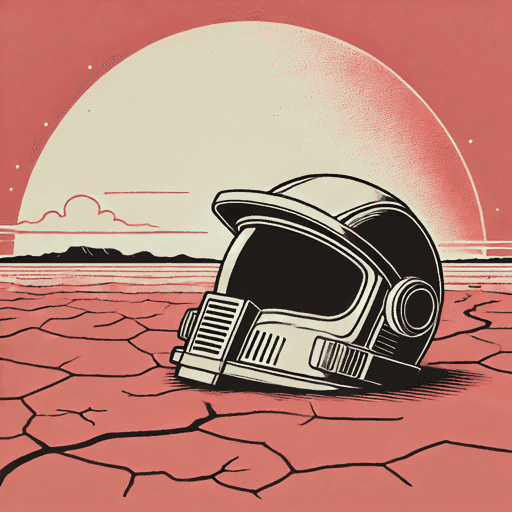
Dark Age
76 pages • 2-hour read
Pierce BrownDark Age
A modern alternative to SparkNotes and CliffsNotes, SuperSummary offers high-quality Study Guides with detailed chapter summaries and analysis of major themes, characters, and more.
Background
Series Context: The Red Rising Saga
Content Warning: This section of the guide includes discussion of death, graphic violence, and child sexual abuse.
Dark Age (2019) is the fifth installment in Pierce Brown’s Red Rising series, a science fiction series that began with Red Rising, released in 2014. Originally envisioned as a trilogy, the series expanded into a second trilogy due to the commercial and critical success of the original books. Brown’s background in political science and economics, as well as his personal interest in mythology and history, inform the series’ exploration of power, rebellion, and societal stratification (“About Pierce.” Pierce Brown).
The first trilogy—comprised of Red Rising, Golden Son, and Morning Star—follows Darrow, a miner on Mars. Born a Red, the lowest-ranking order of worker in his society, Darrow infiltrates the Gold elite after discovering the oppressive nature of the class system that structures “the Society”—the 14-caste hierarchy that operates in this dystopian future. Darrow ultimately rises through the Gold’s ranks to lead a revolution. The second trilogy—comprised of Iron Gold, Dark Age, and Light Bringer—shifts from the mythic hero’s journey to multi-perspectival narration that explores the messy aftermath of revolution.
Dark Age continues this shift, presenting a grittier, more morally complex world where victory is far from clean. The Solar Republic—born from Darrow’s revolution—is riddled with bureaucracy, dissent, and betrayal. The novel elevates supporting characters like Lysander, Virginia, Ephraim, and Lyria into point-of-view protagonists, deepening the political and emotional layers of the saga. By this stage, the narrative no longer asks who should lead but whether peace is even possible. Dark Age marks a tonal and structural transformation, setting the stage for the series’ next installment, Light Bringer.
Physical Context: Dystopian Solar System
Set in a dystopian future, Dark Age spans planets, moons, and political factions across the solar system. Pierce Brown’s universe exerts constant pressure on the characters, shaping their choices, allegiances, and identities. From the scorched sands of Mercury to the frigid reaches of Jupiter’s moons, the solar system functions as a fractured empire where each world has its own physical environment, societal customs, and strategic importance.
The Society’s now-shattered, color-based caste system shaped the early structure of this word: Golds ruled at the top, Obsidians were bred as mythic warriors, Reds toiled as subterranean laborers, Blues navigated ships and managed data systems, Grays enforced order as soldiers and police, Whites served as judges and religious leaders, Oranges maintained the mechanical backbone of society, etc. Each color was engineered for a specific role, their identities, worth, and freedoms rigidly assigned by function. Dark Age also introduces the Ascomanni: a lost tribe twisted by time and war into something brutal. The consequences of revolution have left these structures in flux: Even in the Republic, differences between colors still exist, though all are guaranteed representation in the Senate. The cities of Mercury, like Heliopolis and Tyche, become epicenters for brutal conflict, as the planet’s instability makes it both symbolically and strategically vital.
The technological sophistication of this universe—razor weapons, mind-control devices, and terraforming “Storm Gods”—is juxtaposed with its brutality: mass crucifixions, child brides, and chemical warfare. This duality reflects the series’ central tension between humanity’s potential and its persistent savagery.
Throughout Dark Age, Brown grounds the narrative in sensory detail and topographical realism. Battles are shaped by geography—deserts, mines, orbital platforms—and the physics of different planets, creating high-stakes settings that are both alien and relatable. The terrain becomes a force in the novel, shaping both strategy and survival.

Unlock all 76 pages of this Study Guide
Get in-depth, chapter-by-chapter summaries and analysis from our literary experts.
- Grasp challenging concepts with clear, comprehensive explanations
- Revisit key plot points and ideas without rereading the book
- Share impressive insights in classes and book clubs