Devolution: A Firsthand Account of the Rainier Sasquatch Massacre
60 pages • 2-hour read
Max BrooksDevolution: A Firsthand Account of the Rainier Sasquatch Massacre
A modern alternative to SparkNotes and CliffsNotes, SuperSummary offers high-quality Study Guides with detailed chapter summaries and analysis of major themes, characters, and more.
Chapters 16-20Chapter Summaries & Analyses
Content Warning: This section of the guide includes discussion of graphic violence, death, illness, bullying, animal cruelty and death, and racism.
Chapter 16 Summary
Kate’s journal picks up at the community dinner. Everyone listens to the person crying until Bobbi calls out into the woods for Vincent. She insists on going out to investigate, urging Dan to accompany her. Mostar stops Dan, believing that the creatures are trying to draw them out into a trap. Carmen spots one of the creatures waiting between the Boothe and Durant houses. It runs back toward the ridge. Kate refers to it as it Scout.
Another round of screams drives Bobbi’s panic. When Reinhardt tries to explain why they can’t investigate, Bobbi attacks him, blaming him for sending Vincent out. Kate restrains Bobbi, pulling her away when Reinhardt moves aggressively toward them. However, Reinhardt collapses. Before they can find out what’s wrong with him, another bombardment starts. They retreat into the Common House for protection.
Mostar believes that Reinhardt’s medication is missing. He struggles, trying to catch his breath. Muttering the name “Hannah,” he expresses his desire to return home. Kate pities him and quietly hopes for his death. They wait six hours to reemerge. Effie diagnoses Reinhardt with stress cardiomyopathy due to an intense panic attack. The group takes turns watching over him while Mostar leads others in fortifying their defenses. Mostar theorizes that the creatures won’t strike again for some time, as they’ve likely eaten Vincent. Bobbi remains in denial. Out of pity, Kate resolves to find out what happened.
In her interview, Schell describes hunting patterns among chimpanzees. They inflict terror to scatter their prey, making them easier to kill. During the attack, the chimpanzees experience bloodlust, feeling no empathy for their prey’s suffering. In the aftermath, the chimpanzees demonstrate social hierarchy, distributing their yield according to social rank.
Chapter 17 Summary
The chapter begins with Roosevelt’s account of the Bauman incident, in which Bauman discovered the corpse of his friend. His friend showed recent signs of having been bitten in the throat. Nearby tracks suggested that the assailant snuck up on Bauman’s friend and caught him unaware.
In the early hours of October 13, Kate leaves to search for Vincent while everyone else is still asleep. Dan catches up to her and gives her a javelin, accompanying her on her search. They follow Scout’s path to the ridge where another Bigfoot had been waiting. In a concealed clearing, they find piles of bone fragments and ash, collecting the different animals the Bigfoots have hunted over the past few days. Among the mounds is one of Vincent’s hiking poles. Kate identifies the clearing as the creatures’ lair.
The Bigfoots emerge, confronting them. Kate identifies each of them by their body type and their assumed function: the Twins, Consort (Alpha’s mate), Scout, Gray (an older male), Granny Dowager (an older female), Princess (an adolescent female), Juno (a pregnant female), a young male she’ll later call Goldenboy, and Alpha. Just before the Bigfoots can grab them, Mostar arrives with a flame-tipped spear, which she uses to push the Bigfoots back. She threatens them, using language that mixes Bosnian with the creatures’ guttural noises. This gives the Hollands a chance to escape.
Kate, Dan, and Mostar reach the Perkins-Forster residence. Mostar concludes that the Bigfoots are afraid of fire, which can help influence their defense planning. She scolds and slaps Kate for her recklessness and then orders Dan, Carmen, and Palomino to craft more stakes. She leads Kate outside to show her that the Bigfoots returned Vincent’s head, leaving it on the slope near the Boothe residence. They resolve not to tell Bobbi what they have found.
Chapter 18 Summary
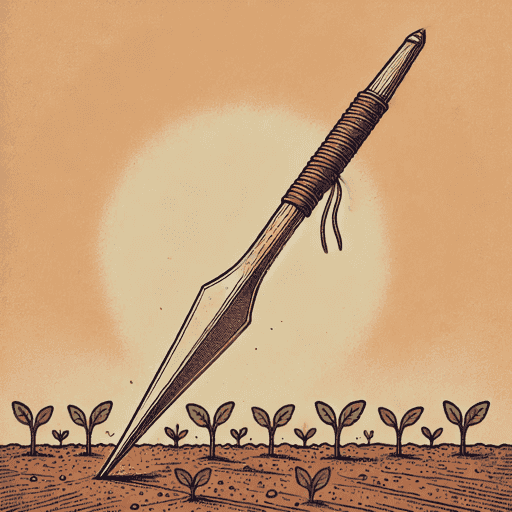
Mostar takes Kate to her workshop and teaches her how to make a spear using bamboo, knives, and wire. She communicates her hope that Kate will teach the others how to make their own spears, but doesn’t elaborate on why she won’t teach them herself. Kate records the steps that Mostar teaches her in her journal.
After they finish their tutorial, Mostar compliments Kate and encourages her to rest. She assures Kate that they’ll bury Vincent’s head later, though this doesn’t stop Kate from feeling shocked over the nature of Vincent’s death.
Palomino visits Mostar’s house, carrying a yoga mat and gesturing at the horizon to point out the time. Mostar asks Kate to retrieve a towel from her closet upstairs. There, Kate finds pictures of Mostar in her youth. Though Kate doesn’t recognize the locations in the photos, they lead her to thoughts of the war and ethnic cleansing in Yugoslavia in the 1990s, which she vaguely remembers from her childhood. This gives her a clearer sense of Mostar’s wartime experiences.
Kate brings down the towel, which Mostar uses to lead Palomino in Muslim prayer. Though Kate can’t understand most of the prayer, she catches one moment when Mostar prays for Vincent.
Chapter 19 Summary
Kate is pleased to discover that her garden is sprouting. Carmen, Palomino, Mostar, and Dan join in her excitement, expressing curiosity about the process that led to the sprouting. Carmen suggests other seeds they can plant, making Kate excited about her garden’s future. She rushes to Reinhardt’s house for her shift to watch over him. She relieves Effie, who thanks her for helping give Palomino something to do to distract her from her fears. Kate resolves to look through Reinhardt’s bookshelves for texts to boost her knowledge of gardening.
Kate is disappointed to see that most of the texts are on philosophy, sociology, and anthropology. While reading through a book on Southern Africa, she finds a section on Zulu warrior women, who arm themselves with an “Iklwa,” a sword/spear hybrid best used in close-quarters combat. The comparison between these warriors and Roman legionnaires fascinates Kate, making her wonder if this pattern indicates an essential human impulse.
Kate falls asleep during her shift and later discovers that Reinhardt has gotten up. She helps him eat and then reflects on how quickly her priorities have changed over the last two weeks. When Reinhardt tries to dismiss her, he explains that he has had nervous spells ever since he was young and should have explained this sooner. He claims that he has spent his adulthood looking for substitutes for the care and protection he experienced in his youth. Kate offers to let him stay with her and Dan so that he has someone to watch over him. Reinhardt declines and offers to find something to help her with her garden. He bids her good night, calling her “Hannah.” Kate thinks again about the future of their lives in Greenloop.
Chapter 20 Summary
The chapter opens with an excerpt from Golda’s Daughter: My Life in the IDF by Lieutenant Colonel Hannah Reinhardt Roth. Hannah narrates her attempt to convince her family that Israel is justified in its right to pursue conflict with the Arab League. She emphasizes the need to use intellect to support her arguments, rather than emotion or passion, which she calls the “language of animals” (219). Hannah’s brother, Alex, argues against the need for hostility, suggesting that they rely on the UN to resolve the conflict. Hannah retorts that they can’t depend on other nations, including the US, for help because they’re in decline. Alex reminds her that they’re American Jews. Their father supports Alex’s arguments, urging them to interrogate the desire for hostility to better understand themselves.
Hannah’s father asks whether war can ever be justified, criticizing Hannah’s violent impulses. She clarifies that she doesn’t condone war wholesale, but maintains the urgent threat that the Arabs pose to Israel. She makes this argument emotionally, prompting the two men to dismiss her entirely. Hannah accuses them of intellectual cowardice and criticizes her father for failing to make a difference in their historical situation, and predicts that Alex will fail similarly, allowing himself to be killed. She walks out on her family.
The novel returns to Kate’s journal at an entry dated October 15. The morning after her shift at Reinhardt’s, Kate happily monitors the continued progress of her garden. She enthusiastically tells Dan about her plans to secure the sprouts with tomato cages. Dan goes to harvest more bamboo. Kate catches up with Effie, who heard positive news on the radio, including word that emergency services will soon begin relief in areas near Rainier. Effie proposes constructing a giant “HELP” sign to catch people’s attention.
As Kate and Palomino proceed to the garden, they hear a scream coming from Reinhardt’s house. Kate and Dan learn that one of the Bigfoots infiltrated the house and killed Reinhardt. Kate imagines that either the creature caught Reinhardt unaware or Reinhardt was conscious of his impending death and accepted it with terror. Looking at the footprints the creature left behind, Kate realizes that it was calm the entire time it was inside the house.
Chapters 16-20 Analysis
These chapters track the first encounter with the complete Bigfoot troop. In her journal, Kate depicts them as a royal family, using terms like “Consort” and “Princess” as placeholders for real names. These names give the troop a more tangible identity, not only allowing Kate to distinguish them but also conveying a clearer sense of the antagonists as real characters.
Although Kate and Dan arrive with no ill intentions, it’s difficult not to look at their actions reflexively. By searching for Vincent, they’re merely echoing the Bigfoots’ intrusive actions upon Greenloop, provoking the Bigfoot to defend their territory as the humans would their own. Conversely, the discovery of Vincent’s remains drives Kate’s perception of the Bigfoots as antagonistic. Complicating this perception (as much as the ill-informed nature of Vincent’s excursion) is the inscrutability of the Bigfoots’ motivations. Evidently, the two communities have started to trap themselves in a complex cycle of violence, in which nearly any act has the potential to stoke tensions. Further heightening the stakes, neither side has the means to negotiate peace or resolve their conflict on peaceful terms. With their continued proximity comes the inevitable threat of violence.
Under these terms, Brooks poses a larger idea about active resistance in the face of hostility. The novel has long presented Mostar as an eccentric character, the odd one out in a neighborhood of people who generally agree with one another. Chapter 18 offers the clearest glimpse into Mostar’s origins yet, giving clear context for her behavior and her actions. The allusions to the Bosnian War suggest that she grew up trying to learn how to survive in an inherently hostile world. She isn’t causing tension for tension’s sake but living honestly under the perception that the world is unkind to those who can’t live independently. Bolstering this idea is the Chapter 20 interlude featuring Reinhardt’s sister, Hannah, who argues against the passive resistance that her family advocates. The self-fulfilling prophecy of the Bigfoots killing Reinhardt is meant to drive the validity of Hannah’s call to active resistance. In a related moment, when Reinhardt calls Kate “Hannah” during their last interaction, it’s a sign of his concession to his sister’s ideas.
Amid these growing tensions is the promise of hope. The garden emerges as a prominent motif for the theme of Resilience as a Catalyst for Personal Growth, as it shows Kate’s perspective growing far beyond the initial concerns that characterized her at the start of the novel. Parallel to Kate’s shift in thinking is her waning reliance on her therapist, whom she no longer addresses in her journal. Instead of being a surrogate for the space of her therapist’s clinic, the journal transforms into a space for Kate to find herself and to affirm the strength of her inner world against her anxieties. Like her pride in the success of her gardening skills, her journal reflects her increasing sense of agency and purpose.

Unlock all 60 pages of this Study Guide
Get in-depth, chapter-by-chapter summaries and analysis from our literary experts.
- Grasp challenging concepts with clear, comprehensive explanations
- Revisit key plot points and ideas without rereading the book
- Share impressive insights in classes and book clubs